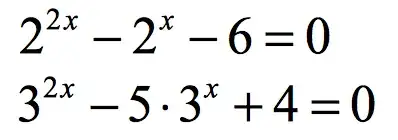
$$2^{2x}-2^x-6=0$$
$$3^{2x}-5\cdot 3^x+4 = 0$$
No clue how to approach this problem..
$$2^{2x}-2^x-6=0$$
$$3^{2x}-5\cdot 3^x+4 = 0$$
No clue how to approach this problem..


Hint:
In each case, you have quadratics in $b^x$:
In the first, put $\;y = 2^x$. Then you have $y^2 - y - 6 = 0$.
For the second, put $\;y = 3^x$. Then you have $y^2 - 5y +4 = 0$.
Note: Both quadratic equations factor quite nicely.
$\begin{align} (1)\quad (2^x)^2 - 2^x - 6 = 0 & \overset{y = 2^x}{\quad \implies\quad} y^2 - y - 6 = (y-3)(y+2) = 0 \\ \\ &\quad\iff y = 2^x = 3 \;\text{ or }\; y = 2^x = -2\end{align}$
We can see immediately that in both solutions, $2^x$ must necessarily be positive, since $2>0$. So we're left with $$2^x = 3 \implies \ln(2^x) = \ln 3 \iff x\ln 2 = \ln 3 \iff x = \dfrac{\ln 3}{\ln 2}\tag{1}$$
$\begin{align} (2)\quad (3^x)^2 - 5(3^x) +4 = 0 & \overset{y = 3^x}{\quad \implies\quad} y^2 - 5y +4 = (y-1)(y-4) = 0 \\ \\ &\quad\iff y = 3^x = 1 \;\text{ or }\; y = 3^x = 4\end{align}$
So we have $$3^x = 1 \implies \ln(3^x) = \ln 1 \iff x\ln 3 = \overbrace{\ln 1 }^{=\,0}= 0 \iff x = 0\tag{1}$$
And we have $$3^x = 4 \implies \ln (3^x) = \overbrace{\ln 4}^{=\ln(2^2) = 2\ln 2} \iff x\ln 3 = 2\ln 2 \iff x = \dfrac {2\ln 2}{\ln 3}\tag{2}$$

Put $2^{x}=X$ and you have a quadratic equation $X^2-X-6=0$ with solution $X_1=3$ and $X_2=-2$ and finally from $2^{x_k}=X_k$ you have $x_k=\frac{\log X_k}{\log 2}$ for $X_k\ge 0$.
The same for the second equation with $3^{x}=X$.

a. Let $2^x = m \implies m^2 - m - 6 = 0$
Solve the quadratic equation to get: $$(m+2)(m-3) = 0 \implies m = -2, \space m =3$$
But remember $2^x = m$ so: $$\therefore 2^x = -2, \space 2^x = 3$$
$\ln$ both sides of the equation to get:
$$\ln 2^x = \ln 3 \implies x\ln 2 = \ln 3 \implies x = \frac{\ln 3}{\ln 2}$$
$$\ln 2^x = \ln - 2$$ You cannot take the $\ln $ of a negative number so that solution is not applicable.
$$\therefore x = \frac{\ln 3}{\ln 2}$$
b. Let $3^x = n \implies n^2 -5n + 4 = 0$
Solve the quadratic equation to get: $$(n-4)(n-1) =0 \implies n = 1, \space n = 4$$
But remember $3^x = n$ so: $$\therefore 3^x = 1, \space 3^x = 4$$
$\ln$ both sides of the equation to get: $$\ln 3^x = \ln 1 \implies x\ln 3 = ln 1$$ but $$\ln 1 = 0 \implies x = 0$$
$$\ln 3^x = \ln 4 \implies x\ln 3 = \ln 4 \implies x = \frac{\ln 4}{\ln 3}$$
$$\therefore x = 0, \space x = \frac{\ln 4}{\ln 3}$$
