6

I am trying to learn how to solve integrals and I've got the hang out of a lot of examples, but I haven't got the slightest idea how to solve this example, this is how far I've got:

$$ \int\sqrt{1 - x^2} \, dx = x\sqrt{1-x^2} - 2\int\frac{x^2}{\sqrt{1-x^2}} \, dx $$

Can you please help me solve it, and also some tips concerning the integration are welcome.

Thank you

Mark
  • 620

5 Answers5

8

Using Trigonometric substitution, $\arcsin x=\phi$

$\implies (i)x=\sin\phi$ and

$(ii)-\frac\pi2\le \phi\le\frac\pi2$ based on principal value of inverse sine ratio,

$\implies\cos\phi\ge0$

$$\int\sqrt{1-x^2}dx=\int|\cos\phi|\cos\phi d\phi = \int\cos^2\phi d\phi$$

$$= \frac12\int(1+\cos2\phi) d\phi$$

$$=\frac12\left(\phi+\frac{\sin2\phi}2\right)+K=\frac{\phi+\sin\phi\cos\phi}2+K$$

  • 1
    @Mark, my pleasure. We can use $15$ of this(http://www.sosmath.com/tables/integral/integ10/integ10.html) setting $n=\frac12$ and use $\int\frac{dx}{\sqrt{1-x^2}}=\arcsin x$ – lab bhattacharjee Dec 24 '13 at 16:57
  • Thank you a lot for this list! I definitely think it will be of great use, sure I will try, because the Wolfram|Alpha result contained $\arcsin(x)$ – Mark Dec 24 '13 at 17:03
8

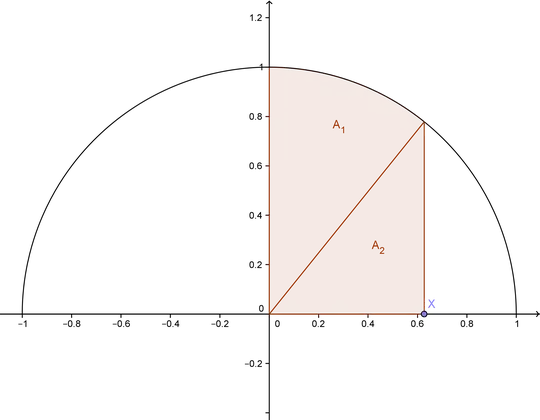
$\newcommand{\cos}{\sin}$ Let's try $$\int_0^{x}\sqrt{1-a^2}\text da$$ You can generalize from that. Now, $\sqrt{1-x^2}$ describes a semicircle. Consider the following image:enter image description here

So we have $\int_0^x\sqrt{1-a^2}\text da=A_1+A_2$. $A_2$ is a right triangle with base $x$ and height $\sqrt{1-x^2},$ so $A_2=\frac12x\sqrt{1-x^2}$. Meanwhile, $A_2$ is a sector of the circle. Note that the angle $$\theta=\angle (0,1)O(x,\sqrt{1-x^2})=\frac{\sin^{-1}x}1=\sin^{-1}x$$ Since the angle from the center is proportional to the area, $A_2=\frac{\theta}{2\pi}\cdot \pi r^2=\frac{\sin^{-1}x}{2}$

Thus $$ \int_0^x\sqrt{1-a^2}\text da=\frac{\sin^{-1}x+x\sqrt{1-x^2}}{2} $$

Tim Ratigan
  • 7,247
3

subsititute $ x =sin\theta $, this gives, $ dx = cos\theta d\theta$

hence, $ \int \sqrt{(1-x^2)} dx = \int (\sqrt{1 - sin^2\theta} ). cos\theta d\theta = \int cos^2 \theta d\theta $

Remember that, $cos(\alpha + \beta) = cos \alpha .cos \beta - sin \alpha . sin \beta $, substituting, $\alpha = \beta = \theta$,

  1. $ (cos^2\theta - sin^2\theta) = cos(2\theta)$, as well

  2. $ (cos^2\theta + sin^2\theta) = 1 $

Adding equation 1. and 2. yields,

$2 cos^2 \theta = 1 + cos2\theta ~ \implies ~ cos^2\theta = \frac{1}{2}(1+cos2\theta)$

hence going back to integral, $\int cos^2\theta d\theta = \frac{1}{2}\int (1+cos2\theta) d\theta = \frac{1}{2}(\theta + \frac{sin2\theta}{2}) + C$

By reverse substitution, $\theta = cos^{-1}x = arccos(x) $ and $sin2\theta = 2.sin\theta . cos\theta$

The solution of indefinite integral is ,

$ \int \sqrt{(1-x^2)} dx = \frac{1}{2} ( \theta + \frac{2.sin\theta.cost\theta}{2} )+ C \implies \frac{1}{2}(\theta + sin\theta. cos\theta) + C $

$ \int \sqrt{(1-x^2)} dx \implies \frac{1}{2}(arccos(x) + x\sqrt{1-x^2}) + C $

2

I, personally, suggest @lab's way because it is general and suitable for students, but you may use this strange substitution as well: $$1-x^2=x^2t^2$$

Mikasa
  • 67,374
  • Is this substitution useful in other types of integrals that are more complicated? Maybe it's just because I've never seen it written this way before. – Joe Dec 24 '13 at 17:38
  • 1
    @Joe: See here, but lab's way is better. Since this integral is very easy. – Mikasa Dec 24 '13 at 18:00
2

Your idea of integrating by parts is good (but you did it wrong):

\begin{align} \int\sqrt{1 - x^2} \, dx &= x\sqrt{1-x^2} - \int x\frac{-2x}{2\sqrt{1-x^2}} \, dx \\ &= x\sqrt{1-x^2} + \int\frac{x^2}{\sqrt{1-x^2}}\,dx\\ &= x\sqrt{1-x^2} + \int\frac{x^2-1+1}{\sqrt{1-x^2}}\,dx\\ &= x\sqrt{1-x^2} - \int\sqrt{1-x^2}\,dx+\int\frac{1}{\sqrt{1-x^2}}\,dx\\ &= x\sqrt{1-x^2} + \arcsin x - \int\sqrt{1-x^2}\,dx \end{align} Therefore $$ 2\int\sqrt{1 - x^2} \, dx = x\sqrt{1-x^2} + \arcsin x $$ and $$ \int\sqrt{1 - x^2} \, dx = \frac{1}{2}x\sqrt{1-x^2} + \frac{1}{2}\arcsin x + c $$

egreg
  • 238,574