Guessing the result
First some experiment with Cinderella to see what the result should be.

Here Cinderella computed the distance ratio numerically, then its guess function tried to turn that number into a likely algebraic expression. Usually this works well, particularly for small constructions with nice numbers like this one here. The third line is only for myself to check that I made no obvious error in rewriting that algebraic term.
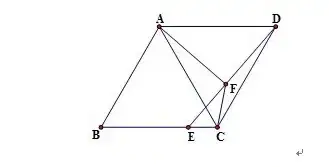
So now you know that the correct result should be $DF=\sqrt{\frac37}AB$.
Prooving the guessed result
You can proove this using explicit coordinates for all points.
\begin{align*}
A &= (1,0) & D &= (0,0) \\
B &= \left(\frac32,\frac{\sqrt3}2\right) &
C &= \left(\frac12,\frac{\sqrt3}2\right) \\
E &= \left(\frac34,\frac{\sqrt3}2\right) &
F &= \left(\frac37,\frac{2\sqrt3}7\right)
\end{align*}
The coordinate system was chosen to make things easier. Point $F$ was computed using the guess from above, namely using $\overrightarrow{DF}=\sqrt{\frac37}\frac{\overrightarrow{DE}}{\left\lVert\overrightarrow{DE}\right\rVert}$. Now all that remains to show is that $A,B,C,F$ are cocircular.
$$
\begin{vmatrix}
x_A^2+y_A^2 & x_A & y_A & 1 \\
x_B^2+y_B^2 & x_B & y_B & 1 \\
x_C^2+y_C^2 & x_C & y_C & 1 \\
x_F^2+y_F^2 & x_F & y_F & 1
\end{vmatrix} =
\begin{vmatrix}
1 & 1 & 0 & 1 \\
3 & \frac32 & \frac{\sqrt3}2 & 1 \\
1 & \frac12 & \frac{\sqrt3}2 & 1 \\
\frac37 & \frac37 & \frac{2\sqrt3}7 & 1
\end{vmatrix} = 0
$$
So the point $F$ with the distance $DF$ as guessed above is indeed cocircular as you found it must be, so it is the right point.
Finding the result without guessing
Without Cinderella, you would not have the coordinates of $F$ up front, so you could assume $\overrightarrow{DF}=\lambda\,\overrightarrow{DE}$ for some $0<\lambda<1$, then write your cocircularity test as
$$
\begin{vmatrix}
1 & 1 & 0 & 1 \\
3 & \frac32 & \frac{\sqrt3}2 & 1 \\
1 & \frac12 & \frac{\sqrt3}2 & 1 \\
\frac{21}{16}\lambda^2 & \frac34\lambda & \frac{\sqrt3}2\lambda & 1
\end{vmatrix} =
-\frac{21\sqrt3}{32}\lambda^2 + \frac{5\sqrt3}4\lambda - \frac{\sqrt3}2 = 0
$$
Since you only test whether the result is zero or not, you may simplify things by scaling rows or columns by some non-zero factor, so you might prefer to actually compute something like
$$
\begin{vmatrix}
1 & 4 & 0 & 1 \\
3 & 6 & 1 & 1 \\
1 & 2 & 1 & 1 \\
\frac{21}{16}\lambda^2 & 3\,\lambda & \lambda & 1
\end{vmatrix} =
-\frac{21}{4}\lambda^2 + 10\,\lambda - 4 = 0
$$
Whether you simplify or not, the solutions you end up with will be
$$
\lambda_1 = \frac47 \qquad \lambda_2 = \frac43 > 1 \\
DF=\lambda_1\,DE = \frac47 DE = \frac47\sqrt{\frac9{16}+\frac34} AB
=\sqrt{\frac37} AB
$$
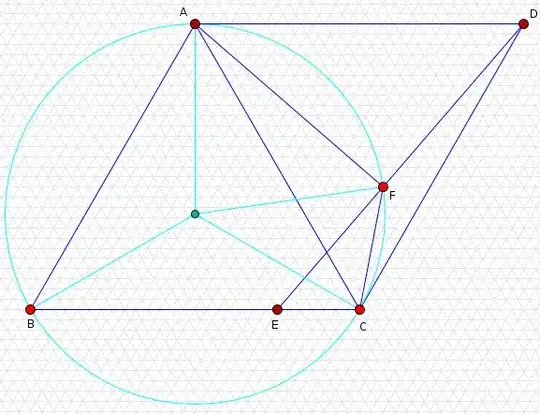
Ideas on a geometric proof
@DonAntonio wrote in several comments that he'd prefer a geometric solution. I have no ready solution yet, but this rational $DF=\frac47DE$ looks like it might stand a chance of being useful. Playing around with the configuration, I also noticed that $\angle DFA=\frac\pi2$, although I have neither proof for this nor a clear idea of how it might be useful. Nevertheless, here is another picture to illustrate both these facts: