0

I did this exercise

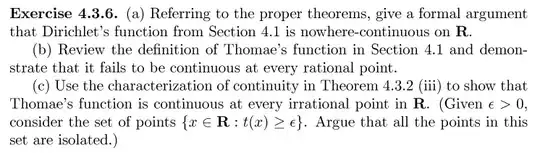
enter image description here

but then I found a mistake in my solution for (c). I don't know how to show that the set given in $(c)$ is isolated but I also don't know how to use it to show $t$ is continuous. Please can someone help me and explain it me? I stuck.

blue
  • 2,884
  • 1
    Given $x$ irrational and $N$ a positive integer, the basic idea is that by choosing $\delta>0$ small enough, you can insure that the interval $(x-\delta,x+\delta)$ excludes all rationals which in lowest terms have denominator of absolute value less than $N$. Note that there are only finitely many rationals, in lowest terms, with denominator in absolute value less than $N$ in the interval $[x-1,x+1]$. If you approach the problem this way, you can safely ignore the hint. – David Mitra Jan 16 '14 at 09:22
  • @DavidMitra OK thank you. But I am trying to understand the hint too. – blue Jan 17 '14 at 08:26
  • @DavidMitra I understand this also. However I am so stuck in proving this, I try $\epsilon-\frac{1}{n}<y<\epsilon+\frac{1}{n}$ and I don't know how to construct one to meet that requirement. Is there any hint on the algebra? – zony_miu Jun 24 '21 at 05:02

2 Answers2

3

Let's just work on $[0,1]$. The general case is only slightly different.

Given $x$ irrational and $\epsilon>0$, we want to show that there is a $\delta>0$ so that $|f(x)-f(y)|=|f(y)|<\delta$ for all $y\in[0,1]$ satisfying $|x-y|<\delta$.

In the following, by "rational", I mean a rational number in $[0,1]$ in lowest terms.

Take any open interval containing $x$. There are at most two rationals in the interval with denominator $2$. There are at most three in the interval with denominator $3$ ... You can find an open interval containing $x$ that does not contain rationals with denominators $2$ or $3$.

In fact, given any positive integer $N$, if you choose $\delta>0$ small enough, you can insure that the interval $I=(x-\delta,x+\delta)\cap[0,1]$ contains no rational with denominator less than $N$.

So, pick $N$ with $1/N <\epsilon$ and choose $\delta$ as just described. Then for $x\in I=(x-\delta,x+\delta)\cap[0,1]$, you'll have what's needed: If $y$ irrational is in $I$, then $f(y)=0$. If $y\in I$ is rational, we must have, by the choice of $\delta$, $f(y)=1/M$ for some $M> N$. But then $|f(y)|<\epsilon$, as desired.
David Mitra
  • 74,748
1

My attempt: instead of showing isolated points as in the hint it is possible to show that the set is closed. Then the complement is open and the continuity at irrational points follows. But I am still interested in the hint now: what is possible to follow if it is shown that the set is a set of isolated points?

blue
  • 2,884