52

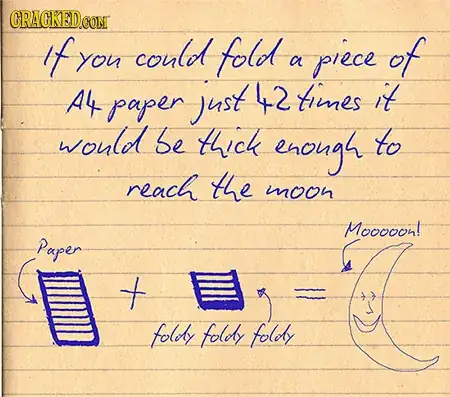
While procrastinating around the web I stumbled on a page that contained the image below, from cracked.com.

I can't help but believe that this is false… Even though the article header says:

22 Statistics That Will Change The Way You See the World

My question: is what the image below implies a mathematical impossibility? (…Just for procrastination's sake…)

mathematical-impossibility

If you could fold a piece of A4 paper just 42 times it would be thick enough to reach the moon

blade19899
  • 749
  • 1
  • 5
  • 13
  • A paper is, say 1 mm thick (I am making that up). You fold it once, it's 2 mm thick, fold it twice, it's 4 mm thick, folding three times it's 8 mm thick, so foldy foldy foldy 42 times, can you figure it out now? – imranfat Mar 27 '14 at 14:07
  • 23
    No, because of the finite thickness of an A4 paper, you cannot fold it 42 times. As a junior in high school Britney Gallivan has worked out a theorem of the upper bound of number of folds of a piece of paper given its thickness and width. – achille hui Mar 27 '14 at 14:13
  • 1
    I did this in high school and college algebra and precalculus classes from the mid 1980s until the early 2000s. I did it as an illustration of the rapidity of exponential growth and as an application of estimation. Since $2^{10}$ is very close to $10^3,$ each $10$ doublings multiplies by $1000.$ So figure out how many sheet thicknesses to the moon (even within a factor of $2$ makes the final answer only $1$ off), and use the fact that $20$ doublings is ${10}^6$ sheet thicknesses, $30$ doublings is $10^9,$ $40$ is $10^{12},$ $41$ is $2 \times {10}^{12},$ $42$ is $4 \times {10}^{12},$ etc. – Dave L. Renfro Mar 27 '14 at 15:50
  • Why this question is tagged 'probability' ? :) – Mars Robertson Mar 27 '14 at 17:10
  • @MichalStefanow I went ahead and modfied to less irrelevant tags. – rschwieb Mar 27 '14 at 17:25
  • @achillehui That's an awesome story: thanks for linking to Britney Gallivan! – rschwieb Mar 27 '14 at 17:27
  • 1
    Whoever included this in a slideshow that calls this a statistic clearly doesn't know much about statistics. I guess maybe popular conception that random numbers attached to some "fact" are called statistics, but then again, popular conception probably says that math is all about random numbers attached to "facts." – rschwieb Mar 27 '14 at 17:29
  • 32
    Instead of folding, imagine that you cut the piece of paper in half -- the short way -- and stacked it. Then cut the stack into two -- the short way -- and stacked it. And so on. If you did that 42 times then you'd end up with an extremely large quantity of extremely fine confetti that would stack up quite high. Of course, since it would be finer than fine dust, it would blow away before it got to the moon. In fact, each piece of confetti would have only a few atoms in it. You certainly couldn't do this a 50th time; you'd have to split atoms. – Eric Lippert Mar 27 '14 at 18:10
  • 11
    @EricLippert In fact, you couldn't even get down to individual items. Once you reach the point where you have only a few monosaccharide units per piece, it's debatable whether they can still be called cellulose fibers, let alone paper. – Superbest Mar 27 '14 at 19:50
  • 9
    @EricLippert instead of cutting the paper you could just go to the office store and pick up a few packs of A46 paper. – CompuChip Mar 28 '14 at 08:03
  • 1
    @CompuChip - you and I made the same mistake. Folding the paper 42 times doesn't give 42 layers (or 42 sheet thicknesses) - it gives something like 4.4x10^12th layers (2 to the 42nd). That's a whole lotta layers - enough so that if a piece of paper is about 1/10th of a millimeter thick then all those layers would add up to about the average orbital radius of the moon (384000 km, give or take). However, in practice a piece of paper can't be folded that many times, which is good job-wise if you happen to be a rocket scientist. :-) Share and enjoy. – Bob Jarvis - Слава Україні Mar 28 '14 at 11:24
  • 1
    I wasn't talking about the thickness, but the surface area. As a scientist I am well aware of the concept of exponential growth :) – CompuChip Mar 28 '14 at 13:42
  • 2
    And now that we know the Ultimate Question, for which the answer is 42, our purpose on Earth is complete. "How many times do I need to fold a A4 sheet of paper to reach the moon?" RIP Douglas Adams. – pablosaraiva Mar 28 '14 at 16:05
  • Quick numbers: sheet of A4 paper is 210mm x 297mm x .1mm (took a higher and simpler number for thickness for ease of math.) So, if you rearrange that paper to reach 385000km (fold, cut, melt down to pulp and repress), that same volume leaves a square footprint of 127 nm per side. (Or 16200 nm2). – Allen Gould Mar 28 '14 at 16:58
  • 12
    The strange thing about the claim is that "A4" does not imply anything about how thick the paper is .... – hmakholm left over Monica Mar 28 '14 at 19:36
  • Assuming a typical 0.1 mm thickness, how large would a sheet of paper need to be so that it could be folded 42 times? – Dan Mar 29 '14 at 02:43
  • 1
    @CompuChip A5 is twice as small as A4, and A3 is twice as large as A4. Hence you would need A-38 paper format... – Xoff Mar 29 '14 at 10:01
  • 3
    @Dan, for the ordinary way of folding a piece of paper in alternate direction, you need a square paper of side $\sim \pi \times 0.1\text{mm} \times 2^{(3/2)(42-1)} \sim 10^{12} \text{km} \sim 7000 \text{AU}$. It is still within this solar system. – achille hui Mar 29 '14 at 10:02
  • 1
    @Xoff, CompuChip is perfectly right. Since A5 is smaller than A4 etc., the hypothetical result of folding 42 times an A4 sheet would be an A46 sheet... – DaG Mar 30 '14 at 21:36
  • 1
    @DaG you're right, I misread ! – Xoff Mar 31 '14 at 04:50
  • you only need to fold it 31 times ! Be clever, if you fold it, fold-it along it's thickness ! It makes not much more sense anyway and you'll start with 297mm that you'll double each time !. All this is only a story of parallepipedes: your theoretical folding is as if you were dividing one side by 2 and multiply another side by 2 (keeping the volume equal). So choose wisely, and start multiplying the 297mm side ! – vaab Apr 03 '14 at 10:49
  • If, as Eric Lippert suggested, the paper were cut instead of folded, I think its size would be divided by 2^21 in each dimension, living us with 100×141.6 nm fragments. – Medinoc Apr 03 '14 at 13:29

11 Answers11

107

Even if the sheet of paper were infinitely foldable, the answer is that no, you can't reach the moon by folding a sheet of A4 paper any number of times, for a reason that bears calling out (and in fact explains why a sheet of paper that size can only be folded a certain number of times — that is, why it's impossible to fold it 42 times in the first place): consider the last fold and imagine looking at the sheet in a cross-section perpendicular to this fold. The 'faces' of the folded paper that are at the top and at the bottom after the last fold must be connected along the fold edge, since they were part of a single 'face' before the fold — but this means that the distance along the paper between the top and bottom must be at least as long as the distance 'through' the paper on a straight line between them. In other words, you need to start with a sheet of paper that's at least 385,000km along at least one direction (using Sabyasachi's numbers) to be able to reach that far, regardless of what sequence of folds you use.

  • 9
    +1 but and why do you assume I don't know people who can supply that kind of paper? ;) – Guy Mar 27 '14 at 15:35
  • 49
    @Sabyasachi that kind of paper would not be called "A4" anymore. – Paŭlo Ebermann Mar 27 '14 at 16:40
  • 10
    @PaŭloEbermann don't you challenge my beliefs. – Guy Mar 27 '14 at 16:44
  • 1
    @Sabyasachi: because that wouldn't be A4... – Axel Mar 27 '14 at 18:37
  • 5
    For the record, your argument is inconsistent because you start by assuming an infinitely foldable sheet but then contradict that by proving that there cannot be an infinitely foldable sheet. As others have pointed out, the statement "if you could fold a sheet 42 times, it could reach the moon" is implicitly true. Thanks for the explanation though of why there is a folding limit in the first place. – imjosh Mar 27 '14 at 19:09
  • 17
    @imjosh "because you start by assuming an infinitely foldable sheet but then contradict that by proving that there cannot be an infinitely foldable sheet." This is just proof by contradiction, and it's certainly a valid line of reasoning, no? – AmadeusDrZaius Mar 27 '14 at 20:34
  • 1
    @AmadeusDrZaius I was just teasing a bit but 1) yes, it's a proof by contradiction of the statement "a paper can be folded 42 times" 2) no, it isn't a correct argument for showing the statement "if a paper can be folded..." is false, because that statement is logically true just as is "if 1+1=3, then I'm the King of Spain" http://math.stackexchange.com/questions/137890/why-is-it-sensical-for-a-proposition-with-a-false-antecedent-to-validate-to-true – imjosh Mar 27 '14 at 21:24
  • 1
    @imjosh 1) By proving that "paper can be folded" $\to$ "paper cannot be folded", we get a proof by contradiction of "paper cannot be folded", which is to say that we have proven the truth of "paper cannot be folded" (not the reverse as you claim). 2) Given this fact, the statement "paper can be folded implies $X$" is also true for any proposition $X$ (also contrary to your claim), for the reason you mention. – Mario Carneiro Mar 27 '14 at 21:39
  • @imjosh It's true that the 'false implies anything' dictum applies to the question as the OP originally phrased it, but I presume that that wasn't the question that was meant, as that's not generally the way that lay grammar treats 'if X then Y' phrases. All the same, I've cleaned up my initial sentence a little bit in hopes of making it clearer just what my 'no' refers to. – Steven Stadnicki Mar 27 '14 at 21:42
  • 7
    A piece of A4 paper cut in half 42 consecutive times would be A46. – Dan Mar 28 '14 at 04:59
  • it would actually have be a lot larger than 385,000 km. The first latitudinal and longitudinal fold is the whole length (or width), but every fold halves the length (or width). if you fold a piece of paper 42 times, you have 21 longitudinal and 21 latitudinal folds, so the length (and width) have been halved 21 times. 2^21 is about 2 million, so that 385,000 km long paper needed to be over 800 billion KM long to begin with. that's almost 5,400 times the distance between Earth and the Sun. – Nzall Mar 28 '14 at 10:00
  • The question references A4, but a "sheet" could reach the moon – Dean Meehan Mar 28 '14 at 12:10
  • -1: interesting reply, but to some other question. – Rolazaro Azeveires Mar 28 '14 at 19:34
  • I'm actually in agreement with imjosh's initial comment. If a(n incompressible) sheet of A4 paper were infinitely foldable, then you'd not only be able to reach the moon with it, you'd be able to create a folded sheet that would be infinitely high. I.e., your answer as a whole is correct, but your first couple sentences are contradictory (and no, they're not "proof by contradiction", which would require you to say "if the sheet of paper were infinitely foldable, you would be able to reach the moon; this implies a contradiction, so the sheet can't be infinitely foldable"). – Kyle Strand Mar 28 '14 at 19:38
  • What about folding it in a concertina to get around this problem. – rwolst Mar 29 '14 at 17:35
  • 5
    @rwolst That's an excellent point, although (of course) then you don't get the doubling effect and need much, much more than 42 folds - still, I'll see if I can find a good way of rewording my answer to address this. The core point still holds, though, that you need paper longer than the distance you start with to reach a given distance; it's in effect a version of 'the shortest distance between any two points is a straight line'. – Steven Stadnicki Mar 29 '14 at 20:45
  • The question is "If you could fold ..." and your answer is "You can't fold...". OK. But what if you could? – slim Mar 31 '14 at 13:06
68

The statement is true in two different senses. As Sabyasachi shows, the intended sense that $2^{42}$ times the thickness of a sheet of paper is greater than the distance to the moon is correct. In the spirit of achille hui's comment, the sentence is an implication with a false antecendent, so it is true in that sense as well. It is also true to say "If you could fold a piece of A4 paper 42 times then the moon is made of green cheese."

Ross Millikan
  • 374,822
  • 5
    A point regarding the last statement "If $false$, then $anything$": Given that the question is real life-motivated and not about a mathematical theory or axiomatic framework, I think it's not good a idea to internalize the accidental flaws of the connective "$\Rightarrow$". Logicians and philosophers work hard for more than 100 years to improve the situation, e.g. via Relevance logic. The material implication $\Rightarrow$ is just sufficiently convenient for doing much of math, it can be translated into a binary operation in Boolean algebra etc. – Nikolaj-K Mar 28 '14 at 09:25
  • NiftyKitty: Good point. The "would" (replaced by Ross with "is") specifically asks us to consider relevance. – shannon Mar 28 '14 at 11:58
  • 1
    The image is false from the two points of view, even if the person who made it was "inspired" by a theoretically true (but practically unfeasible) statement. Here are the errors : The text says "if you could fold a piece of paper 42 times", but it does not say how it is folded. It need to be folded in such a way that the thickness doubles at every fold. The drawing is also incorrect as it shows an accordeon fold, so in this case the final thickness would be 42thickness and not (2^42)thickness. This is quite a difference, isn't it. – radouxju Mar 28 '14 at 13:53
  • You're conflating the subjunctive mood with propositional logic. It's true that in propositional logic, the statement "if you can fold a piece of A4 paper 42 times, then the moon is made of green cheese" is true. But the phrase "if you could" implies that the first part of the statement (folding a piece of A4 paper 42 times") necessitates the truth of the latter part of the statement. – Kyle Strand Mar 28 '14 at 19:31
  • @radouxju I don't think that's supposed to be an accordion fold; that's the paper after just one fold, and the lines are there because the paper is lined notebook paper. – Kyle Strand Mar 28 '14 at 19:32
56

Unless you tear the paper while you fold it, no two points of the paper can become farther from each other (in three dimensions) after folding than when the paper was flat.

Okay, perhaps there is some give in the paper, so let's generously say the folded paper forms a Lipschitz continuous embedding of the original flat paper into physical space, with Lipschitz constant $2$.

This still means that no two points on the folded (or scrunched or whatever) A4 paper can be farther apart than twice the diagonal of the flat paper, or about 72 centimeters. That's a far way from the distance to the moon.

  • 12
    This comment is severely underrated. Many of the "well, theoretically, yes" answers are really pretty poor, considering that this is a very clear "well, theoretically, NO". I'm a little disappointed in a bunch of upvotes for naively multiplying the thickness of the paper by 2^42. – msouth Mar 30 '14 at 01:59
  • 1
    This is an even clearer way of making my point that doesn't rely on any specific properties of the fold in question - very well-put. – Steven Stadnicki Dec 19 '14 at 20:26
29

In my experience a standard sheet of paper, has thickness around $0.1$ mm.

Folding $42$ times, the thickness is,

$$2^{42}\times0.1\approx 439804 \,km$$

Wolfram Alpha tells us that the average distance is, $385000$ kilometers which makes the claim most certainly valid.

Guy
  • 8,857
  • 1
  • 28
  • 57
  • 5
    The shortest side (assuming you always fold along the widest side) would be $210/2^{21}\approx0.0001$ millimeters long, that is $0.1$ micrometers. ;-) – egreg Mar 27 '14 at 15:22
  • 1
    @egreg I really hope you aren't in charge NASA's space program. – Guy Mar 27 '14 at 15:24
  • 2
    Note that A4 paper has an area of $2^{-4}m^2$, so the folded (or let's better assume cut) paper tower would have an area of $2^{-46}\mathrm m^2=(2^{-23}\mathrm m)^2\approx (10^{-7}\mathrm m)^2=(0.1\mathrm\mu\mathrm m)^2$. – Carsten S Mar 27 '14 at 15:26
  • @CarstenSchultz Which agrees with my estimate. ;-) – egreg Mar 27 '14 at 15:29
  • @egreg, yes, you posted while I was looking up molecule sizes. $1000\mathrm{\mathring A}$ seems long enough ;) – Carsten S Mar 27 '14 at 15:30
  • 5
    @CarstenSchultz why is everyone so seriously assuming that I plan to go to the moon by folding paper? – Guy Mar 27 '14 at 15:31
  • I was just trying to supply additional information. – Carsten S Mar 27 '14 at 15:32
  • 1
    @CarstenSchultz I know. I'm just kidding. ;) – Guy Mar 27 '14 at 15:34
  • 5
    Just to verify, I measured a package of 500 sheets of paper, and it was about 5 cm thick. So, 0.1 mm per sheet is a good estimate. – Dan Mar 28 '14 at 05:01
  • @Sabyasachi Will the same be possible if we replace the paper with cloth, which I presume would be much more flexible – Firee Mar 28 '14 at 11:22
  • @Firee for practical folding, known major problems are the winkles and air trapped between sheet. Using cloth instead of paper may help the air trapping issue but the winkles will become problematic. For easy folding, gold foil will be a much better choice. This is what Britney Gallivan use when she first break the number of folds record in 2002. – achille hui Mar 28 '14 at 15:06
  • 1
    @Dan I did say "from experience". I measured 80 sheets with a screw gauge once. Don't say why. – Guy Mar 29 '14 at 13:37
  • 2
    This is the correct answer. "42 folds to the Moon" is a parable for Moore's Law; it's about doubling. Why are people obsessing about the physics of paper-folding? – Greg Hendershott Mar 29 '14 at 16:21
  • @GregHendershott All nasa fans here. ;) – Guy Mar 29 '14 at 16:25
14

Just for the sake of discussion, lets consider how skinny the paper would get after folding it 42 times.

A sheet of A4 paper is 30 cm long. If you fold it in half 42 times and alternate directions, you'll get down to a length of 30 cm / 2^21 = 1430 angstroms. ("cut in half" might be more accurate.) Your paper would mathematically reach the moon, but since paper is made of long cellulose fibers (thousands of units), it wouldn't really be paper any more. The dimensions of the paper would be under the length of a single cellulose fiber.

blah
  • 820
3

I have been reading all these theoretical answers, but no one made a comment about taking a piece of paper and actually doing the folding.

I bet that you can not fold a standard sheet of paper (75 g/cm2) with your bare hands more than 6-7 times. And you will end up with a total height of about 1cm.

If you ask a group, most of them will think we can fold the paper 20, 30, 40 or even more times.

This exercise is a good one to show the disparity between the physical world and the abstraction of it inside our mind.

  • aha, don't think about, just do it! – vp_arth Mar 27 '14 at 20:15
  • 6
    idk...@vp_arth can't you just fold it with your mind? Not sure about you but my mind powers are pretty dang strong. :p – codedude Mar 27 '14 at 22:40
  • Interesting point. This exercise is a good one to show the disparity between the physical world and the abstraction of it inside our mind. When I was at school, a teacher asked the folding paper question to a group, and most people thought the right number should be around 40-50 times..... Pretty high folding paper mind powers for the real world..... :) – Enrique Haro Mar 27 '14 at 23:10
2

It depends on whether the sheet can be compressed.

The other answers all assume that the sheet has a constant thickness. If this is the case, then consider "folding" the paper in such a way that we don't care if the edge of the crease rips; i.e., we ignore the paradox demonstrated in Steven Stadnicki's answer. So our "folded" stack is really equivalent to cutting the paper into tiny rectangles and stacking them, as long as with each cut we separate every rectangle into two new rectangles (i.e. we double the number of rectangles each time). (This is a pretty loose definition of "folding," of course, but we're trying to reach the moon with a piece of paper, so that's hardly surprising.) If we use this definition of "folding", and we're able to perform the cuts at the atomic level and ensure that all the rectangles are perfectly stacked on top of one another, and the rectangles still have the same width as the original piece of paper (which is, at this point, a ridiculous assumption; see blah's answer), then yes, we'll reach the moon (as per Sabyasachi's answer).

If, however, the pressure created by making the folds (and cutting the paper into tiny rectangles and whatnot) compresses the paper so that it becomes less than ~0.1mm thick, then our exponent will no longer be valid. Say that during the cutting process, the cellulose fibers unravel somewhat, leaving only two layers of fiber. Since the fibers are 2-20 nm in diameter, let's say that the two-fiber-layer sheets are about 10nm thick. $2^{42} \times 10nm = 43,980 m$, which, according to Wolfram Alpha, is about five times the height of Mount Everest. Impressive, but only about 1.14% of the distance to the moon.
Kyle Strand
  • 947
  • 6
  • 19
0

I think the question has been misunderstood by those who offer a straight "no".

As already pointed out, it has been proven that you can only fold paper 7 times, if you always fold it in half every other direction.

You can fold it 11 times if you always fold it in the same direction, see here:

http://en.wikipedia.org/wiki/Britney_Gallivan

But if you fold it like an accordion, as demonstrated in the sketch, well, who says you cannot reach the moon? :-)

I don't think we have the machinery to perform such a fine folding task--see also @blah's comment. Anyone interested?

  • 7
    OK, so you fold it like an accordion and you end up with a cylinder of folded paper that reaches to the moon. The original length of your paper is now oriented in two directions: some parts are parallel to the base of the cylinder and some are parallel to the long sides. However, your original piece of paper was only 297mm long so the total amount of that length that is parallel to the long sides of the cylinder cannot be more than 297mm, so your cylinder is at most 297mm tall. That leaves you approximately 384399.999703km short of the moon. Better buy some more paper! – David Richerby Mar 28 '14 at 12:13
  • @DavidRicherby Thank you for solving this ridiculous puzzle! – mirkastath Mar 28 '14 at 12:39
0

There are $2$ more problems most people did not adress here.

  1. If you folded a paper $42$ times, its area would decrease accordingly, and after $42$ folds, the area in contact with earth would be $1.4\cdot 10^{-14}$ metres. This means you would have a column of paper roughly $0.1$ of a micrometer in width (if it was square). If you always folded paper over the same axis (keeping the width constant in one direction), this would mean the paper is still less than $10^{-13}m$ thick in the other dimension. This is smaller than one atom.

  2. A column of paper reaching to the moon would have to spin along with the earth. Its centre of gravity would be $219,902,325$ kilometres above the surface of the earth, way above the geostacionary satelite height. This means the paper would actually be pulled upwards by the centrifugal force of earth's spinning.

5xum
  • 123,496
  • 6
  • 128
  • 204
  • If, however, you alternate folding directions, then the rectangles you produce are juuuuuuuust wide enough to be still "papery," probably, let alone bigger than a single atom. See blah's and my answers. – Kyle Strand Mar 31 '14 at 17:10
-1

Look at the pattern-

If you fold the paper $1$ time,you get $2$ folds ($2$ papers one below the other).

If you fold $2$ times you get $4$ folds.

If you fold it $3$ times,you get $8$ folds.

Now,surprisingly it is in the form of a G.P. with common ratio $2$.

We also know,nth term of a GP=$a_n=ar^{n-1}$(a=first term,r=common ratio,n=nth term)

Now,here $n=42$, we have $a_n=2\times2^{42-1}=2\times2^{41}=2^{42}$.

So,if we fold a paper $42$ times we will have a total of $2^{42}$ folds.

Assuming one fold has $0.1mm$ (nearly),you can get the thickness of our resulting paper as $2^{42}\times0.1=439804Km$(approx.) which is more than enough to reach the moon.

Soham
  • 9,990
-1

Mathematically, it is possible. however realistically you will loss paper every time you fold, because you have to count the width of the paper being folded.

  • 2
    It is mathematically possible to fold something to a length longer than it is? Even given an idealized piece of paper. Think about it. After folding an idealized piece of paper can it be longer than it started out? – msouth Mar 30 '14 at 02:01
  • @msouth well, i'm no mathematician, but when you fold it, it decreases x and y and increases height. so it looks thicker, but if you keep going, then if the paper could maintain its structural integrity which it couldn't, it'd start looking like a piece of elastic or rather, a thin strand. And if it were theoretically possible to stretch an "elastic band" very far, I wonder how long till one splits an atom? – barlop Mar 30 '14 at 08:15
  • @barlop what I was getting at is that, say you have a solid object with a length, width, and a height. Find the longest straight line inside that volume, call it the "diameter" of the volume. Then, start folding that volume. Once you have folded it, the longest straight line contained in that volume will be less than or equal to the diameter. Folding something like paper doesn't increase its diameter. You might increase the measurement in one direction (e.g. you can increase the "thickness" measurement by folding it in half), but you do so at the expense of some other dimension. – msouth Mar 31 '14 at 11:32
  • @msouth yes that's what i'm saying, and as you say "you do so at the expense of some other dimension." hence I said, it ends up like a thin strand(of what was paper and is 'now' I don't know what), and you end up with a thin strand, because it is SO (as you say) at the expense of the other dimensions. – barlop Mar 31 '14 at 18:50
  • 1
    @barlop No, we're still not talking about the same thing. Changing it to a thin strand is either via cutting into teeny tiny strips or stretching, neither of which is what is commonly understood by the idea of "folding". It's not just that it's any transformation you want at the expense of the other dimensions--you can't increase the diameter by folding. If you fold, you will decrease the diameter. The longest "paper stick" you can fit inside the boundaries of the folded object is always shorter after a fold. – msouth Apr 01 '14 at 19:24