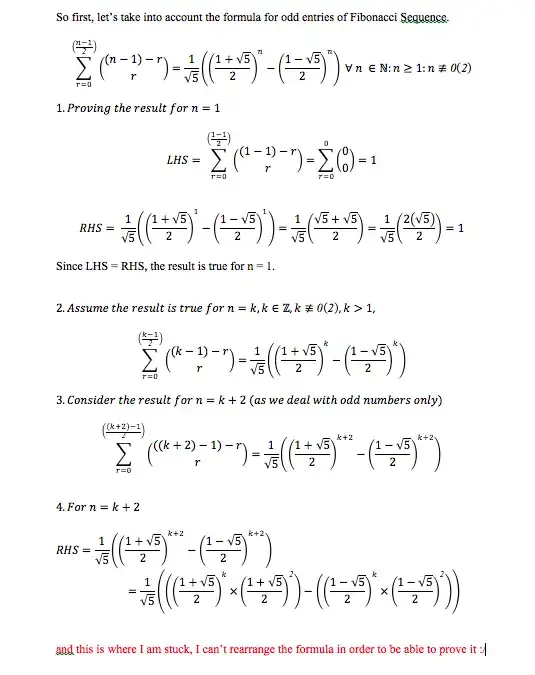
General term: $s_n = \displaystyle \sum_{0}^{\lfloor\frac{n-1}{2}\rfloor}\binom{n-1-r}{r} \text{ for } n \in \mathbb{N} \tag{1}$
I think you struggled because the binomial sum $s_{n+2}$ has a decomposition that involves both its even and odd numbered predecessors, and not just any one of them, as you were trying in the inductive step.
Decomposition: $s_{n+2} = s_{n+1} + s_{n} \tag{2}$
This is easy to prove by using the combinatorial identity $\binom{n}{k}=\binom{n-1}{k}+\binom{n-1}{k-1}$. See here and here.
We can then use this property along with strong induction to prove:
$P(n): s_n = \frac{1}{\sqrt{5}}\left(\frac{1 + \sqrt{5}}{2}\right)^n - \frac{1}{\sqrt{5}}\left(\frac{1 - \sqrt{5}}{2}\right)^n \text{ true } \forall n \in \mathbb{N}\tag{3}$
Proof-sketch:
Base case: Show $P(1)$ and $P(2)$ to be true (by evaluating both sides).
Inductive step: Assume $P(n)$ and $P(n+1)$ true.
Then $\begin{aligned}s_{n+2} & = s_{n+1} + s_{n} \\ & = \frac{1}{\sqrt{5}}\left(\frac{1 + \sqrt{5}}{2}\right)^{n+1} - \frac{1}{\sqrt{5}}\left(\frac{1 - \sqrt{5}}{2}\right)^{n+1} + \frac{1}{\sqrt{5}}\left(\frac{1 + \sqrt{5}}{2}\right)^n - \frac{1}{\sqrt{5}}\left(\frac{1 - \sqrt{5}}{2}\right)^n \\ & = \frac{1}{\sqrt{5}}\left(\frac{1 + \sqrt{5}}{2}\right)^n\left(\frac{3 + \sqrt{5}}{2}\right) - \frac{1}{\sqrt{5}}\left(\frac{1 - \sqrt{5}}{2}\right)^n\left(\frac{3 - \sqrt{5}}{2}\right) \\ & = \frac{1}{\sqrt{5}}\left(\frac{1 + \sqrt{5}}{2}\right)^{n+2} - \frac{1}{\sqrt{5}}\left(\frac{1 - \sqrt{5}}{2}\right)^{n+2} \\ & \implies P(n+2) \text{ true }\end{aligned}$
This completes our proof. $ \blacksquare$
Note: The formulas for odd $n$ and even $n$ follow automatically from $(3)$ by the removal of the floor function in $s_n$.