1

Consider $\varphi: U\subset \mathbb{R}^{n-1}\to \mathbb{R}$ a Lipschitz function and $\Omega=Graph(\varphi)$, i.e.,
$$\Omega=\{x=(x_1,...,x_n)\in U\times\mathbb{R};x_n=\varphi(x_1,...,x_{n-1})\}.$$

The set $\Omega$ satisfies the Sphere Condition?

Sphere Condition means that existe $r>0$ (uniform) such that for each $z\in\Omega$, there is $\xi$ satisfying $z\in \partial B_r(\xi)$ and $B_r(\xi)\cap\Omega=\emptyset$.

More generally, if $\Omega$ is only Lipschitz manifold (not necessarily graphic), $\Omega$ satisfies the Sphere Condition?

user73454
  • 646
  • Are you sure you wrote down the definition of the 'sphere condition' correctly? I have to admit I do not understand it, while I do know what a spere condition is. At least $\xi\in \partial B_r(\xi)$ will not work. Also, I do not believe that $\Omega$ does satisfy a sphere condition for general Lipshitz functions, but I did not check thoroughly. – Thomas Apr 09 '14 at 16:10
  • (you probably meant $\xi\in \partial B_r(z)$. Also, you don't seem to care whether the sphere is below or above the graph?) – Thomas Apr 09 '14 at 16:14
  • @Thomas Sorry, fixed! Yes, do not care if the sphere is below or above the graph. – user73454 Apr 09 '14 at 16:24
  • https://math.stackexchange.com/questions/43169/smooth-boundary-condition-implies-exterior-sphere-condition – Guy Fsone Jul 18 '22 at 10:53

3 Answers3

1

A sharp answer to your question

Theorem: A domains $\Omega\subset \Bbb R^d$ satisfies the both interior and exterior sphere condition if and only if $\partial \Omega$ is $C^{1,1}$. See Theorem 1.0.9, here

Counter-example of $C^{1,\alpha}$ domain not satisfying the interior sphere condition

Consider $\Omega=\{(,)\in \Bbb R^2:>||^{1+\alpha}\},$ with $0\leq \alpha<1$. This domain is $C^{1,\alpha}$ smooth. Because for $ f(x)= |x|^{1+\alpha},$ we have $f'(x)=(\alpha+1) |x|^{\alpha-1}x$ which is $\alpha$-H"older continuous. In fact it can be shown that \begin{align} |f'(x)- f'(y)|= \alpha||x|^{\alpha-1}x-|y|^{\alpha-1}y|\leq (\alpha+1)2^{1-\alpha} |x-y|^{\alpha}\,. \end{align}
Let $ B= B((x_0, y_0), r)$ , $r>0$ be a ball touching the boundary at $(0,0)$ and such that $ \overline{B}\subset \Omega$. We have that $(0,0)\in \partial \Omega\cap B((x_0, y_0), r)$ then necessarily \begin{align*} \text{$x_0^2 +y_0^2=r^2$ and $y_0>|x_0|^{1+\alpha}$}\implies y_0= \sqrt{r^2-x_0}. \end{align*} Moreover, since $\partial B\subset \Omega$ in particular the bottom part $\partial B_-= \{ (x,y): y=y_0- \sqrt{r^2-(x-x_0)^2} \}$ is contained in $\Omega$. That is, for all $(x,y)\in \partial B_-$ with $|x-x_0|\leq r$ we have \begin{align*} y=y_0- \sqrt{r^2-(x-x_0)^2}= \sqrt{r^2-x_0}- \sqrt{r^2-(x-x_0)^2}\qquad\text{and}\qquad y>|x|^{1+\alpha} \end{align*} That is for all $|x-x_0|\leq r$ we get that \begin{align*} \sqrt{r^2-x_0^2}- \sqrt{r^2-(x-x_0)^2}>|x|^{1+\alpha} \end{align*} Letting $x\to x_0$ it follows that \begin{align*} r^2-x_0^2\geq (r+|x_0|^{1+\alpha})^2\Longleftrightarrow -x_0^2\geq 2r|x_0|^{1+\alpha}+|x_0|^{2(1+\alpha)} \end{align*} Which is possible only if $x_0=0$ so that $y_0=r$ that is $(x_0, y_0)= (0,r)$. In this case, for $0<|x|<r$, the above inequality becomes \begin{align*} r^2+|x|^{2(1+\alpha)} -2r|x|^{1+\alpha}= (r-|x|^{1+\alpha})^2> r^2-x^2, \quad \text{ i.e., }\quad |x|^{2\alpha} -2r|x|^{\alpha-1}+1)>0. \end{align*} Given that $ |x|^{2\alpha} -2r|x|^{\alpha-1}+1\xrightarrow{x\to0}-\infty$ as $\alpha-1<0$, there is $0<|x|<r$ such that \begin{align*} -1>( |x|^{2\alpha} -2r|x|^{\alpha-1}+1)>0. \end{align*} This is impossible and hence the point $(0,0)$ does not satisfies the interior sphere condition. However $(0,0)$ satisfies the exterior sphere condition.

Guy Fsone
  • 23,903
  • Please do not post the same answer to multiple posts. If an answer satisfies the needs of more than one question, please post the answer only once, and flag the other questions as duplicates. – Xander Henderson Aug 11 '22 at 23:34
1

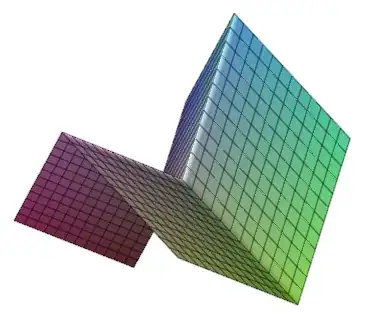
This is not true. The Lipschitz condition allows for corners, which are bad for the sphere condition. In two dimensions, a simple counterexample is $\varphi(x) = |x_1|-|x_2|$ pictured below.

corners

A sphere containing $(0,0,0)$ has to be either above or below the graph; due to symmetry we may assume it's above it. Then its intersection with the plane $x_2=0$ must be the single point $(0,0,0)$; for otherwise it would be a circle, and a circle cannot stay above the graph of $x_3=|x_1|$. Therefore, the center of the sphere is $(0,r,0)$ where $r$ is its radius. But then the sphere contains the point $(0, r-r/\sqrt{2}, -r/\sqrt{2})$ which is below the graph of $\varphi$.

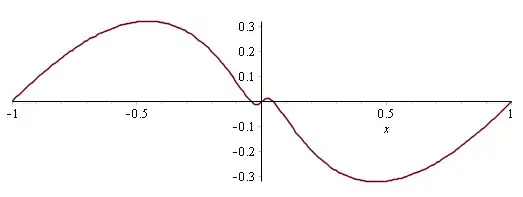
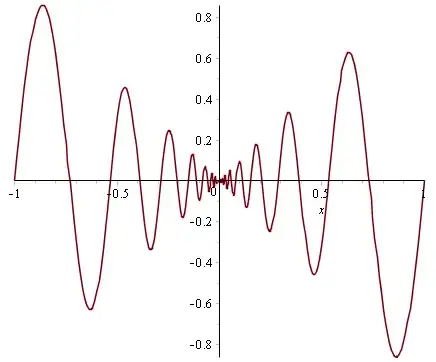
Here is another example, which works in all dimensions starting with $1$: $\varphi = x_1 \sin \log |x_1|$. This is a Lipschitz function ($\varphi'$ is bounded), but the graph of $\varphi$ meets both $x_n= |x_1|$ and $x_n=-|x_1|$ infinitely often. This rules out a sphere touching the origin from either above or below. The example works in higher dimensions with the same $\varphi$: it just does not depend on $x_2,\dots,x_{n-1}$. The only thing I don't like about this example is that it's impossible to see what goes on from looking at an actual plot of $\varphi$.

slow

But $\varphi = x_1 \sin (10 \log |x_1|)$, which is also Lipschitz, makes a better illustration.

better

user127096
  • 9,683
  • @EdsonSampaio I suggest making it a separate question, including the definition of semi-algebraic for those (like me) unfamiliar with the term. – user127096 Apr 10 '14 at 16:31
0

Neither the category of semi-algebraic it is valid, as done by the user @user127096, namely $\varphi(x,y)=|x|-|y|$ is semi-algebraic.