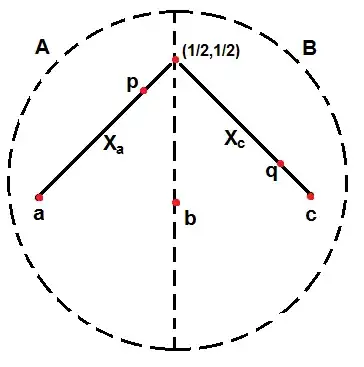
Let $C^\prime$ be the Cantor set and let $C = C^\prime \times \{0\}$ (viewed as a subset of $\mathbb{R}^2$). For $c \in C$, let $L(c)$ denote the half-closed line segment connecting $(c,0)$ to $(\tfrac{1}{2}, \tfrac{1}{2})$ (including $(c,0)$ but excluding $(\tfrac{1}{2}, \tfrac{1}{2})$).
If $c \in C$ is $(0,0)$, $(1,0)$, or an endpoint of an interval deleted in the Cantor set, let $X_{c} = \{ (x,y) \in L(c) : y \in \mathbb{Q} \}$. For all other $c \in C$, let $X_{c} = \{ (x,y) \in L(c) : y \notin \mathbb{Q} \}$.
Cantor's Teepee is the set $\bigcup_{c \in C} X_{c}$ equipped with the subspace topology inherited from the standard topology on $\mathbb{R}^2$.
I've found several references to the fact that Cantor's Teepee is totally disconnected, but I cannot quite prove it.
It was brought to my attention in the comments that I had taken the wrong definition for totally disconnected when first working on this problem, as demonstrated in the following example. The property I had been attempting to prove was totally separated, which lead to the quandary I was experiencing below.
In particular, I cannot seem to separate two points that belong to the same $X_c$. For concreteness:
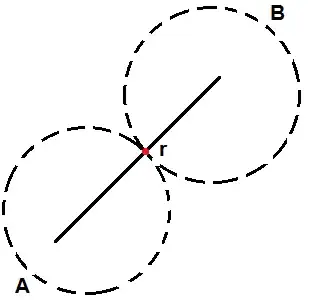
What are two separated open sets $A$ and $B$ such that
<ul>
<li>$A$ and $B$ witness the disconnectedness of Cantor's Teepee,</li>
<li>$(0,0) \in A$, and</li>
<li>$(\tfrac{1}{4}, \tfrac{1}{4}) \in B$?</li>
</ul>
Notice $(0,0), (\tfrac{1}{4}, \tfrac{1}{4}) \in X_0$. Presumably the method that works for this example can be easily modified to work for any pair of points belonging to the same $X_c$.