I can't understand what it means to do the Taylor series at the point $a$.
The best way would be showing me how it looks for different $a$ on a graph. Do I find those graphs on the Internet?
I can't understand what it means to do the Taylor series at the point $a$.
The best way would be showing me how it looks for different $a$ on a graph. Do I find those graphs on the Internet?


...The best way would be showing me how it looks for different $a$ on a graph.
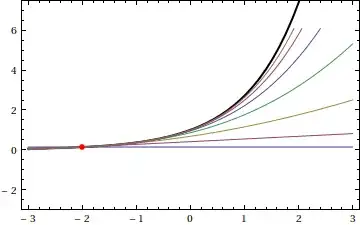
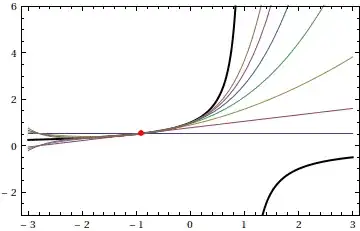
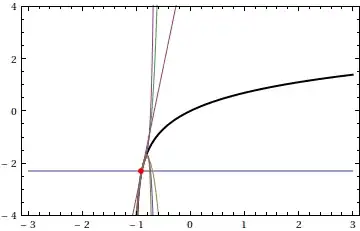
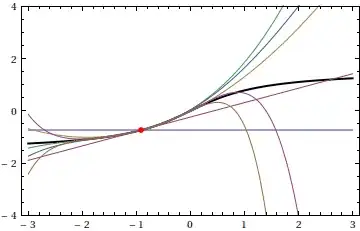
The others have done (most of) the math; I'll do the cartoons:
$\exp\,x$:
$\dfrac1{1-x}$:
$\ln(1+x)$:
$\arctan\,x$:
$\sin\,x$:
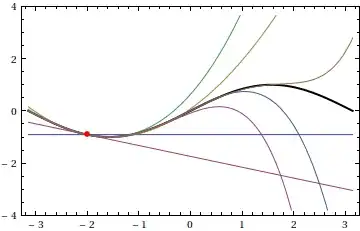
Note that the polynomials (except for the horizontal constant function) are "tangent" to the original function at the expansion point (shown in red above). That's sort of the idea: these polynomials are the unique $p$-th degree polynomials that have $p+1$-fold contact with the function being approximated.
If you do a Taylor series around $0$ (also called a MacLaurin series) it looks like $f(x)=b_0+b_1x+b_2x^2+\ldots$. If you do it around $a$ it looks like $f(x)=b_0+b_1(x-a)+b_2(x-a)^2+\ldots$. The expansion is generally more accurate the closer $x$ is to the expansion point.

I guess that you can find a lot of stuff just googling "Taylor series". Anyway, here is a very brief explanation.
Let $f:(a,b)\rightarrow\mathbb R$ differentiable infinitely many times. You can consider the series
$$ \sum_{n=0}^\infty\frac{f^{(n)}(x_0)(x-x_0)^n}{n!} $$
which under suitable hypotheses gives you $f(x)$ back in a neighborhood of $x_0$. So, the fact that you have fixed a base point $x_0$, that now I see you called $a$, explains why the expansion is around a point.
Now, exercise: write down the Taylor series for $f(x)=e^x$ about $x_0=0$ and then $x_0=1$ and see that they are different.
