8/18/14 Edit: If anyone has a copy of a related reference, then I would be happy to see it. For now, I am accepting the answer below and considering the question answered in the affirmative: Yes.
Earlier Edit: It appears that the answer is "yes," either by an already existent publication or by combining the Guo reference mentioned below with the answer here (and a remark on cycles admitting graceful labelings). But I have not been able to track down an accessible reference, and hope that someone can find one!
Note: Perry Iverson points out that the graphs described below go by different names, and suggests an answer already exists in the literature. I am adding a reference-request tag in the hopes that someone can find a proof of the full characterization. According to Gallian's A Dynamic Survey of Graph Labeling (pdf), there is some work due to Wenfu Guo, who (from the citation below) is using notation similar to mine - even if they are called dragons rather than balloons.
However, it is clear that the proof alluded to below is not bidirectional (or is mis-stated) since it discusses only the cases when the cycle is congruent to $1$ or $2$ (mod $4$), yet Leen Droogendijk's approach can be extended to gracefully label $B(n,k)$ whenever $n \equiv 0$ or $3$ (mod $4$); precisely the complementary cases! Moreover, the image from Wikipedia clearly shows a graceful labeling in which the cycle is congruent to $3$ (mod $4$).
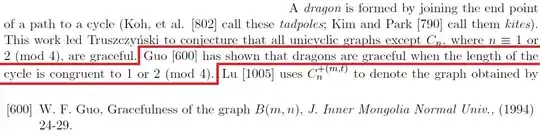
I will gladly accept an answer with an accessible version of the work by Guo (or by anyone else who has managed a characterization of such graphs).
The wikipage on graceful labelings includes the following diagram:

Quoting from the page:
In graph theory, a graceful labeling of a graph with $m$ edges is a labeling of its vertices with some subset of the integers between $0$ and $m$ inclusive, such that no two vertices share a label, and such that each edge is uniquely identified by the positive, or absolute difference between its endpoints.
Let us call a graph a balloon if it consists of an $n$-cycle with a single strand (string) emanating from one of the vertices in the aforementioned cycle. Furthermore, let us require the balloon component to have $n \geq 3$ vertices and the string component to have an additional $k \geq 1$ vertices; in such a case, we denote the balloon as $B(n,k)$.
For example, the diagram above depicts $B(3,2)$, i.e., a balloon with a $3$-cycle (the vertices labeled $0, 4, 5$ make up the balloon component) and a length $2$ string (emanating from the vertex $0$).
Fact: For all $k \geq 1$, the balloon $B(3,k)$ admits a graceful labeling.
(Proof: Left to reader.)
Question: Which balloons admit graceful labelings?
For example, can anyone prove that $B(4,k)$ admits a graceful labeling for all $k \geq 1$?
Alternatively, can anyone come up with an $n \geq 3$ and $k \geq 1$ for which $B(n,k)$ does not admit a graceful labeling?
A word of caution: The conjecture that all trees admit graceful labelings is a notoriously difficult open problem. (For a related MSE post, see here.) Ideally, I would wish for a full characterization of the gracefulness of balloons; however, I will certainly up-vote responses with non-trivial contributions (and may simply "accept" one, particularly if the question here can be transformed into one that implies the conjecture for trees).


Also see this thesis, middle of page 29: https://tspace.library.utoronto.ca/bitstream/1807/13623/1/MQ53395.pdf
– Perry Elliott-Iverson Jun 23 '14 at 18:19