I want to find the normal to ellipse through an arbitrary point. There is an array of points located arround a given ellipse (but not on ellipse curve). What I want to find is the normal of each of that point to the ellipse and then find the corresponding point on a given ellipse curve.
The following are given : $P_1, a, b (F_1, F_2)$, ellipse center $C$ is $(0,0)$
What I can generate are the orange lines $ \overline{F_1P_1} $ and $ \overline{F_2P_1}$ Now I can build the bisection line between the orange lines. This should be the normal of a point on an ellipse. ($P_1$ is not on ellipse curve, but I assume that the same assumption is true for an arbitrary point $P_1$ that is located on that normal).
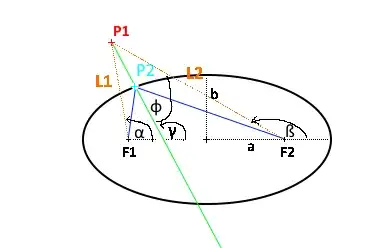
$F_1$ and $F_2$ are found as:
$$e=\sqrt(a^2-b^2)$$ $$F_1=\binom{-e}{0}, F_2 = \binom{+e}{0}$$
$\alpha, \beta, \gamma$ and $\phi$ are calculated as:
$$dx_{1}=P_{1x}-F_{1x}$$ $$dy_{1}=P_{1y}-F_{1y}$$ $$dx_{2}=P_{1x}-F_{2x}$$ $$dy_{2}=P_{1y}-F_{2y}$$ $$l_{1} = \sqrt{(dx_{1}^2+dy_{1}^2)}$$ $$l_{2} = \sqrt{(dx_{2}^2+dy_{2}^2)}$$ $$\alpha = \arccos (dx_{1}/l_{1})$$ $$\beta = \arccos (dx_{2}/l_{2})$$ $$\gamma = {{\alpha + \beta} \over {2}} $$ $$\phi = {{180 - (\alpha \pm \beta)} \over {2}}$$
Now I can generate the normal line. I have to find y-intercept n and slope m.
$$f_{n}(x)=m\cdot x+n$$
$$f_{n}(P_{x})=P_{y}$$
$$m=tan(γ)$$
$$n={{f_{n}(x)} - {m\cdot x}}$$
The next step is to find the intersection of this normal with the ellipse. I have no idea how to proceed.
Is the above assumption to find the normal true?
My first idea was to find the intersection point $P_3$ of the normal with the baseline $\overline {F_{1}F_{2}}$ and then generate a point on ellipse like in:
$$x_{n}=C_{x} - P_{3x} + a\cdot \cos t$$ $$y_{n}=C_{y} - P_{3y} + b\cdot \sin t$$
But seems to be wrong. Anyone an idea?


http://math.stackexchange.com/questions/609351/reflection-inside-an-ellipse
– Empy2 Jul 03 '14 at 09:15