Can $\pi(x)$ be written in terms of $\psi(x)$? I can only seem to approximate it:
$$ \pi(x)\approx\sum_{n=1}^{\infty}\left[\dfrac{\mu(n)}{n}\left(\dfrac{1}{\log(x^{1/n})}\left(\psi(x^{1/n})-x^{1/n}+\sqrt{\pi}\right)+\operatorname{li}(x^{1/n})-1\right)\right] $$
Is there a relationship of equivalence between $\psi(x)$ and $\pi(x)$ (ie, an inversion formula), or can it only approximate it?
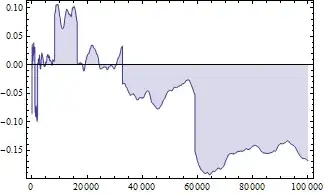
Out of interest I include the difference up to $10^5$ between the RHS and the LHS
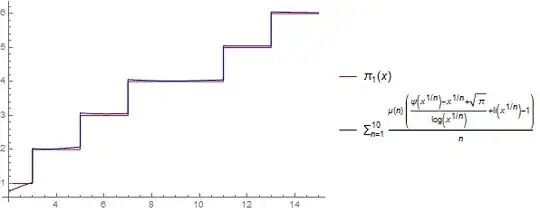
and both together for very small $x$