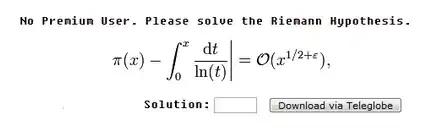
The Riemann Hypothesis is arguably the most famous problem in mathematics. Its usual statement involves the zeroes of a function $\zeta:\mathbb C\to\mathbb C$ defined by $$\zeta(s)=\sum_{n=1}^\infty \frac{1}{n^s}.$$ Although it looks like it's only in the world of complex numbers, it turns out to have much deeper implications in number theory and exaplaining the behavior of the prime numbers. It's an open problem, however - nobody has solved it yet. We have however proved that many things assuming it, and the statement here is one of these.
The symbol $\pi(x)$ is the prime counting function, it counts the number of prime numbers less than or equal to $x$. So for instance $\pi(6) = 3$, because of the $3$ primes $2,3,5$. I assume you understand the integral. The $O(x^{1/2+\varepsilon})$ is just saying that the expression roughly acts like $x^{1/2+\varepsilon}$ as $x$ grows.
The problem is very hard - it's even worth a million dollars. I would go ahead and assume it's a scam or a joke.