4

Suppose that I randomly generate $N$ numbers according to the standard normal distribution, $\mathcal{N}(0,1)$. Then suppose I pick the highest $m$ numbers, $x_1\leq x_2 \leq \cdots \leq x_m$. What is the expected value of the (arithmetic) average of $x_1,\dotsc , x_m$?

Forgive me, I couldn't get my probability theory phrasing 100% accurate here. Hopefully my meaning is clear.


EDIT: A better attempt at proper phrasing might be,

If $a_1,\dotsc , a_N$ are real numbers and $m<N$, define $y_m(a_1,\dotsc , a_N)$ to be the average of the top $m$ values among $a_1,\ldots ,a_N$. If $X_1,\dotsc ,X_N\sim \mathcal{N}(0,1)$ are i.i.d. r.v.'s, define $Y=y_m(X_1,\dotsc ,X_N)$. What is $\mathbb{E}(Y)$?

(Would be greatful foro suggestions on how to improve the formal statement here.)

  • Note: this question has been asked before here for uniformly distributed variables, but the link in the answer is broken. It was also asked here, but the answer given was for uniformly distributed random variables. – Samuel Handwich Oct 20 '14 at 05:47

2 Answers2

1

You can derive the result from this answer on Cross Validated.

By linearity of expectation, you just need to add the top $m$ order statistics and divide by $m$.

Dale M
  • 2,813
1

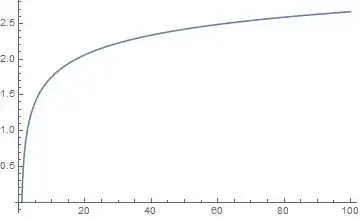
To answer this question, one must note that by generating a random number from a distribution with cumulative distribution function $F$, one is uniformly sampling the y-axis and choosing the x-axis value. Hence, we should first find the corresponding $x$-value of the partition chosen, that is $$\frac{1}{{\sqrt {2\pi } }}\int\limits_x^{ + \infty } {{e^{ - \frac{{{t^2}}}{2}}}dt} = \frac{M}{N}$$which yields $$x = \sqrt 2 {\rm{InverseErfc}}\left( {\frac{{2M}}{N}} \right)$$Now, all we have to compute is the expected value of $x$ in this range, that is $$\begin{array}{c}{\rm{Answer}} = \frac{{\frac{1}{{\sqrt {2\pi } }}\int\limits_{\sqrt 2 {\rm{InverseErfc}}\left( {\frac{{2M}}{N}} \right)}^{ + \infty } {t{e^{ - \frac{{{t^2}}}{2}}}dt} }}{{\frac{1}{{\sqrt {2\pi } }}\int\limits_{\sqrt 2 {\rm{InverseErfc}}\left( {\frac{{2M}}{N}} \right)}^{ + \infty } {{e^{ - \frac{{{t^2}}}{2}}}dt} }}\\ = \frac{N}{{\sqrt {2\pi } M}}{e^{ - \frac{{{{\left( {{\rm{InverseErfc}}\left( {\frac{{2M}}{N}} \right)} \right)}^2}}}{2}}}\end{array}$$A plot could be constructed for this problem by defining $u = \frac{N}{M}$ and noticing that $1 \le u < + \infty $ enter image description here Hope it helps ;)