How can I find what value in column 1 of my list corresponds to the minimum value in column 2?
Asked
Active
Viewed 1,624 times
9

-
What value or what position? – Dr. belisarius Sep 03 '12 at 03:14
-
Hi @belisarius, I just saw this. This is my first use of this website, and so far it is very helpful. I did need to know the value, and now I'd also like to find out how to find the position in the array. Thank you! – Michelle Sep 03 '12 at 03:37
-
1Related: (900) – Mr.Wizard Feb 06 '13 at 01:39
9 Answers
15
Pick[] is one way to go about it:
test = {{15, 11}, {5, 14}, {2, 13}, {3, 5}, {13, 15}, {6, 10}, {8, 15}, {0, 2},
        {10, 13}, {2, 5}};

Pick[#1, #2, Min[#2]] & @@ Transpose[test]
   {0}

J. M.'s missing motivation
- 124,525
- 11
- 401
- 574
-
-
-
-
Hi @belisarius, I just saw it. This is my first visit to the website and I did not at first notice that I needed to "expand" the new comments. – Michelle Sep 03 '12 at 03:37
-
@Michelle Welcome! It takes some time to get used to the features of the site. Feel free to ask – Dr. belisarius Sep 03 '12 at 03:39
-
@belisarius thank you! I also need to know the position in the array that corresponds to the minimum value in the 2nd column. I have tried many things and cannot figure it out. I might be making a small mistake, as a Junior in Physics I am not familiar with Mathematica yet. – Michelle Sep 03 '12 at 03:40
-
@Michelle
{Min[#2], Position[#1, Min[#2]]} & @@ Transpose[test]– Dr. belisarius Sep 03 '12 at 03:47 -
@Michelle, "Can I also find which item in the array the minimum value is?" -
Pick[Thread[{#1, #2}], #2, Min[#2]] & @@ Transpose[test]andPick[#, #[[All, 2]], Min[#[[All, 2]]]] &[test]are two ways to do it. You get a $p\times 2$ array, where $p$ is the number of results returned; for each entry, the second component is the minimum value in the second column, and the first component is the corresponding entry in the first column. – J. M.'s missing motivation Sep 03 '12 at 04:14 -
7
Edit
In my earlier submission, I mistakenly took "corresponds to" as meaning "has the same value as". Here I interpret "corresponds to" as "occupies the same row as".
This variation relies on Position, as before.
#1[[Position[#2, Min@#2][[1, 1]]]] & @@ Transpose@t
Exemplification
t happens to be 15x7:
t={{0, 10, 4, 19, 1, 3, 2}, {3, 18, 1, 12, 7, 14, 16}, {11, 8, 17, 18, 7, 12, 17}, {12, 16, 0, 16, 8, 3, 11}, {8, 2, 14, 3, 18, 7, 6}, {5, 15, 14, 9, 9, 3, 2}, {9, 10, 17, 6, 19, 14, 0}, {3, 5, 18, 11, 10, 12, 6}, {7, 13, 7, 13, 16, 14, 16}, {14, 12, 4, 19, 18, 20, 7}, {18,3, 19, 15, 16, 18, 8}, {1, 18, 5, 11, 3, 5, 2}, {16, 11, 7, 11, 2, 2, 19}, {1, 8, 7, 7, 15, 1, 20}, {11, 9, 2, 7, 2, 18, 4}}
The lowest value in column 2 is 2. It sits next to the value 8 in column one.
#1[[Position[#2, Min@#2][[1, 1]]]] & @@ Transpose@t
8
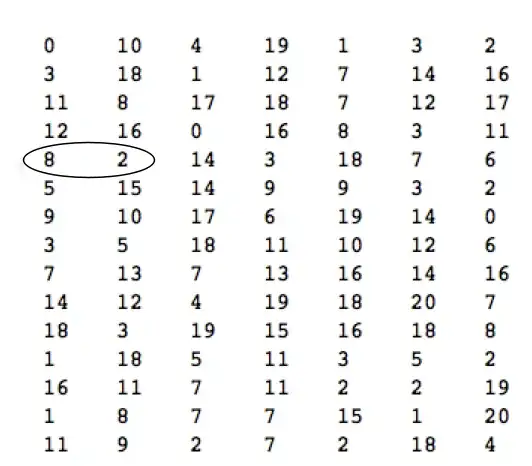
Explanation
Let's explain what the following does:
#1[[Position[#2, Min@#2][[1, 1]]]]
First note that Min@#2returns the minimum value in the second column: 2
Now plug 2 into
Position[#2, Min@#2][[1, 1]]
obtaining
Position[#2, 2][[1, 1]]
returning `5'.
Substituting again, #1[[5]] returns the value the cell at column 1, row 5:
8

DavidC
- 16,724
- 1
- 42
- 94
4
Here's a straightforward way using Cases:
list = {{1, 2}, {2, 2}, {3, 1}, {4, 1}, {2, 4}}; (* example list *)
With[{min = Min@#[[All, 2]]}, Cases[#, {x_, min} :> x]] &@list
(* {3, 4} *)
You can also use Select or Pick, depending on the usage. You should read through the documentation to see how to use them.

rm -rf
- 88,781
- 21
- 293
- 472
4
Here's another way, stealing @J.M's test list
test = {{15, 11}, {5, 14}, {2, 13}, {3, 5}, {13, 15}, {6, 10}, {8, 15}, {0, 2},
        {10, 13}, {2, 5}};

First@Extract[test, test~Reverse~2~Ordering~1]
0
Remove First to see the whole row
Or probably faster is
Extract[#1, #2~Ordering~1] & @@ Transpose[test]

Rojo
- 42,601
- 7
- 96
- 188
2
Sure.
Not sure about "asking" but here's a way to do it.
I'll build some data for an example:
a = RandomReal[{0, 10}, {10, 2}]
And to find the value in the position in column 1 of the minimum of column 2:
a[[Flatten[Position[a[[All, 2]], Min[a[[All, 2]]]]], 1]]

kale
- 10,922
- 1
- 32
- 69
2
Beware of the possibility of multiple minima, especially in long lists of discrete elements. I think for a novice J.M.'s solution is the more instructive. I have changed its first element to demonstrate two identical minima:
test = {{15, 2}, {5, 14}, {2, 13}, {3, 5}, {13, 15}, {6, 10}, {8, 15}, {0, 2}, {10, 13}, {2, 5}};

Pick[#1, #2, Min[#2]] & @@ Transpose[test]

out: {15, 0}
Finding the position of the minimum/minima:
min = Min@test[[All, 2]]
pos = Position[test[[All, 2]], min]

out: 2
out: {{1}, {8}}
In order to grab the corresponding values in Col. 1, the "pos" list must be Flattened first:
test[[Flatten@pos, 1]]

out: {15, 0}

Romke Bontekoe
- 1,903
- 12
- 19
2
With
test = {{15, 11}, {5, 14}, {2, 13}, {3, 5}, {13, 15}, {6, 10}, {8, 15},
    {0,2}, {10, 13}, {2, 5}};
variations with Ordering in Rojo's answer using Part instead of Extract:
test[[Ordering[test[[All, 2]], 1]]][[1, 1]]
or
First[#[[1]][[Ordering[#[[2]], 1]]] &[Transpose[test]]]
or
test[[Ordering[test, 1, #1[[2]] < #2[[2]] &]]][[1, 1]]
(* 0 *)

kglr
- 394,356
- 18
- 477
- 896
1
Using two newer functions:
test = {{15, 11}, {5, 14}, {2, 13}, {3, 5}, {13, 15}, {6, 10}, {8, 15}, {0, 2}, {10, 13}, {2, 5}};
MinimalBy[test, Last][[1, 1]]
0
First @ Extract[PositionSmallest[Last /@ test]] @ test
0
MinimalBy since V 10.3
PositionSmallest since V 13.2

eldo
- 67,911
- 5
- 60
- 168
0
Another way, using Query and SelectFirst:
f[mat_] := mat // Query[SelectFirst[#[[2]] == Min[mat[[All, 2]]] &], 1]
Testing f:
test = {{15, 11}, {5, 14}, {2, 13}, {3, 5}, {13, 15},
       {6, 10}, {8, 15}, {0, 2},{10, 13}, {2, 5}};
t={{0, 10, 4, 19, 1, 3, 2}, {3, 18, 1, 12, 7, 14, 16}, {11, 8, 17, 18, 7, 12, 17},
  {12, 16, 0, 16, 8, 3, 11}, {8, 2, 14, 3, 18, 7, 6}, {5, 15, 14, 9, 9, 3, 2},
  {9, 10, 17, 6, 19, 14, 0}, {3, 5, 18, 11, 10, 12, 6}, {7, 13, 7, 13, 16, 14, 16},
  {14, 12, 4, 19, 18, 20, 7}, {18,3, 19, 15, 16, 18, 8}, {1, 18, 5, 11, 3, 5, 2},
  {16, 11, 7, 11, 2, 2, 19}, {1, 8, 7, 7, 15, 1, 20}, {11, 9, 2, 7, 2, 18, 4}};
f /@ {test, t}
({0, 8})

E. Chan-López
- 23,117
- 3
- 21
- 44