I have the following function
$$V(r) = \sum_{i=1}^N 4 \epsilon_i \left(\frac{\sigma_i^{12}}{\|r-r_{0i}\|^{12}}-\frac{\sigma_i^6}{\|r-r_{0i}\|^6}\right)$$
which -for those interested- corresponds to a sum of Lennard-Jones potentials, with the following real life set of parameters
sig = {0.329633, 0.0400014, 0.405359, 0.235197, 0.387541, 0.235197,
       0.235197, 0.387541, 0.235197, 0.235197, 0.387541, 0.235197,
       0.235197, 0.387541, 0.235197, 0.235197, 0.329633, 0.0400014,
       0.0400014, 0.0400014, 0.356359, 0.302906, 0.329633, 0.0400014,
       0.387541, 0.235197, 0.235197, 0.356359, 0.302906, 0.329633,
       0.0400014, 0.405359, 0.235197, 0.387541, 0.235197, 0.235197,
       0.405359, 0.235197, 0.36705, 0.235197, 0.235197, 0.235197, 0.36705,
       0.235197, 0.235197, 0.235197, 0.356359, 0.302906, 0.329633,
       0.0400014, 0.405359, 0.235197, 0.387541, 0.235197, 0.235197,
       0.387541, 0.235197, 0.235197, 0.356359, 0.302906, 0.329633,
       0.0400014, 0.0400014, 0.356359, 0.302906, 0.329633, 0.0400014,
       0.405359, 0.235197, 0.405359, 0.235197, 0.36705, 0.235197, 0.235197,
       0.235197, 0.387541, 0.235197, 0.235197, 0.36705, 0.235197, 0.235197,
       0.235197, 0.356359, 0.302906}

eps = {0.8368, 0.192464, 0.08368, 0.092048, 0.23012, 0.092048, 0.092048,
       0.23012, 0.092048, 0.092048, 0.23012, 0.092048, 0.092048, 0.23012,
       0.092048, 0.092048, 0.8368, 0.192464, 0.192464, 0.192464, 0.46024,
       0.50208, 0.8368, 0.192464, 0.23012, 0.092048, 0.092048, 0.46024,
       0.50208, 0.8368, 0.192464, 0.08368, 0.092048, 0.23012, 0.092048,
       0.092048, 0.08368, 0.092048, 0.33472, 0.092048, 0.092048, 0.092048,
       0.33472, 0.092048, 0.092048, 0.092048, 0.46024, 0.50208, 0.8368,
       0.192464, 0.08368, 0.092048, 0.23012, 0.092048, 0.092048, 0.23012,
       0.092048, 0.092048, 0.29288, 0.50208, 0.8368, 0.192464, 0.192464,
       0.46024, 0.50208, 0.8368, 0.192464, 0.08368, 0.092048, 0.08368,
       0.092048, 0.33472, 0.092048, 0.092048, 0.092048, 0.23012, 0.092048,
       0.092048, 0.33472, 0.092048, 0.092048, 0.092048, 0.46024, 0.50208}

r0 = {{0.681, -2.673}, {0.605, -2.736}, {0.715, -2.578}, {0.812, -2.583},
      {0.628, -2.607}, {0.654, -2.698}, {0.533, -2.609}, {0.63, -2.515},
      {0.559, -2.545}, {0.609, -2.423}, {0.763, -2.509}, {0.825, -2.446},
      {0.804, -2.6}, {0.742, -2.461}, {0.709, -2.367}, {0.829, -2.465},
      {0.642, -2.547}, {0.629, -2.515}, {0.675, -2.642}, {0.555, -2.543},
      {0.693, -2.445}, {0.778, -2.359}, {0.585, -2.422}, {0.526, -2.499},
      {0.55, -2.291}, {0.543, -2.236}, {0.459, -2.299}, {0.638, -2.219},
      {0.661, -2.105}, {0.715, -2.293}, {0.688, -2.387}, {0.829, -2.244},
      {0.791, -2.156}, {0.867, -2.346}, {0.893, -2.431}, {0.946, -2.309},
      {0.754, -2.38}, {0.674, -2.422}, {0.697, -2.255}, {0.627, -2.281},
      {0.77, -2.205}, {0.657, -2.197}, {0.802, -2.482}, {0.729, -2.503},
      {0.825, -2.566}, {0.883, -2.448}, {0.956, -2.216}, {1.034, -2.126},
      {0.986, -2.287}, {0.921, -2.356}, {1.104, -2.268}, {1.178, -2.271},
      {1.13, -2.381}, {1.056, -2.379}, {1.217, -2.362}, {1.135, -2.523},
      {1.218, -2.53}, {1.055, -2.534}, {1.137, -2.64}, {1.171, -2.628},
      {1.083, -2.751}, {1.043, -2.753}, {1.08, -2.832}, {1.099, -2.133},
      {1.196, -2.059}, {0.987, -2.095}, {0.911, -2.161}, {0.964, -1.963},
      {1.042, -1.957}, {0.833, -1.955}, {0.818, -1.859}, {0.844, -2.053},
      {0.759, -2.051}, {0.92, -2.024}, {0.861, -2.146}, {0.714, -1.996},
      {0.729, -2.089}, {0.708, -1.934}, {0.581, -1.991}, {0.505, -2.018},
      {0.565, -1.898}, {0.586, -2.053}, {0.98, -1.845}, {1.047, -1.739}}
which -again, for those interested- correspond to a 2D projection of the first five residues of a S4S5 alpha helix for the Kv1.2 Ion Channel.
Defining $V(r)$ as
v[r_, r0_, s_, ep_] := 4 ep (s^12/EuclideanDistance[r, r0]^12 -
                             s^6/EuclideanDistance[r, r0]^6);
I can plot the potential with
Plot3D[Sum[v[{x, y}, r0[[i]], sig[[i]], eps[[i]]], {i, 1, 84}],
       {x, -0.5, 2}, {y, -3.5, -1},
       PlotStyle -> Directive[Opacity[0.35], Blue],
       AxesLabel -> {x, y}, PlotRange -> {-5, 1}
]
obtaining the following output

or, using PlotPoints -> 50
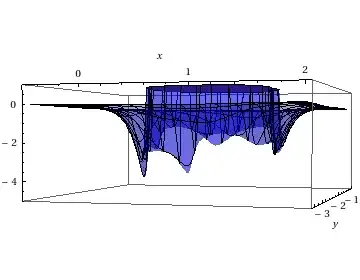
where the minima/maxima can be seen really well.
The thing is, I have a lot of these objects, with a lot more elements, and a lot of minima/maxima, in a way that is very expensive for my (old) computer to simply increase PlotPoints for smoother graphics, and I was wondering, due the fact that $V(r)$ rapidly decreases, if there is a way to ask MMA to increase resolution near the minima/maxima, and reduce it far from the data set r0.
Hope my question is clear and interesting.
--FINAL EDIT--
First of all, I want to thank you all for your comments and answers. If I could, I'd accept all of them, since each one gave me the insight needed to solve my problem. For obvious reasons, Silvia's answer deserves maximum recognition, but readers should also check PlatoManiac and Sjoerd C. de Vries responses, as they will provide a full picture.
Now, to honour the work of all the people involved, I'll show you the beautiful application of the code they've worked out.
Here is a caricaturization of the S4S5 linker helix, believed to play a major role in the opening and closing of voltage gated potassium channels.

This helix generates all sort of van der Waals interactions, that can be modelled by the Lennard-Jones potential.
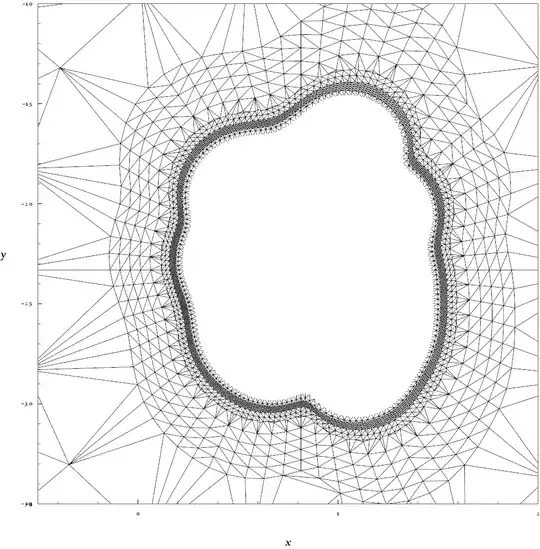
For specific reasons, I need to see how this potential looks on a given plane, namely the XY plane, and it is very important to capture all the maxima and minima of it, as it will provide a full picture of the dynamics in that plane.
Thanks to Silvia's code, one can see:
a view from below of the potential generated by the helix,

a sideways view, where the peaks are actually minima,

and a view form above,

What you are seeing is the van der Waals interactions generated by the helix over that plane, and if you're wondering what does that sharp barrier around the helix is, it's the macroscopic consequence of Pauli's Exclusion Principle!
Thank you all for your help, you've put a big smile on my face!




exprand thenPlot3D[expr,...]. – b.gates.you.know.what Sep 10 '12 at 20:27ListPlot3Dwill be good. – Silvia Sep 11 '12 at 17:23vusingDotinstead ofEuclideanDistanceto avoid all theAbs:v[r_,r0_,s_,ep_]:=4ep(s^12/(#.#&[r-r0])^6-s^6/(#.#&[r-r0])^3). It's also worth puttingexpr=Expand@Sum[...]– Simon Woods Sep 11 '12 at 19:48Expand@Sum[...]increases performance? If, instead ofexpr, I define a function for the sum, (i.e.vTot[r_,r0_,s_,ep_]:=Expand@Sum[...], and then doPlot3d[vTot[...]], does it still apply? – Pragabhava Sep 12 '12 at 00:53Expandhere just reduces the number of multiplications in the expression, for a minor speed increase. In your definition ofvTotyou have usedSetDelayed- this is unwise as it means theSumwill be recomputed every time you evaluatevTot. – Simon Woods Sep 12 '12 at 19:10