If your equations and constraints are linear (or can be expressed as linear), and if a machine precision solution is enough you can use functions like LinearProgramming or NMinimize to get a solution:
M = 50;
NMinimize[{
  z1 + z2 + z3,
  {
   -1 + Abs[q2 (-(7/4) + t1)] == 0,
   q1 == 0,
   -1 + Abs[q1 (-(7/4) + t2)] >= 0 - M*z3,
   -1 + Abs[q1 (-(7/4) + t2)] <= 0 + M*z3,
   3 + q2 == 0,
   t1 >= 7/4 - z1*M,
   t2 >= 7/4 - z2*M,
   z1 \[Element] Integers, 0 <= z1 <= 1,
   z2 \[Element] Integers, 0 <= z2 <= 1,
   z3 \[Element] Integers, 0 <= z3 <= 1
   }
  },
 {t1, t2, q1, q2, z1, z2, z3}
 ]
{2., {t1 -> 2.08333, t2 -> 549.224, q1 -> 0, q2 -> -3., z1 -> 1, z2 -> 1, z3 -> 0}}
Basically, you introduce some binary ($0-1$) decision variables $z_i$ and one or more costant $M$ big enough so that you can rewrite the desired $i$ constraint in a way that when $z_i$ is $1$ constraint is always satisfied. You then minimze the sum of $z_i$.
More references to LinearProgramming in my answer here and
and another example of "conditional constraints", here:
With NMinimize you can also handle some non-linear constraint. Unfortunately Minimize is not available because:
Minimize::mixdom: Exact optimization with mixed real and integer variables is not yet implemented.
You can of course try to implement by yourself this strategy (a search on a suitable tree) to get an exact answer. If there are only few "conditional constraints" you can also try to Solve for all possible $(z_1z_2\ldots)$ until you find a solution. In this case, with at most $2^3=8$ cases is not too difficult.
As an idea of how we can do a search on a tree, start building a suitable tree. This tree is such that the binary digits of the node are used to identify a subset of constraints. There is also an interesting ordering in DepthFirstScan visit order; see the picture.
vt[n_] := Module[{l, p},
  l = Range[0, 2^n - 1];
  p = FromDigits[#, 2] & /@
    Replace[IntegerDigits[l,
      2], {a : 0 ..., 1, b___} :> {a, 0, b}, {1}];
  TreeGraph[l, p, VertexShapeFunction -> "Name",
   VertexLabels -> Thread[l -> IntegerString[l, 2, n]]]
  ]
vt[4]
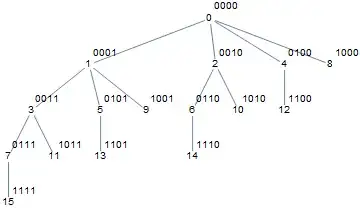
A simple (?), but far from optimal, search function is:
ssolve[eqns_, cons_, vars_, dom : _ : Reals] :=
 Module[{n, t, m, c, s, l, w, r},
  n = Length@cons;
  t = vt[n];
  s = Association@Thread[VertexList[t] -> False];
  m = -\[Infinity]; c = Indeterminate;
  r = {};
  DepthFirstScan[t, 0,
   "DiscoverVertex" -> Function[{u, v, d},
     Which[
      s[v], s[u] = True,
      d > m,
      With[{sol =
         Quiet@Solve[
           Join[eqns, Pick[cons, IntegerDigits[u, 2, n], 1]], vars,
           dom]},
       If[sol == {}, s[u] = True,
        c = u; r = sol; m = d
        ]]
      ]]];
  {Pick[cons, IntegerDigits[c, 2, n], 1], r}
  ]
A sample (all your equations and inequalities are considered optional):
eqns = Thread /@ {{-1 + Abs[q2 (-(7/4) + t1)],
      q1, -1 + Abs[q1 (-(7/4) + t2)], 3 + q2} == 0, {t1, t2} >= 7/4} //
   Flatten
vars = {t1, t2, q1, q2};
ssolve[{}, eqns, vars, Reals]
The return value is a list with the set of constraints fulfilled and the return value of Solve.
{{-1 + Abs[q2 (-(7/4) + t1)] == 0, -1 + Abs[q1 (-(7/4) + t2)] == 0,
  3 + q2 == 0, t1 >= 7/4,
  t2 >= 7/4}, {{t1 -> ConditionalExpression[25/12, q1 > 0],
   t2 -> ConditionalExpression[(4 + 7 q1)/(4 q1), q1 > 0],
   q2 -> ConditionalExpression[-3, q1 > 0]}, {t1 ->
    ConditionalExpression[25/12, q1 < 0],
   t2 -> ConditionalExpression[(-4 + 7 q1)/(4 q1), q1 < 0],
   q2 -> ConditionalExpression[-3, q1 < 0]}}}
I didn't fully tested the code but the basic idea should work, and should be more efficient than testing all the possible subsets of constraints. The use of built-in function DepthFirstScan is easy, but unfortunately at present doesn't allow to really skip the visit of a subtree.
Edit. In the way I used DepthFirstScan, nodes are not processed in DFS order. To fix this problem, I think a more involved code is required. At this point, I don't really see any reason to build a TreeGraph and use DepthFirstScan. I think it's better to use another strategy. I'll try to post an update when I have time.


Solve[{x^2 + 1 == 0, y^2 - 1 == 0}, {x, y}, Reals]gives no solution, whileMinimize[{Abs[x^2 + 1] + Abs[y^2 - 1]}, {x, y}, Reals]finds a solution forywhich is still useful to me. (If you read the above, please don't tell me to separate the equations and solve them independently. I know I can do that for this particular example, but that also completely misses the point of my question, which I think is clear.) – user541686 Mar 10 '16 at 22:14ArgMin[]route would be more expedient than forcingSolve[]to do your bidding. FWIW, your last snippet gives the same output asWith[{p = 1}, ArgMin[Norm[Subtract @@@ {x^2 + 1 == 0, y^2 - 1 == 0}, p], {x, y}, Reals]]. Do you really need to use the $1$-norm? That is a more difficult problem than minimizing with respect to the usual $2$-norm. – J. M.'s missing motivation Mar 13 '16 at 03:05ArgMinis a solution, but I'm asking if there is a way to useSolve.ArgMinis solving a harder problem than the one I need, because I really don't need to minimize errors with respect to unsatisfiable constraints. If there isn't a way then that's a perfectly valid answer. – user541686 Mar 13 '16 at 03:23ArgMineither (NArgMinsometimes works, but I want something symbolic...). – user541686 Mar 13 '16 at 03:51{t1 -> 25/12, t2 -> Indeterminate, q1 -> 0, q2 -> -3}a solution to that system? Are your sublists meant to beOr? – Mr.Wizard Mar 13 '16 at 06:38Function[{t1, t2, q1, q2}, {-1 + Abs[q2 (-(7/4) + t1)], q1, -1 + Abs[q1 (-(7/4) + t2)], 3 + q2}][25/12, Indeterminate, 0, -3]you see the vector becomes{0, 0, Indeterminate, 0}which is pretty close to all zeros. – user541686 Mar 13 '16 at 06:42