I have got a list:
lis:={
{{1, 2, 3, 4}},
{{1, 2, 3}, {4}},
{{1, 2, 4}, {3}},
{{1, 2}, {3, 4}},
{{1, 2}, {3}, {4}},
{{1, 3, 4}, {2}},
{{1, 3}, {2}, {4}},
{{1, 4}, {2, 3}},
{{1}, {2, 3, 4}},
{{1}, {2, 3}, {4}},
{{1, 4}, {2}, {3}},
{{1}, {2, 4}, {3}},
{{1}, {2}, {3, 4}},
{{1}, {2}, {3}, {4}}
};
and I would like to pick out those lists which satisfy the following condition:
list == Mod[list+2,4,1]
but, they should be "equal" as a set of lists, not in a "element to element" way. For example, {{1,2},{3,4}} is a list satisfied the condition, since Mod[{{1,2},{3,4}}+2,4,1] is {{3, 4}, {1, 2}}, which is not equal to {{1,2},{3,4}} since the "position" is not right, but we should regard it as equal in the sense of set, since they are both the set of {1,2} and {3,4}.
An example which not satisfied our condition is that {{1,2,3},4}, since Mod[{{1, 2, 3}, 4} + 2, 4, 1] is {{3, 4, 1}, 2}, as a set they are not equal, one is the union of {1,2,3} and {4}, but the results is the union of {1,3,4} and {2}.
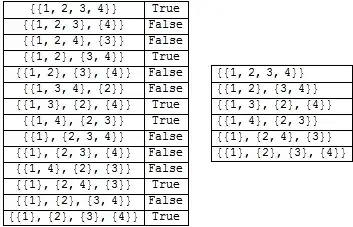
Can I use a pattern to sort out the one satisfied my condition in the list? I would like to make it work with any list.



Cases[]can be written in an equivalent, longer, but maybe more transparent form:Sort[Map[Sort, list]] == Sort[Map[Sort, Mod[list + 2, 4, 1]]]. I trust that this form might be more understandable to you. The key is in the third argument ofMap[]; see the docs for details. – J. M.'s missing motivation Sep 28 '12 at 15:14Map[]works here, it is instructive to replace theSort[]with a "generic" function. TryRemove[f]; With[{l = {{1}, {2}, {3, 4}}}, Map[f, {l, Mod[l + 2, 4, 1]}, 2]]. – J. M.'s missing motivation Sep 28 '12 at 15:43