Introduction
The first thing that I noticed is that the functional form for all of your CDD and LHS functions are identical.
I propose that rather than defining six functions for each, we define one function and change the input arguments to cover the various cases.
cdd[s_, a_, b_, c_] := 10^(a + b*c - b*s)*Exp[-10^(s - c)]

lhs[s_?NumericQ, a_?NumericQ, b_?NumericQ, c_?NumericQ] :=
 NIntegrate[Log[10]*10^u*cdd[u, a, b, c], {u, s, Infinity}]
Note that we use NumericQ for all of the input arguments to lhs. This will be required the results are plotted.
As an example, here is the output for the average parameters you had set for the first case
With[
 {
  a1 = -23.29,
  b1 = 0.88,
  c1 = 20.82,
  s = 20.3
  },
 {cdd[s, a1, b1, c1], lhs[s, a1, b1, c1]}
 ]
(* {1.08754*10^-23, 0.00291862} *)
Interval
The problem you were experiencing is that you wanted to use Interval but it was not accepted by NIntegrate so one was stuck.
The strategy will be to create all permutations of the average inputs parameters +/- their deltas and compute the minimum and maximum.
So for the first step, imagine that we have three parameters a, b and c and when their respective delta is subtracted we have the minus version, am, bm and cm.
We can get a list of all permutation of minus
Flatten[Outer[List, {a, am}, {b, bm}, {c, cm}], 2]
(* {{a, b, c}, {a, b, cm}, {a, bm, c}, {a, bm, cm}, {am, b,
  c}, {am, b, cm}, {am, bm, c}, {am, bm, cm}} *)
Clearly we can perform the same operation for adding the delta.
Next we will define two functions that use lhs but compute the minimum of subtracting the delta values and the maximum of adding the delta values.
The case is covered where delta is zero for a particular parameter.
lhsMinus[s_?NumericQ, a_?NumericQ, da_?NumericQ, b_?NumericQ,
  db_?NumericQ, c_?NumericQ, dc_?NumericQ] := Module[
  {
   aList,
   bList,
   cList
   },
  aList = If[da == 0, {a}, {a, a - da}];
  bList = If[db == 0, {b}, {b, b - db}];
  cList = If[dc == 0, {c}, {c, c - dc}];

  Min[Map[lhs[s, Sequence @@ #] &,
    Flatten[Outer[List, aList, bList, cList], 2]]]
  ]

lhsPlus[s_?NumericQ, a_?NumericQ, da_?NumericQ, b_?NumericQ,
  db_?NumericQ, c_?NumericQ, dc_?NumericQ] := Module[
  {
   aList,
   bList,
   cList
   },
  aList = If[da == 0, {a}, {a, a + da}];
  bList = If[db == 0, {b}, {b, b + db}];
  cList = If[dc == 0, {c}, {c, c + dc}];

  Max[Map[lhs[s, Sequence @@ #] &,
    Flatten[Outer[List, aList, bList, cList], 2]]]
  ]
Plot
Now plot the results for the first set of parameters. For the large spread in the s values the delta's had to be increased or the min and max were too close to be visible.
With[
 {
  a1 = -23.29,
  da = 0.08,
  b1 = 0.88,
  db = 0.08,
  c1 = 20.82,
  dc = 0.04
  },
 LogPlot[
  {
   lhsMinus[s, a1, da, b1, db, c1, dc],
   lhs[s, a1, b1, c1],
   lhsPlus[s, a1, da, b1, db, c1, dc]
   },
  {s, 20.3, 23.1},
  {PlotStyle -> {Blue, Black, Red}},
   PlotRange -> {10^-35, 1}
  ]
 ]
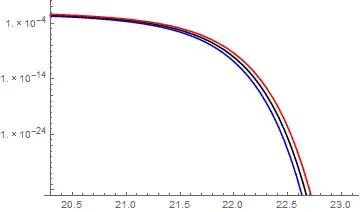
I think this should get you started. I leave to you the plot of the second data set.
Numerical Derivatives and a faster version
If one were able to ascertain the polarity that a change in a parameter has on the outcome one could construct a faster version by reducing the number of permutations.
testDeriv = With[
  {
   a1 = -23.29,
   b1 = 0.88,
   c1 = 20.82
   },
  Table[
   {s, (lhs[s, a1 + 0.001, b1, c1] - lhs[s, a1, b1, c1])/0.001,
    (lhs[s, a1, b1 + 0.001, c1] - lhs[s, a1, b1, c1])/0.001,
    (lhs[s, a1, b1, c1 + 0.001] - lhs[s, a1, b1, c1])/0.001},
   {s, 20.3, 23.3, 0.5}
   ]
  ]

(* {{20.3, 0.00672811, 0.00102687, 0.0117371}, {20.8,
  0.00194452, -0.000360691, 0.00494013}, {21.3,
  0.000116524, -0.0000671435, 0.000553761}, {21.8,
  7.0401*10^-8, -7.15508*10^-8, 8.08399*10^-7}, {22.3,
  2.90222*10^-17, -4.32226*10^-17, 9.63237*10^-16}, {22.8,
  4.69431*10^-46, -9.28372*10^-46, 5.11146*10^-44}, {23.3,
  3.58277*10^-136, -8.85485*10^-136, 1.5721*10^-133}} *)
It appears that the derivative of lhs with respect to a and c is always positive and with respect to b may be either positive or negative.
Using that hypothesis a faster version of the lhs for intervals would be:
lhsMinus2[s_?NumericQ, a_?NumericQ, da_?NumericQ, b_?NumericQ,
  db_?NumericQ, c_?NumericQ, dc_?NumericQ] := Module[
  {
   aList,
   bList,
   cList
   },
  aList = If[da == 0, {a}, {a - da}];
  bList = If[db == 0, {b}, {b, b - db, b + db}];
  cList = If[dc == 0, {c}, {c - dc}];

  Min[Map[lhs[s, Sequence @@ #] &,
    Flatten[Outer[List, aList, bList, cList], 2]]]
  ]
and indeed testing shows that it does produce a smaller minimum:
testMinus = With[
   {
    a1 = -23.29,
    da = 0.04,
    b1 = 0.88,
    db = 0.04,
    c1 = 20.82,
    dc = 0.01
    },
   Table[
    {s, lhsMinus[s, a1, da, b1, db, c1, dc],
     lhsMinus2[s, a1, da, b1, db, c1, dc]},
    {s, 20.3, 23.3, 0.5}
    ]
   ];

Map[{#[[1]], #[[3]]/#[[2]]} &, testMinus]
(* {{20.3, 1.}, {20.8, 0.98248}, {21.3, 0.947516}, {21.8,
  0.909672}, {22.3, 0.870701}, {22.8, 0.832196}, {23.3, 0.794958}} *)
The same is true for the positive side:
lhsPlus2[s_?NumericQ, a_?NumericQ, da_?NumericQ, b_?NumericQ,
  db_?NumericQ, c_?NumericQ, dc_?NumericQ] := Module[
  {
   aList,
   bList,
   cList
   },
  aList = If[da == 0, {a}, {a + da}];
  bList = If[db == 0, {b}, {b, b - db, b + db}];
  cList = If[dc == 0, {c}, {c + dc}];

  Max[Map[lhs[s, Sequence @@ #] &,
    Flatten[Outer[List, aList, bList, cList], 2]]]
  ]

testPlus = With[
  {
   a1 = -23.29,
   da = 0.04,
   b1 = 0.88,
   db = 0.04,
   c1 = 20.82,
   dc = 0.01
   },
  Table[
   {s, lhsPlus[s, a1, da, b1, db, c1, dc],
    lhsPlus2[s, a1, da, b1, db, c1, dc]},
   {s, 20.3, 23.3, 0.5}
   ]
  ];

Map[{#[[1]], #[[3]]/#[[2]]} &, testPlus]
(* {{20.3, 1.}, {20.8, 1.01669}, {21.3, 1.05383}, {21.8,
  1.09744}, {22.3, 1.14645}, {22.8, 1.19945}, {23.3, 1.25562}} *)


Min[LHSHybrid[s, a1, b1, c1]]will not output anything meaningful because in the definition ofLHSHybrid,c1has to satisfyNumericQ.IntervalgivesFalsewhen you applyNumericQ. The same applies with all other functions inLogPlotthat havea1,b1, etc. in them.In addition,
– JungHwan Min May 23 '16 at 01:06infinityshould have a capital i as the first letter, or else it will be treated as a variable.Infinitymeans infinity, andinfinitymeans a variable named "infinity".LogPlotare not numeric, meaning nothing will be on the graph. – JungHwan Min May 23 '16 at 01:13sas input seems to work fine; try restarting the kernel.NumericQis still a problem. Also, the problem with the functions involvingIntervals is thatNIntegratecannot haveIntervals in them. – JungHwan Min May 23 '16 at 01:49IntervalfromNIntegrate? If so, there might be a workaround to this. – JungHwan Min May 23 '16 at 01:55MinMaxdoes not work as intended... – JungHwan Min May 23 '16 at 02:38