2

How can I calculate the Asymptotic Rate of growth of a function, for instance like:

$X^3 - X^2 - X -1$

EDIT:

For instance, as you can see in this graph, after the 1200 the function approximates to the limit. I want to if there is a easy way to calculate the rate of grow, after 1200 for instance.

enter image description here

Edit

I'm trying to find a generalized way in order to graphically find it for Fibonacci, Tribonacci, Tetranacci sequences

Dr. belisarius
  • 115,881
  • 13
  • 203
  • 453
whynot
  • 321
  • 3
  • 10

1 Answers1

3

As J.M. mentioned in the comments:

All the n-nacci sequences have exponential behavior; the base of their dominant exponential term is (expressed in Mathematica notation)

Root[x^n - Sum[x^k, {k, 0, n - 1}], Mod[n, 2, 1]]

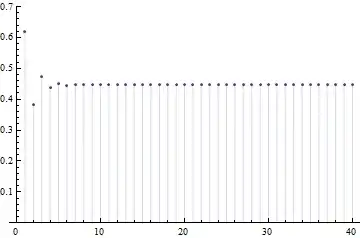
Demonstration:

With[{n = 2},
 base = Root[x^n - Sum[x^k, {k, 0, n - 1}], Mod[n, 2, 1]] // N;
 DiscretePlot[Fibonacci[x]/base^x, {x, 1, 40}, PlotRange -> {0, 0.7}]
 ]

Mathematica graphics

Daniel Lichtblau adds that Mathematica is able to calculate the Fibonacci series development at infinity:

Simplify[Normal[Series[FunctionExpand[Fibonacci[x]], {x,Infinity,2}]], 
         Assumptions->Element[x,Integers]]

Mathematica graphics

Sjoerd C. de Vries
  • 65,815
  • 14
  • 188
  • 323
  • 1
    Could take the series at infinity for cases like Fibonacci, where we have a closed form. This gives some exponential stuff: Simplify[Normal[Series[FunctionExpand[Fibonacci[x]], {x,Infinity,2}]], Assumptions->Element[x,Integers]] – Daniel Lichtblau Jan 09 '14 at 23:40
  • PS Thanks for taking so much time to respond to several unanswered posts. I noticed you've handled quite a few in the past day or two. (Maybe others before that, but I wasn't noticing then.) – Daniel Lichtblau Jan 09 '14 at 23:42
  • @DanielLichtblau Thanks! I had some spare time which coincided nicely with rm-rf's clean-up call. – Sjoerd C. de Vries Jan 10 '14 at 22:05