eq1 = y - x - 2;
eq2 = z + x - 2;
One can solve a system of equations
sol = {x, y, z} /. Solve[{eq1 == 0, eq2 == 0}, {x, y, z}]
{{x, 2 + x, 2 - x}}
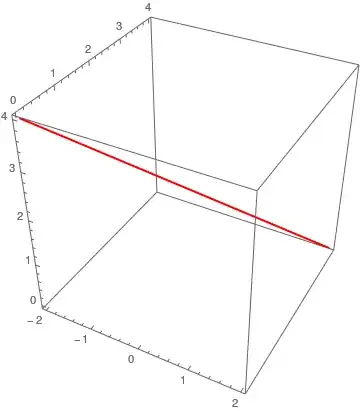
to get the intersection in parametric form:
ParametricPlot3D[Evaluate@sol, {x, -2, 2}, PlotStyle -> {Thick, Red}]
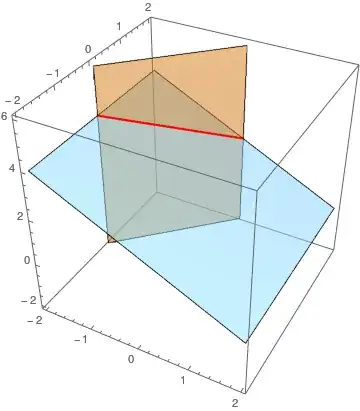
A different approach is to use Mesh functions:
ContourPlot3D[{eq1 == 0, eq2 == 0}, {x, -2, 2}, {y, -2, 2}, {z, -2,
  6}, MeshFunctions -> {Function[{x, y, z, f}, eq1 - eq2]},
 MeshStyle -> {Thick, Red}, Mesh -> {{0}},
 ContourStyle -> Directive@{Opacity[0.5]}]
One can fade the surfaces completely to have only the highlighted intersection left:
ContourPlot3D[{eq1 == 0, eq2 == 0}, {x, -2, 2}, {y, -2, 2}, {z, -2,
  6}, MeshFunctions -> {Function[{x, y, z, f}, eq1 - eq2]},
 MeshStyle -> {Thick, Red}, Mesh -> {{0}},
 ContourStyle -> Directive@{Opacity[0]}, BoundaryStyle -> Transparent]


=means you defineyto be2+x, you are essentially running{2 + x, 2 - x}– Feyre Dec 19 '16 at 13:38Line, orArrow, andInfiniteLine. – Feyre Dec 19 '16 at 13:43