This equation has many more 'nice' valued roots than you think. Let's see what a man-machine cooperation can find. I'm going to take fairly rough steps and back-substitute the results to see whether I stepped on any mathematician's toes in the process.
First, let's move everything to one side of the equation and whisk everything on that side together:
 (Exp[x^2*Log[2, (3 + x)/10] - x^2*Log[1/2, 2 + 3*x]] -
  Exp[x^2 - 4 + 2*Log[Sqrt[2], (3*x^2 + 11*x + 6)/10]]) // Together
 (1)
(1)
Since it is easy to see that (3+x)(2+3*x) == (6 + 11 x + 3 x^2) the right hand part of the above equation equals zero if (6 + 11 x + 3 x^2)==0.
Solve[6 + 11 x + 3 x^2 == 0, x]
{{x -> -3}, {x -> -(2/3)}}
Let's further explore that part of the numerator of (1). We take the log of both parts (allowed because the whole term between parenthesis should equal zero, add a few minus signs to make everything still zero). Rewrite the logs using a few rules for logarithms:
  Log[-10^((4/Log[2])) E^4 (3 + x)^(x^2/Log[2]) (2 + 3 x)^(x^2/Log[2])] -
  Log[-10^((x^2/Log[2])) E^x^2 (6 + 11 x + 3 x^2)^(4/Log[2])]
   //. {Log[a_ b_] -> Log[a] + Log[b], Log[a_^b_] -> b Log[a]}

Again, looking through your eye lashes you notice you can factor out a term (4-x^2):

The first part has solutions $\pm 2$, of course, and for the second part we find:
Solve[ 1 + Log[10]/Log[2] - Log[6 + 11 x + 3 x^2]/Log[2] == 0, x]

{{x -> -(14/3)}, {x -> 1}}
Back-substituting all solutions in your equation:
x^2*Log[2, (3 + x)/10] - x^2*Log[1/2, 2 + 3*x] ==
x^2 - 4 + 2*Log[Sqrt[2], (3*x^2 + 11*x + 6)/10]
  /. {{x -> -14/3}, {x -> -2}, {x -> 2},
      {x ->  1}, {x -> -3}, {x -> -2/3}} // FullSimplify
{False, True, True, True, True, True}
So, we have solutions for x = -3,-2, -2/3, 1, and 2.
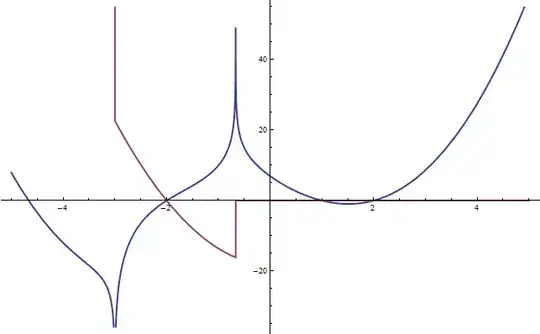
However, as acl, Artes and Whuber have pointed out, some of these have a problem. For x =-3 we get a Log[2,0] in the first term of the left-hand side of the equation that Mathematica cancels with another Log[0]; same for the second term and x = -2/3. The situation for x=-2 is different. You get logs of negative numbers like Log[-4] which have a complex answer that depending on the branch cut definition that is being used. In this case we get I Pi + Log[4]. If you do Exp[I Pi + Log[4]], you get -4. So, depending on your stance on branch cuts you might consider the full set of solution to be {-2, 1, 2}. And if you don't like the first one, we've still found 1 and 2 as exact values, not with numerical root finding approximations.







FindRootor this ? – b.gates.you.know.what Oct 21 '12 at 15:26