1

A solid lies between planes perpendicular to the​ y-axis at $y=0$ and $y=1$. The​ cross-sections perpendicular to the​ x-axis are circular disks with diameters running from the​ $y=1$ to the parabola $x=\sqrt{19}y^2$. Find the volume of the solid. $$$$After evaluating the volume of the solid I wanted to make a 3D plot of this object. Since I am new to mathematica, the way I thought about it was:

    f[x_] := Integrate[Pi/4*(1 - Sqrt[x]/19^(1/4))^2, x]
    Plot3D[f[x], {x, 0, Sqrt[19]}, {y, 0, 1}]

However, I get error that state:

    Integrate::ilim: Invalid integration variable or limit(s) in 0.0003116612744631582`. >>
    Integrate::ilim: Invalid integration variable or limit(s) in 0.31166158581308273`. >>
    Integrate::ilim: Invalid integration variable or limit(s) in 0.6230115103517023`. >>
General::stop: Further output of Integrate::ilim will be suppressed during this calculation. >>

How can I fix this?

(I want to show the volume between the two curves such that the cross sections perpendicular to the x-axis are disks whose diameter run from $y=1$ to $f(x)$)

enter image description here

user372003
  • 560
  • 3
  • 11

1 Answers1

4

Update 2

Now understanding the desired region, the volume can be obtained by 'sliding' the disks onto x-axis and using cylindrical coordinates:

f[x_]:= Sqrt[x/Sqrt[19]]
vol=Integrate[r, {u,0,2Pi},{v,0,Sqrt[19]},{r,0,(1-f[x])/2}]

Surface enclosing desired volume $\frac{\sqrt{19}\pi}{24}$:

g[r_, u_, v_] := {u, r Cos[v], (1 + f[u])/2 + r Sin[v]}
ParametricPlot3D[
 g[(1 - f[u])/2, u, v], {u, 0, Sqrt[19]}, {v, 0, 2 Pi}, Mesh -> False,
  Background -> Black, AxesStyle -> White]

enter image description here

or using RegionPlot3D:

RegionPlot3D[
 0 < (y^2 + (z - (1 + f[x])/2)^2) <= (1 - f[x])^2/4, {x, 0, 
  Sqrt[19]}, {y, -1/2, 1/2}, {z, 0, 1}, Mesh -> None, 
 BoxRatios -> Automatic, Background -> Black, 
 AxesStyle -> Directive[Bold, White, 12
   ]]

enter image description here

Update

Based on OP comment below. In the following three approaches are used. The first determine the volume of the "yellow" region and the desired "red" region is determined by subtracting from bounding cylinder (volume:$19\pi$): firstly cartesian then cylindrical coordinates. The third just "flips" the region and determines directly using cylindrical coordinates.

Note: the region functionality had difficulty determining volume or even discretizing region. Others may have better approach.

region = ImplicitRegion[
   0 < x^2 + y^2 < 19 && 
    0 < z^4 < ((x^2 + y^2)/19), {{x, -Sqrt[19], 
     Sqrt[19]}, {y, -Sqrt[19], Sqrt[19]}, {z, 0, 1}}];
complement = 
  ImplicitRegion[
   0 < x^2 + y^2 < 19 && 
    0 < ((x^2 + y^2)/19) < z^4 < 1, {{x, -Sqrt[19], 
     Sqrt[19]}, {y, -Sqrt[19], Sqrt[19]}, {z, 0, 1}}];
Show[
 RegionPlot3D[complement, PlotPoints -> 40, 
  PlotStyle -> Directive[Red, Opacity[0.5]]],
 RegionPlot3D[region, PlotPoints -> 40, PlotStyle -> Opacity[0.5]],
 Background -> Black

 ]
vr = Integrate[((x^2 + y^2)/19)^(1/4), {x, y} \[Element] 
   Disk[{0, 0}, Sqrt[19]]]
cc = Integrate[
  r, {t, 0, 2 Pi}, {r, 0 , Sqrt[19]}, {z, 0, Sqrt[r/Sqrt[19]]}]
ans1 = 19 Pi - vr
ans2 = 19 Pi - cc
ans3 = Integrate[
  r, {t, 0, 2 Pi}, {r, 0 , Sqrt[19]}, {z, 0, 1 - Sqrt[r/Sqrt[19]]}]
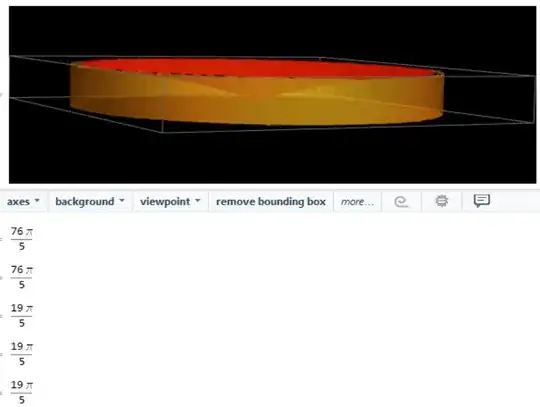
enter image description here

Original Answer

I am not sure whether the following or its complement is desired. The following is based on sections as "circular disks". If the full paraboloid is desired then double. Note can also use volume of paraboloid: $V_\text{paraboloid}= \pi a^2 h/2$ ( $a=1$,$h=\sqrt{19}$, $\mapsto \sqrt{19}\pi/2$ ):

Cylindrical coordinates:

Integrate[r, {t, 0, Pi}, {r, 0, 1}, {z, 0, Sqrt[19] r^2}]

Implicit region:

reg = ImplicitRegion[
   0 < (y^2 + z^2) < 
    x/Sqrt[19], {{x, 0, Sqrt[19]}, {y, 0, 1}, {z, -1, 1}}];
RegionPlot3D[reg, BoxRatios -> Automatic, Background -> Black]
Volume[reg]
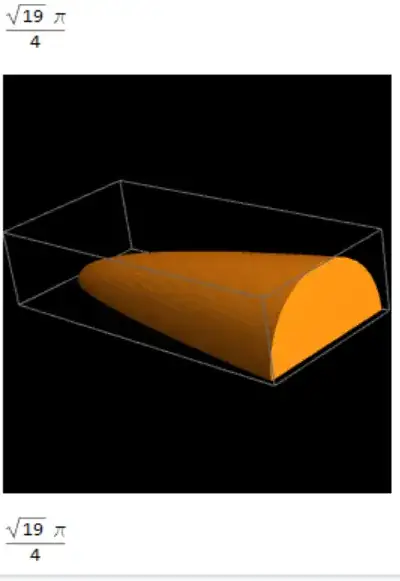
enter image description here

ubpdqn
  • 60,617
  • 3
  • 59
  • 148
  • Thank you for your response, however, I am looking for the volume created by disks that are perpendicular to the region between the curve $y =1$ and $x=\sqrt{19}y^2$ and not between $x=0$ and $x=\sqrt{19}y^2$. The figure should look differently. Although I appreciate your response! I still learned a new thing! Thank you. – user372003 Jan 21 '17 at 09:44
  • The volume that is given by your code is $\frac{19\pi}{5}$, instead the real volume of the figure is $\frac{\pi\sqrt{19}}{24}\approx0.57058$. Therefore, I presume there is a mistake in the way you designed your code. – user372003 Jan 21 '17 at 22:40
  • @user372003 thank you. I had a feeling a made a mistake. I will look at when I get time. Could you post what derivation you used. – ubpdqn Jan 21 '17 at 22:43
  • I believe that you revolved the region, given by the equations, around the y-axis:$\int^1_0\pi\left(\sqrt{19}y^2\right)^2dy = \frac{19}{5}$ Therefore, what you did would be correct if it was a solid of revolution I was looking for. Instead I am asking for the volume created by the infine summation of disks whose radiuses are given by $\frac{1}{2}\left(1-\frac{\sqrt{x}}{19^{\frac{1}{4}}}\right)$ – user372003 Jan 21 '17 at 23:16
  • @user372003 sorry for second misinterpretation and the clarification...i will work on when time permits. I am off to breakfast with my children at their place – ubpdqn Jan 21 '17 at 23:19
  • No hurry! Thank you again. – user372003 Jan 21 '17 at 23:21
  • @user372003 I have an answer for (I hope) the correct region and get your answer. Will post when I get access to computer. – ubpdqn Jan 22 '17 at 00:35