13

My goal is to link the curvature of a bent stack of paper in a wind tunnel to its bending modulus $B$, knowing all the other physical properties. To this end, I would like to reproduce the numerical simulation in P. Buchak, C. Eloy and P. M. Reis, Phys. Rev. Lett. 105, 194301 (2010), also available here.

With $s$ the curvilinear abscissa along the stack, and $\theta(s)$ the angle between the stack and horizontal at $s$, the curvature of the stack should be governed by:

Fx'[s] == 
  -rhoa*U^2*W*Sin[theta[s]]*(N[Pi,10]/4*W*Cos[theta[s]]^2*theta'[s] - 
    0.5*Cd*Sin[theta[s]]^2)

Fy'[s] == 
  -rhoa*U^2*W*Cos[theta[s]]*(0.5*Cd*Sin[theta[s]]^2 - 
    N[Pi,10]/4*W*Cos[theta[s]]^2*theta'[s])+sigmap*9.81*W

B*W*theta''[s] == Sin[theta[s]]*Fx[s] - Cos[theta[s]]*Fy[s]

with the following boundary conditions:

Fx[L] == 0,Fy[L] == 0,theta[0] == 0,theta'[L] == 0

where $L$ is the length of the stack.

The other parameters are: $U$ (wind speed), $\rho_a$ (density of air), $W$ (stack width), $C_d$ (drag coefficient), $\sigma_p$ (area density of stack) — all of which I know experimentally — and $B$ (bending modulus) which I am looking for.

I tried to compute these equations using Mathematica's NDSolve.

sol = 
  NDSolve[{(*equations*),(*boundary conditions*)}, {Fx, Fy, theta}{s, 0, L},
    MaxSteps -> Infinity, InterpolationOrder-> All];

and plotted the expected shape of the stack.

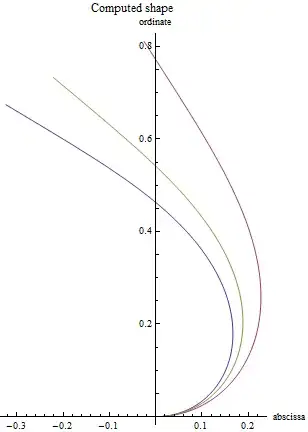
The result is that... it doesn't match at all! (the following figures correspond to $U=5m\cdot s^{-1}$)

figure 1

figure 2

Furthermore, the code can lead to very surprising results for high wind speed! (the following figure corresponds to $U = 10m\cdot s^{-1}$ and $L = 0.3m$, all the other parameters being unchanged)

figure 3

Are there other computational methods which would work to solve this ODE system, or more efficient and accurate options to use with NDSolve?

-------- EDIT --------

As requested, I provide here a complete Mathematica code.

The governing equations of my system can be rewritten as

Fx'[s] == Sin[theta[s]](0.5*Cd*Cy*Sin[theta[s]]^2-
        0.25*N[Pi,10]*lambda*Cy*Cos[theta[s]]^2*theta'[s])
Fy'[s] == -Cos[theta[s]](0.5*Cd*Cy*Sin[theta[s]]^2-
       0.25*N[Pi,10]*lambda*Cy*Cos[theta[s]]^2*theta'[s])+Delta
theta''[s] == Sin[theta[s]]*Fx[s]-Cos[theta[s]]*Fy[s]

and have the same boundary conditions as previously.

The algorithm now has 4 adimensionned parameters: $C_d = 1.76$ (drag coefficient), $C_y = \frac{\rho_aU^2L^3}{B}$ (Cauchy number, $C_y > 18.5$), $\lambda = \frac{W}{L}$ (aspect ratio, $0.1 < \lambda < 0.5$) and $\Delta = \frac{\sigma_pgL^3}{B}$ (elastrogravity number, $0.1 < \Delta < 20$).

(* PARAMETERS *)
Cd = 1.76; (* drag coefficient *)
Cy = 90; (* Cauchy number *)
lambda = 0.4; (* aspect ratio *)
Delta = 1; (* elastogravity number *)

(* SIMULATION *)
sol = NDSolve[{Fx'[s]==Sin[theta[s]](0.5*Cd*Cy*Sin[theta[s]]^2-
               0.25*N[Pi,10]*lambda*Cy*Cos[theta[s]]^2*theta'[s]),
               Fy'[s]==-Cos[theta[s]](0.5*Cd*Cy*Sin[theta[s]]^2-
               0.25*N[Pi,10]*lambda*Cy*Cos[theta[s]]^2*theta'[s])+Delta,
               theta''[s]==Sin[theta[s]]*Fx[s]-Cos[theta[s]]*Fy[s],
               Fx[1]==0,Fy[1]==0,theta[0]==0,theta'[1]==0},{Fx,Fy,theta},
               {s,0,1},MaxSteps->Infinity,InterpolationOrder->All];
(* résolution du système *)

(* PLOT *)
ParametricPlot[{Integrate[Cos[Evaluate[theta[t] /. sol][[1]]], {t,0,s}],
                Integrate[Sin[Evaluate[theta[t] /. sol][[1]]],{t,0,s}]},
               {s, 0, 1},AspectRatio->1,AxesLabel->{"abscissa","ordinate"},
               PlotLabel->"Computed shape"]

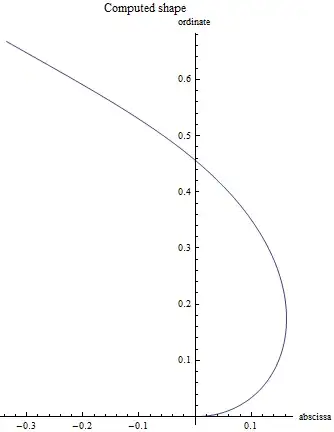
The (* PLOT *) section returns a graph of the computed shape of the stack (ie, $y = \int_0^1 ds \sin(\theta)$ vs. $x = \int_0^1 ds \cos(\theta)$).

Executing this script gave me the following graph

figure 4

which does not match the experimental observations (see 1st figure of the question).

Thanks for your help!

J. M.'s missing motivation
  • 124,525
  • 11
  • 401
  • 574
yketa
  • 133
  • 7
  • 1
    Please give all the numerical values for your parameters in your code, and show the exact code snipped that you used to generate those plots. – MarcoB Feb 24 '17 at 23:55
  • 2
    I'm going to upvote this question and at the same time vote to put this on hold as long as you don't provide the additional numerical values for the parameters. It is a very interesting question, although I'm not sure someone can help you without studying the paper (which is too much for the common user). Nevertheless, except for the missing parameters, your questions is very well written and extremely interesting. – halirutan Feb 25 '17 at 04:09
  • The numerical values I used to test the code where the ones provided on figure 1 (from the paper): rhoa=1.225[kg.m-3], W=0.029[m], Cd=1.76, sigmap=0.0391[kg.m-2], B=0.0082759[N.m], L=0.15 to 0.3[m], U=5 to 10[m.s-1]. Thanks for your interest for my question! – yketa Feb 25 '17 at 05:46
  • @yketa what thing doesn't match? – zhk Feb 25 '17 at 05:55
  • The computed shape of the stack looks physical at U [wind speed] = 5m.s-1 but does not match the experimental result in the 1st figure of the paper (nor the model). Furthermore, the computed shape of the stack does not look physical at all at U = 10m.s-1, this is what concerns me! – yketa Feb 25 '17 at 06:03
  • @yketa You should share complete code, it will make life easy to verify. – zhk Feb 25 '17 at 06:05
  • 2
    @yketa you should edit your question and include are the relevant information. – zhk Feb 25 '17 at 06:39
  • I can't reproduce your result: Mathematica graphics – xzczd Feb 27 '17 at 06:09
  • @xzczd First, thank you very much for your interest in my question! Then, what numerical values did you use? Your results look one of my simulation at low $C_y$, (here $C_y = 20$ with the same other parameters) with the abscissa axis upside down. Furthermore, it looks like $\int_0^1 \sqrt{dx^2 + dy^2} > 1$ while it should be exactly equal to 1. – yketa Feb 27 '17 at 06:30
  • @xzczd Maybe the difference of result has to do with something I have not coded right or something I did not initialize right. I am quite new to Mathematica and I have encountered a lot of these errors yet. – yketa Feb 27 '17 at 06:34
  • I just executed the code given in your question. You mean the parameters are from your experiment? Have you tried the parameters given in the paper? BTW, the normalized length is indeed 1: NIntegrate[Sqrt[Cos@theta@s^2 + Sin@theta@s^2] /. sol[[1]], {s, 0, 1}] – xzczd Feb 27 '17 at 07:09
  • I re-executed the code I provided and I still get the same figure. Weird... I used parameters both from my experiment and from the paper and I obtained similar results. I also just happened to get a figure with the abscissa axis turned upside down, just as you did. However, both situations should be physically equivalent. Is it possible for Mathematica not to give the same result every time? – yketa Feb 27 '17 at 07:22
  • Almost impossible. I suggest you to place all the code in one cell and execute. – xzczd Feb 27 '17 at 07:54
  • 1
    This is exactly what I have done. My equations are not linear, therefore there might be different solutions for the same boundary conditions. NDSolve may always return the same solution, but is there a way to look for others? – yketa Feb 27 '17 at 08:07

1 Answers1

11

yketa's guess is right. This nonlinear boundary value problem (BVP) has multiple solutions, and we need to manually set proper initial guess for "Shooting" method to get the desired result. Let me reproduce FIG.2 in the paper:

(* Parameters are taken from the paper. *)
Ulst = {111/10, 65/10, 88/10};
g = 981/100;
rhoa = 129/100;
L = 15 10^-2;
W = 29/10 10^-2;
BW = 24 10^-5;
rhophW = 114/1000/10^3 10^2;
rhoph = rhophW/W;
B = BW/W;
Delta = rhoph g L^3/B;
lambda = W/L;
Cd = 176/100;
Cy = rhoa U^2 L^3/B;

k = 1/2 Cd Cy Sin[theta[s]]^2 - Pi/4 lambda Cy Cos[theta[s]]^2 theta'[s];

(* The integration can be computed inside NDSolve, too. *)
add = {intSin'[s] == Sin@theta[s], intSin[0] == 0, intCos'[s] == Cos@theta[s], 
   intCos[0] == 0};

Clear[sol, U]
shoot[ic_] := {"Shooting", "StartingInitialConditions" -> ic};
sol[var_] := Block[{U = var}, First@NDSolve[{
      Fx'[s] == Sin[theta[s]] k,
      Fy'[s] == -Cos[theta[s]] k + Delta,
      theta''[s] == Sin[theta[s]] Fx[s] - Cos[theta[s]] Fy[s],
      Fx[1] == 0, Fy[1] == 0, theta[0] == 0, theta'[1] == 0, add}, 
       {Fx, Fy, theta, intSin, intCos}, {s, 0, 1}, 
     Method -> shoot@{Fx[1] == 0, Fy[1] == 0, theta[1] == 3, 
        theta'[1] == 0, intSin[1] == 0, intCos[1] == 0}]];

ParametricPlot[{intCos@s, intSin@s} /. sol /@ Ulst // Evaluate, {s, 0, 1}, 
 AxesLabel -> {"abscissa", "ordinate"}, PlotLabel -> "Computed shape"]

Mathematica graphics


In the code piece above, I simply dope out the proper initial guess intuitively, but this can actually be done in a systematic way for your problem. Let me show you the way with the parameters given in your question as an example.

We first set up a initial value problem with ParametricNDSolveValue:

Cd = 1.76;(*drag coefficient*)
Cy = 90;(*Cauchy number*)
lambda = 0.4;(*aspect ratio*)
Delta = 1;(*elastogravity number*)
k = 1/2 Cd Cy Sin[theta[s]]^2 - Pi/4 lambda Cy Cos[theta[s]]^2 theta'[s];
add = {intSin'[s] == Sin@theta[s], intSin[0] == 0, intCos'[s] == Cos@theta[s], 
   intCos[0] == 0};
test = ParametricNDSolveValue[{
    Fx'[s] == Sin[theta[s]] k,
    Fy'[s] == -Cos[theta[s]] k + Delta,
    theta''[s] == Sin[theta[s]] Fx[s] - Cos[theta[s]] Fy[s],
    Fx[1] == 0, Fy[1] == 0,(*,theta[0]\[Equal]0*)theta[1] == par, 
    theta'[1] == 0}, {Fx, Fy, theta}, {s, 0, 1}, par];

Then we need to find out all the possible values of par that result in theta[0] == 0. (It is not hard for your specific problem because 0 < par <2 Pi according to the model. ) This job can be done by e.g. RootSearch, but here I'll just do it in a more basic way i.e. by observing the graph:

Plot[test[par][[3]][0], {par, 0, 2 Pi}, PlotRange -> 1]

Mathematica graphics

From the graph we can see 3 (4?) possible solutions. We try them from right to left:

rst = NDSolve[{
    Fx'[s] == Sin[theta[s]] k,
    Fy'[s] == -Cos[theta[s]] k + Delta,
    theta''[s] == Sin[theta[s]] Fx[s] - Cos[theta[s]] Fy[s],
    Fx[1] == 0, Fy[1] == 0, theta[0] == 0, theta'[1] == 0, add}, {Fx, Fy, 
    theta, intSin, intCos}, {s, 0, 1}, 
   Method -> shoot@{Fx[1] == 0, Fy[1] == 0, theta[1] == 2.6, 
      theta'[1] == 0, intSin[1] == 1, intCos[1] == 1}];

ParametricPlot[{intCos@s, intSin@s} /. rst // Evaluate, {s, 0, 1}, 
 AxesLabel -> {"abscissa", "ordinate"}, PlotLabel -> "Computed shape"]

Mathematica graphics

OK, the right-most root is the one we need.

xzczd
  • 65,995
  • 9
  • 163
  • 468
  • Thank you so very much for your answer and your time! All seems a lot clearer now! – yketa Feb 27 '17 at 15:12
  • @yketa You're welcome. I wouldn't have found out the answer so quickly if you hadn't pointed out the possibility of existence of multiple solutions :) – xzczd Feb 27 '17 at 16:25