I have a nonlinear set of equations with a boundary condition at infinity. Consequently I have to shoot for the boundary. This question has some good ideas but there is an extra complication in my case; my boundary conditon at infinity is the second derivative going to zero and this is approached asymptotically. I will have more problems the same and this is minimum example I can demonstrate.
The equations and initial conditions at zero are here
eqns = {-Derivative[3][a[0]][η] == (-(1/2))*α*
           (-1 + 2*Derivative[1][a[0]][η]^2 + Derivative[1][a[1]][η]^2 +
              Derivative[1][a[2]][η]^2 + Derivative[1][b[1]][η]^2 +
              Derivative[1][b[2]][η]^2 -
       2*a[0][η]*Derivative[2][a[0]][η] -
              a[1][η]*Derivative[2][a[1]][η] - a[2][η]*Derivative[2][a[2]][
                  η] - b[1][η]*Derivative[2][b[1]][η] -
              b[2][η]*Derivative[2][b[2]][η]),
       Derivative[1][b[1]][η] - Derivative[3][a[1]][η] ==
         (1/2)*(-4*α*Derivative[1][a[0]][η]*Derivative[1][a[1]][η] -
              2*α*Derivative[1][a[1]][η]*Derivative[1][a[2]][η] -
              2*α*Derivative[1][b[1]][η]*Derivative[1][b[2]][η] +
              2*α*a[1][η]*Derivative[2][a[0]][η] +
       2*α*a[0][η]*
                Derivative[2][a[1]][η] + α*a[2][η]*
        Derivative[2][a[1]][η] +
              α*a[1][η]*Derivative[2][a[2]][η] + α*b[2][η]*
                Derivative[2][b[1]][η] + α*b[1][η]*
        Derivative[2][b[2]][η]),
       1 - Derivative[1][a[1]][η] - Derivative[3][b[1]][η] ==
         (1/2)*(-4*α*Derivative[1][a[0]][η]*Derivative[1][b[1]][η] +
              2*α*Derivative[1][a[2]][η]*Derivative[1][b[1]][η] -
              2*α*Derivative[1][a[1]][η]*Derivative[1][b[2]][η] +
              2*α*b[1][η]*Derivative[2][a[0]][η] +
              α*b[2][η]*Derivative[2][a[1]][η] - α*b[1][η]*
                Derivative[2][a[2]][η] +
       2*α*a[0][η]*Derivative[2][b[1]][η] -
              α*a[2][η]*Derivative[2][b[1]][η] + α*a[1][η]*
                Derivative[2][b[2]][η]), 2*Derivative[1][b[2]][η] -
           Derivative[3][a[2]][η] ==
         (1/2)*(α - α*Derivative[1][a[1]][η]^2 -
              4*α*Derivative[1][a[0]][η]*Derivative[1][a[2]][η] +
              α*Derivative[1][b[1]][η]^2 +
       2*α*a[2][η]*Derivative[2][a[0]][
                  η] + α*a[1][η]*Derivative[2][a[1]][η] +
              2*α*a[0][η]*Derivative[2][a[2]][η] -
              α*b[1][η]*Derivative[2][b[1]][η]),
       -2*Derivative[1][a[2]][η] - Derivative[3][b[2]][η] ==
         (1/2)*(-2*α*Derivative[1][a[1]][η]*Derivative[1][b[1]][η] -
              4*α*Derivative[1][a[0]][η]*Derivative[1][b[2]][η] +
              2*α*b[2][η]*Derivative[2][a[0]][η] +
              α*b[1][η]*Derivative[2][a[1]][η] + α*a[1][η]*
                Derivative[2][b[1]][η] + 2*α*a[0][η]*Derivative[2][b[2]][
                  η])};
ic0 = {a[0][0] == 0, Derivative[1][a[0]][0] == 0, a[1][0] == 0,
       b[1][0] == 0, Derivative[1][a[1]][0] == 0, Derivative[1][b[1]][0] ==
         0, a[2][0] == 0, b[2][0] == 0, Derivative[1][a[2]][0] == 0,
       Derivative[1][b[2]][0] == 0};
I then have a shooting function that determines the values of the second derivative at a point that is getting towards infinity.
ClearAll[shoot];
shoot[{(a0_)?NumberQ, a1_, b1_, a2_, b2_}, inf_] :=
   (sol = First[NDSolve[Evaluate[Join[eqns, ic0,
                 {DerivatClearAll[shoot];
shoot[{(a0_)?NumberQ, a1_, b1_, a2_, b2_}, inf_] :=
   (sol = First[NDSolve[Evaluate[Join[eqns, ic0,
                 {Derivative[2][a[0]][0] == a0, Derivative[2][a[1]][0] == a1,
                   Derivative[2][b[1]][0] == b1, Derivative[2][a[2]][0] == a2,
                   Derivative[2][b[2]][0] == b2}] /. {α -> 0.1}],
           {a[0], a[1], b[1], a[2], b[2], Derivative[2][a[0]],
             Derivative[2][a[1]], Derivative[2][b[1]], Derivative[2][a[2]],
             Derivative[2][b[2]]}, {η, 0, inf}]];
     res = {Derivative[2][a[0]], Derivative[2][a[1]], Derivative[2][b[1]],
           Derivative[2][a[2]], Derivative[2][b[2]]} /. sol;
     (#1[inf] & ) /@ res)
By playing around I have found some good starting values and when I use these with infinity set to 9 everything works.
starts = {{a0, 0.054}, {a1, 0.704}, {b1, -0.702}, {a2, 0.021}, {b2,
    0.020}};
inf = 9;
rts = FindRoot[shoot[{a0, a1, b1, a2, b2}, inf] == {0, 0, 0, 0, 0},
   starts];
shoot[{a0, a1, b1, a2, b2} /. rts, inf]
{-6.60792*10^-14, 5.00619*10^-13, 3.11087*10^-13, -3.76011*10^-13, 1.65523*10^-13}
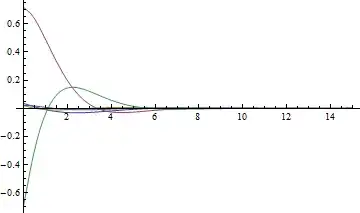
If I plot the second derivative I can see that it goes to zero.
Join[{Plot[Evaluate[{a[0]''[η]} /. sol], {η, 0, inf},
   PlotRange -> All]},
 Table[
  Plot[Evaluate[{a[n]''[η], b[n]''[η]} /. sol], {η, 0,
    inf}, PlotRange -> All],
  {n, 1, 2}
  ]
 ]

However my infinity is not big enough. If I increase it to say 10 or more I get
inf = 10;
rts = FindRoot[shoot[{a0, a1, b1, a2, b2}, inf] == {0, 0, 0, 0, 0},
   starts];
shoot[{a0, a1, b1, a2, b2} /. rts, inf]
FindRoot::lstol: The line search decreased the step size to within tolerance specified by AccuracyGoal and PrecisionGoal but was unable to find a sufficient decrease in the merit function. You may need more than MachinePrecision digits of working precision to meet these tolerances.
If one runs the integration on from the results with inf = 9 then one can see that the second derivative was made to pass through the point 9 but is not zero subsequently. Here I have run the inf = 9 case to get the roots but now solve and plot using these values for inf = 15.
inf = 15;
sol = First@NDSolve[Evaluate[Join[eqns, ic0,
       {(a[0]'')[0] ==
         a0, (a[1]'')[0] ==
         a1, (b[1]'')[0] == b1,
        (a[2]'')[0] ==
         a2, (b[2]'')[0] == b2}] /.
      Join[{α -> 0.1}, rts]],
    {a[0], a[1], b[1], a[2], b[2], a[0]'', a[1]'', b[1]'', a[2]'',
     b[2]''}, {η, 0, inf}];
Join[{Plot[Evaluate[{a[0]''[η]} /. sol], {η, 0, inf},
   PlotRange -> All]},
 Table[
  Plot[Evaluate[{a[n]''[η], b[n]''[η]} /. sol], {η, 0,
    inf}, PlotRange -> All],
  {n, 1, 2}
  ]
 ]

So I have failed to get the asymptotic solution. I have tried integrating over an interval at large values of η and then using FindMinimum but this does not give good results.
Do you have any further ideas? Thanks


tutorial/NDSolveBVPhas mentioned that, "some initial value problems with growing modes are inherently unstable even though the BVP itself may be quite well posed and stable", and I think your equation system happens to belong to this type. As to the derivative, sadly it's not possible to extract them directly AFAIK. (You see, FDM only solves for the function value. ) – xzczd Nov 29 '17 at 13:11pdetoaeis not limited to rectangular grid, it can handle all the regular domain (e.g. a circle) in principle. 2. I'm not quite sure about the meaning of "altering the difference equations", but the 2 methods should be equivalent if you mean "eliminating some of the variables from the difference equation system using b.c.", I prefer using the discretized b.c. as additional equations because it doesn't disarrange the variables so the rebuilding process will be easier. 3. Sadly I have no tool for nonlinear problem on irregular grid at the moment. – xzczd Dec 01 '17 at 10:56pdetoaeor FDM? As topdetoae, I think its usage is straightforward if one has a basic understanding for FDM, but if you still find it confusing, feel free to ask. As to FDM, I recommend reading Chapter 5 of Introduction to Partial Differential Equations by Peter J. Olver. You can also checktutorial/NDSolvePDEin Mathematica document, that tutorial is quite long and somewhat obscure, but at least the first example therein is relatively simple. – xzczd Dec 01 '17 at 11:431/4and0.25won't match. One possible workaround is using abitrary precision number like0.25\4`. ) – xzczd Feb 23 '18 at 12:12aebc = ptoafunc@{ic0, bc};I sometimes get thousands of equations rather than just a few for the boundary conditions. – Hugh Feb 23 '18 at 12:15