Given two lists like
list1 = {{1, 1}, {2, 4}, {3, 9}, {4, 16}};
list2 = {{2, 6}, {3, 9}, {4, 12}, {5, 15}};
I would like to produce an output like
listout = {{2, {4, 6}}, {3, {9, 9}}, {4, {16, 12}}}
Given two lists like
list1 = {{1, 1}, {2, 4}, {3, 9}, {4, 16}};
list2 = {{2, 6}, {3, 9}, {4, 12}, {5, 15}};
I would like to produce an output like
listout = {{2, {4, 6}}, {3, {9, 9}}, {4, {16, 12}}}


Good question. Second try.
f1[a_List, b_List] :=
   Reap[Sow[#2, #] & @@@ a ~Join~ b, a[[All, 1]] ⋂ b[[All, 1]], List][[2, All, 1]]
Pick:
f2[a_List, b_List] :=
 With[{aa = a[[All, 1]], bb = b[[All, 1]]},
   {#[[1, 1]], #[[All, 2]]} & /@
      Pick[a ~Join~ b, aa ~Join~ bb, Alternatives @@ (aa ⋂ bb)] ~GatherBy~ First
 ]
Edit: Here is another method using GatherBy. While this method did not come to mind when I first wrote this answer I have used related methods for some time. It works by preconditioning GatherBy so that we collect the expressions we want at the beginning of the results and then discarding the rest. This is the same principle I used for How to Delete Elements from List1 appearing in List2? and more recently Complement on pre-sorted lists, and which jVincent used for Counting the population of integers.
f3[a_List, b_List] :=
  With[{pre = List /@ ( a[[All, 1]] ⋂ b[[All, 1]] )},
    {pre[[All, 1]], GatherBy[Join[pre, a, b], First][[;; Length@pre, 2 ;;, 2]]}\[Transpose]
  ]
At the expense of greater code length this can be made faster by using Szabolcs's inversion method with GatherBy:
f4[a_List, b_List] :=
 Module[{pre, first, all, n, a1, b1},
   {a1, b1} = {a[[All, 1]], b[[All, 1]]};
   n = Length[pre = a1 ⋂ b1];
   first = Join[pre, a1, b1];
   all = Join[a, b];
   {pre, Map[all[[#, 2]] &,
      GatherBy[Range@Length@first, first[[#]] &][[;; n, 2 ;;]] - n]}\[Transpose]
 ]
Test:
list1 = {{1, 1}, {2, 4}, {3, 9}, {4, 16}};
list2 = {{2, 6}, {3, 9}, {4, 12}, {5, 15}, {5, 7}};

f1[list1, list2]
{{2, {4, 6}}, {3, {9, 9}}, {4, {16, 12}}}
I included {5, 7} in list2 to show that this is finding the intersection of the two lists and not merely repeats within a single list.
this works for the given example:
ReplaceList[{list1, list2}, {{___, {a_, b_}, ___}, {___, {a_, c_}, ___}} :> {a, {b, c}}]

(* {{2, {4, 6}}, {3, {9, 9}}, {4, {16, 12}}} *)
RuleDelayed (:>) when working with named patterns on the right-hand side. This correctly localizes the symbols. I made this edit for you; I hope you don't mind.
– Mr.Wizard
Dec 17 '12 at 07:56
Update 3: A generalization for any number of lists and any column as the key:
 ClearAll[combineBy];
 combineBy[lists : __List, col_Integer] /; (col <= Min[Length /@ # & /@ {lists}]) :=
  With[{intNodes =  Alternatives @@ Intersection @@ (#[[col]] & /@ # & /@ {lists}),
  joined = GatherBy[Join[lists], #[[col]] &],
  othercols = DeleteCases[Range[Min[Length /@ # & /@ {lists}]], col]},
  {#[[1, col]], Join @@ #[[All, othercols]]} & /@
     Pick[joined, ! FreeQ[#[[1, col]], intNodes] & /@ joined]]
OP's example:
  list1 = {{1, 1}, {2, 4}, {3, 9}, {4, 16}};
  list2 = {{2, 6}, {3, 9}, {4, 12}, {5, 15}, {5, 7}};
  combineBy[list1, list2, 1]
  (* {{2, {4, 6}}, {3, {9, 9}}, {4, {16, 12}}} *)
  combineBy[list1, list2, 2]
  (* {{9, {3, 3}}} *)
More examples:
  list3 = Table[RandomSample[Range[7], 3], {3}];
  list4 = Table[RandomSample[Range[7], 3], {4}];
  list5 = Table[RandomSample[Range[7], 3], {6}];

  Prepend[Prepend[{SpanFromAbove, SpanFromAbove,  #,
   Column[combineBy[list4, list5, #]]} & /@ {2, 3},
   {Column@list4, Column@list5, 1, Column[combineBy[list4, list5, 1]]}],
   {"list4", "list5", "key column", "result"}] //
   Grid[#, Alignment -> {Center, Center}, Dividers -> All] &
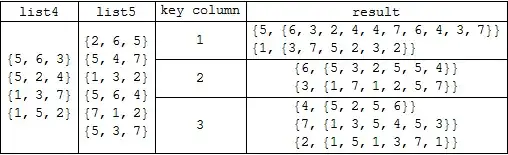
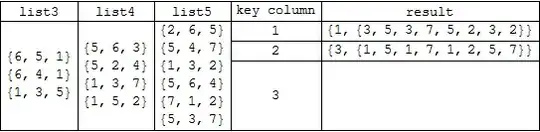
  Prepend[Prepend[{SpanFromAbove, SpanFromAbove, #,
   Column[combineBy[list3, list4, #]]} & /@ {2, 3},
   {Column@list3, Column@list4, 1, Column[combineBy[list3, list4, 1]]}],
   {"list3", "list4", "key column", "result"}] //
   Grid[#, Alignment -> {Center, Center}, Dividers -> All] &

  Prepend[Prepend[{SpanFromAbove, SpanFromAbove,  #,
   Column[combineBy[list3, list5, #]]} & /@ {2, 3},
   {Column@list3, Column@list5, 1,  Column[combineBy[list3, list5, 1]]}],
   {"list3", "list5", "key column", "result"}] //
   Grid[#, Alignment -> {Center, Center}, Dividers -> All] &

  Prepend[Prepend[{SpanFromAbove, SpanFromAbove, SpanFromAbove,  #,
     Column[combineBy[list3, list4, list5, #]]} & /@ {2, 3},
    {Column@list3, Column@list4, Column@list5, 1,
      Column[combineBy[list3, list4, list5, 1]]}],
    {"list3", "list4", "list5", "key column", "result"}] //
   Grid[#, Alignment -> {Center, Center}, Dividers -> All] &
  ClearAll[combine];
  combine[list1_List, list2_List] :=
  With[{intNodes = Intersection[First /@ list1, First /@ list2],
    joined =  GatherBy[Join[list1, list2], First]},
    {First[First@#],  Last[#]} & /@ (Transpose /@
    Select[joined, MemberQ[intNodes, #[[1, 1]]] &])]

 combine[list1, list2]
 (* {{2, {4, 6}}, {3, {9, 9}}, {4, {16, 12}}} *)
 combine[list1, {{2, 6}, {3, 9}, {4, 12}, {5, 15}, {5, 7}}]
 (* {{2, {4, 6}}, {3, {9, 9}}, {4, {16, 12}}} *)
(Updated with correction thanks to @Mr.W's comment: the second argument of Select is changed from Length[#]>2& in the original post to the correct version that accounts for the intersection of the first columns of the two lists.)
Update 2: Using Pick instead of Select:
ClearAll[combine2];
combine2[list1_List, list2_List] :=
 With[{intNodes = Intersection[First /@ list1, First /@ list2],
   joined =  GatherBy[Join[list1, list2], First]},
 {#[[1, 1]], #[[-1]]} & /@
  (Transpose /@ Pick[joined, MemberQ[intNodes, #[[1, 1]]] & /@ joined])]

Pick myself. See the comments below my answer. Great minds and all that.
– Mr.Wizard
Dec 17 '12 at 07:12
Cases, Select,Pick), Pick is almost always the first that I try ... and it rarely disappoints.
– kglr
Dec 17 '12 at 07:38
I like this one:
{#[[1,1]],#[[All,2]]}&/@Select[GatherBy[list1~Join~list2,First],Length[#]>1&]

(*{{2,{4,6}},{3,{9,9}},{4,{16,12}}}*)

Edit 1
processList[list1_, list2_] := Module[{intersection, tmp1, tmp2},

 (* find the intersection of the all the first elements *)
  intersection = Intersection[list1[[All, 1]], list2[[All, 1]]];

 (* now find cases in each list in which the first element is one of the intersecting
  elements *)
  tmp1 = Cases[list1, {x_ /; MemberQ[intersection, x], __}];
  tmp2 = Cases[list2, {x_ /; MemberQ[intersection, x], __}];

  (* now gather all sub-lists based on the first element and map them to give the
  desired output *)
  {#[[1, 1]], ##[[All, 2]]} & /@ GatherBy[Join[tmp1, tmp2], First]
  ]
test:
processList[list1, {{2, 6}, {3, 9}, {4, 12}, {5, 15}, {5, 7}}]
(* {{2, {4, 6}}, {3, {9, 9}}, {4, {16, 12}}} *)
Edit 2
Since we're onto Pick methods :) ...this seems relatively concise. Two steps from above and then pick out the elements for output.
processList2[list1_, list2_] := Module[{intersection, tmp},

  intersection = Intersection[list1[[All, 1]], list2[[All, 1]]];
  tmp = {#[[1, 1]], ##[[All, 2]]} & /@ GatherBy[Join[list1, list2], First];
  Pick[tmp, tmp[[All, 1]] /. Thread[Rule[intersection, True]]]
  ]

list2 = {{2, 6}, {3, 9}, {4, 12}, {5, 15}, {5, 7}};
processList2[list1, list2]
(* {{2, {4, 6}}, {3, {9, 9}}, {4, {16, 12}}}  *)
For all of these Pick methods I'm not sure how efficient creating the stencil can be for this particular problem. If the stencil is efficiently created then Pick is a fast way of picking out elements from lists.

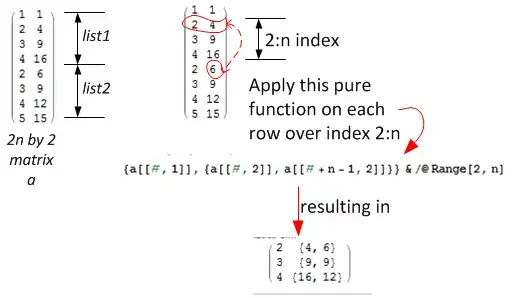
a = Join[list1, list2]
n = Length[list1];
{a[[#, 1]], {a[[#, 2]], a[[# + n - 1, 2]]}} & /@ Range[2, n]

Explanation: Use linear indexing. We have 2 matrices as input. list1 and list2. Each is an n by 2 size matrix. Joining them results in one 2n by 2 matrix called a. This diagram explains the algorithm

{2, 3, 4}?
– Andrew Cheong
Aug 25 '13 at 03:34
Just for fun, a rule-based approach:
list2/.{{i_Integer/;!MemberQ[list1[[All,1]],i],x_}:>Sequence[],{i_Integer,x_}:>{i,{i/.(Rule@@@list1),x}}}

Using Association - related functions (not yet available in 2012)
a = {{1, 1}, {2, 4}, {3, 9}, {4, 16}};
b = {{2, 6}, {3, 9}, {4, 12}, {5, 15}};
Cases[{, {, __}}] @
 KeyValueMap[List] @ Merge[# &] @ MapApply[Rule] @ Join[a, b]
{{2, {4, 6}}, {3, {9, 9}}, {4, {16, 12}}}

WolframLanguageData["GroupBy",
  {"VersionIntroduced",  "DateIntroduced"}]

a = {{1, 1}, {2, 4}, {3, 9}, {4, 16}};
b = {{2, 6}, {3, 9}, {4, 12}, {5, 15}};
MapApply[List] @
Normal @
Select[Length @ # > 1 &] @
GroupBy[Join[a, b], First -> Last]
{{2, {4, 6}}, {3, {9, 9}}, {4, {16, 12}}}
Map[{#[[1, 1]], Flatten @ #[[All, 2 ;;]]} &] @
Values @
Select[Length@# > 1 &] @
GroupBy[Join[a, b], First]
{{2, {4, 6}}, {3, {9, 9}}, {4, {16, 12}}}
WolframLanguageData["WolframLanguageData",
  {"VersionIntroduced",  "DateIntroduced"}]

Cases[KeyValueMap[List]@GroupBy[Join[list1,list2],First->Last],{a_,{b_,c__}}->{a,{b,c}}]

(* {{2,{4,6}},{3,{9,9}},{4,{16,12}}} *)
list1x = {{1, 1}, {2, 4}, {3, 9}, {4, 16}};
list2x = {{2, 6}, {3, 9}, {4, 12}, {5, 15},{2,100},{2,2},{2,1}};

Cases[KeyValueMap[List]@GroupBy[Join[list1x,list2x],First->Last],{a_,{b_,c__}}->{a,{b,c}}]

(* {{2,{4,6,100,2,1}},{3,{9,9}},{4,{16,12}}} *)


f2[a_, b_] := ({#1[[1, 1]], #1[[All, 2]]} & ) /@ GatherBy[ Cases[Join[a, b], {Alternatives @@ Intersection[a[[All, 1]], b[[All, 1]]], _}], First]– Mike Honeychurch Dec 17 '12 at 06:56ApplyAlternativecompares with theMemberQtest for larger lists. I normally useAlternativebut forgot all about it when I wrote my answer – Mike Honeychurch Dec 17 '12 at 06:57Alternativestest quite a bit faster thanMemberQfor me. For pure speed this seems best of what I've tried:Pick[#, First /@ #, Alternatives @@ inter] & @ Join[a, b]whereinteris the first elements intersection. – Mr.Wizard Dec 17 '12 at 07:10Pickwill generally provide a much faster solution than e.g.Cases/Selectif you can develop aPickmethod. – Mike Honeychurch Dec 17 '12 at 07:35