For constructing a sum of terms which are symbolic, I noticed that in addition to
Sum[f[i],{i,1,10}]

(* f[1] + f[2] + f[3] + f[4] + f[5] + f[6] + f[7] + f[8] + f[9] + f[10] *)
I can also do
Array[f,10,1,Plus]

(* f[1] + f[2] + f[3] + f[4] + f[5] + f[6] + f[7] + f[8] + f[9] + f[10] *)
or even Plus@@Table[f[i],{i,1,10}] or Total[Table[f[i],{i,1,10}]].
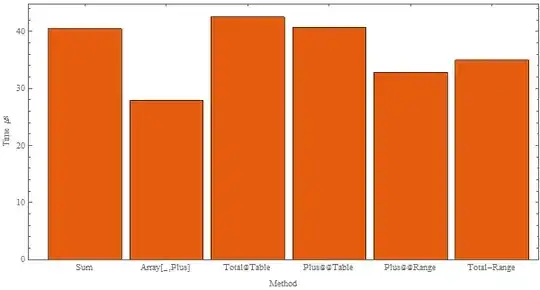
While it is not a huge surprise I'm able to achieve the same result using different functions in Mathematica, I'm wondering if there are specific use cases which prefers one form over another for the construction of a sum of symbolic terms. Right now all I can think of for Array is that there the local iterator i is not needed. But performance/memory-wise, is there something else I should be aware of?



a = 0; Table[a = a + 1; ToExpression[StringJoin["a" <> ToString[a]]][i, j], {i, 3}, {j, 3}]toa = 0; Array[a = a + 1; ToExpression[StringJoin["a" <> ToString[a]]], {3, 3}]. Old SO question – user1066 Jul 01 '18 at 07:30