I commented out some of the options, because they made it difficult for me to see what was exactly happening. [Edit: Change the texture pattern to a variable, to clarify how to modify it. A line pattern given at end.]
stripePattern =
  Graphics[{Red, Rectangle[{0, 0}, {1, 1/2}], Blue,
    Rectangle[{0, 1/2}, {1, 1}]}, PlotRangePadding -> 0];

Graphics3D[{Texture[stripePattern],
  Polygon[{{0, 0, 0}, {0, 2, 0}, {1, 2, 0}, {1, 0, 0}},
   VertexTextureCoordinates -> {{0, 0}, {1, 0}, {1, 4}, {0, 4}}]},
 Boxed -> False
 (*,Lighting->{{"Ambient",LightBlue}},ViewPoint->{0.2,0,0.2},RotationAction->"Clip"*)
]

If you have arbitrary polygons, then I don't know how to make the computation of VertexTextureCoordinates easily automatic. (One could compute a projection rather automatically I suppose.) @Mr.Wizard's answer might be easiest in that case.
Graphics3D[{Texture[stripePattern],
  Polygon[{{0, 0, 0}, {0, 0, 2}, {0, 2, 2}, {0, 3, 1}, {0, 2, 0}},
   VertexTextureCoordinates -> {{0, 0}, {1, 0}, {1, 4}, {1/2, 6}, {0, 4}}]},
 Boxed -> False
]
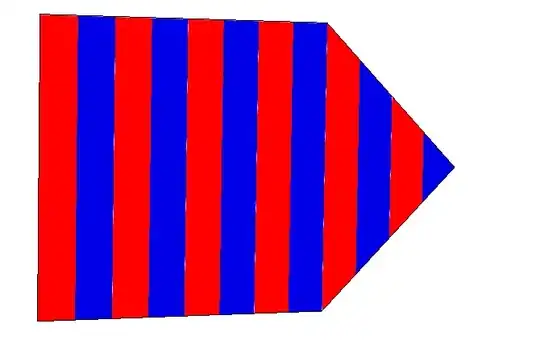
Addendum - Edited
Here's a projection function that projects the polygon onto the texture coordinate system. (Please excuse not putting in full error checking.)
I have edited the code to replace the pattern by lines instead of stripes, per the OP's query.
project[polygonVertices_, stripeDirection_, nStripeMultiplier_] :=
  Module[{normal, e1, e2},
    normal =
     Normalize@
      Catch[(If[Chop[#] != {0, 0, 0}, Throw[#]] &@(Cross @@ Differences[#])) & /@
         Partition[polygonVertices, 3, 1, 1];];
    e2 = normal\[Cross]Normalize[stripeDirection];
    e1 = e2\[Cross]normal;
    polygonVertices.Transpose[{e1, nStripeMultiplier e2}]
    ] /; Length[polygonVertices] >= 3;

linePattern =
  Graphics[{Thickness[0.15], Red, Line[{{0, 1/2}, {1, 1/2}}]},
   PlotRangePadding -> 0, PlotRange -> {{0, 1}, {0, 1}}];

With[{poly =
   Table[RandomReal[{1, 2}] {Cos[t], Sin[t],
      Cos[t] - 2 Sin[t]}, {t, π/6, 2 π, π/6}]},
 Graphics3D[{Texture[linePattern],
   Polygon[poly,
    VertexTextureCoordinates -> project[poly, {-2, -2, 2}, 4]]},
  Lighting -> {{"Ambient", White}}]
 ]


