One thing that you could do is to rescale your equation:
Clear[x, ξ, eq1, eq2, A];
eq1 = a x^(17/6) - b x^2 - 1 == 0
eq1 /. x -> A*ξ // PowerExpand
The result is:
-1 - A^2 b ξ^2 + a A^(17/6) ξ^(17/6) == 0
Choose A such that the factor in front of the largest power is unity:
s1 = Solve[a A^(17/6) == 1, A][[1, 1]];
Simplify[(eq1 /. x -> A*ξ /. s1) /. b -> c*a^(12/17), {A > 0, a > 0, b > 0}]
where c = b/a^(12/17). Now you have an equation with a single parameter, easy to solve. Here it is:
1 + c ξ^2 == ξ^(17/6)
You can define the interval of its variation, I cannot do that. For this reason to give an example I suppose that c varies from 0 to 2. Let us look at the solution. Evaluate this:
Plot[{1 + \[Xi]^2, ξ^(17/6)}, {ξ, 0, 3},
  PlotStyle -> {Red, Blue},
  AxesLabel -> {Style["\[Xi]"],
     Row[{Style["1+\!\(\*SuperscriptBox[\(\[Xi]\), \(2\)]\), ", Red],
     Style["\!\(\*SuperscriptBox[\(\[Xi]\), \(17/16\)]\)", Blue]}]}]
You will see this image: ![The image shows the intersection of the left- and right-hand parts of the equation in question]
There is a solution in the vicinity of ksi=1.5. Now we can make a list of numeric solutions of this equation. Evaluate this:
lst = Table[{c, FindRoot[1 + c*ξ^2 == ξ^(17/6), {ξ, 1.4}][[1, 2]]}, {c, 0.1, 2, 0.01}];
By plotting this list, one finds the dependence of solutions upon the value of the parameter c. Evaluating this:
ListPlot[Select[lst, #[[2]] ∈ Reals &],
   AxesLabel -> {Style["c", 14], Style["ξ", 14]},
   AxesOrigin -> {0, 0}]
One gets the following plot: ![Dependence of the solutions ksi upon the parameter c]![Dependence of the solution ksi upon the parameter c]![enter image description here]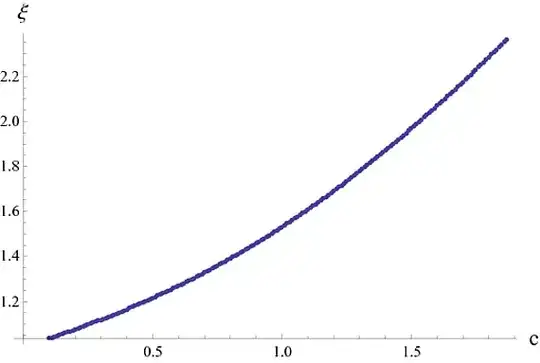
This is already the solution you are looking for. You can do somewhat more, however. If one fits the solution by some simple function on this interval of c, one finds (though approximate) an analytical and accurate solution that can be used in further analytical calculations, if any:
ft = Fit[Select[lst, #[[2]] ∈ Reals &], {1, c, c^2}, c]
which yields this:
1.00914 + 0.292415 c + 0.231262 c^2
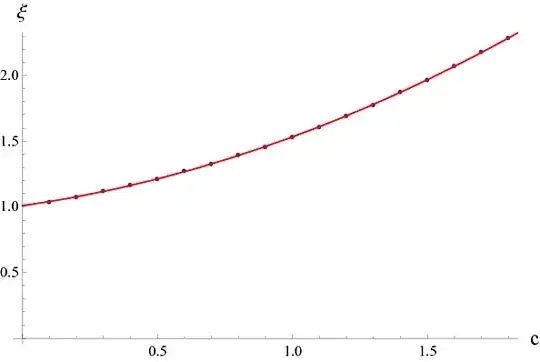
This is your solution. To see, how accurate it is, evaluate this:
Show[{
   ListPlot[Select[lst, #[[2]] ∈ Reals &],
      AxesLabel -> {Style["c", 14], Style["\[Xi]", 14]}],
   Plot[ft, {c, 0, 2}, PlotStyle -> Red]
}]
You will obtain the following plot:
Have fun.



SolveMathematica returns aRootobject, which indeed an analytical solution, as I know. And stated in documentation. – m0nhawk Feb 05 '13 at 07:37aandb. – Yves Klett Feb 05 '13 at 08:42