EDIT
The functions CoulombF[], CoulombG[], CoulombH1[], and CoulombH2[] are now built-in, starting from version 13.
Old version
The formulae here also allow for an expression in terms of the irregular Whittaker function WhittakerW[]:
CoulombPhase[ℓ_, η_] := (LogGamma[1 + ℓ + I η] - LogGamma[1 + ℓ - I η])/(2 I)
CoulombHPlus[ℓ, η, ρ_] :=
             Exp[π (η - I ℓ)/2 + I CoulombPhase[ℓ, η]] WhittakerW[-I η, ℓ + 1/2, -2 I ρ]
CoulombHMinus[ℓ, η, ρ_] :=
              Exp[π (η + I ℓ)/2 - I CoulombPhase[ℓ, η]] WhittakerW[I η, ℓ + 1/2, 2 I ρ]
Compare with OP's implementation (which has a different argument convention):
N[{CoulombHPlus[2/3, 3/4, 5], CoulombHplus[2/3, 4/3, 5 3/4]}]
   {-0.93049 + 0.597603 I, -0.93049 + 0.597603 I}
N[{CoulombHMinus[2/3, 3/4, 5], CoulombHminus[2/3, 4/3, 5 3/4]}]
   {-0.93049 - 0.597603 I, -0.93049 - 0.597603 I}
These are of course the complex-valued solutions (they are related to the real solutions in a way similar to the relationship of the Hankel functions with the Bessel functions); if one wants the real-valued irregular solution, this is easily done. For completeness, I will also include an implementation of the regular Coulomb function:
CoulombFactor[ℓ_, η_] :=
      Exp[-π (η + I (ℓ + 1))/2] Sqrt[Gamma[1 + ℓ - I η] Gamma[1 + ℓ + I η]]/(2 (2 ℓ + 1)!)
CoulombF[ℓ, η, ρ_] := CoulombFactor[ℓ, η] WhittakerM[I η, ℓ + 1/2, 2 I ρ]
CoulombG[ℓ, η, ρ_] := (CoulombHPlus[ℓ, η, ρ] + CoulombHMinus[ℓ, η, ρ])/2
Compare:
N[{(CoulombHPlus[2/3, 3/4, 5] - CoulombHMinus[2/3, 3/4, 5])/(2 I),
   CoulombF[2/3, 3/4, 5]}] // Chop
   {0.597603, 0.597603}
N[{(CoulombHPlus[2/3, 3/4, 5] + CoulombHMinus[2/3, 3/4, 5])/2,
   CoulombG[2/3, 3/4, 5]}] // Chop
   {-0.93049, -0.93049}
Replicate the plots here:
With[{ℓ = 0, η = Sqrt[15/2]},
     Plot[{CoulombF[ℓ, η, ρ], CoulombG[ℓ, η, ρ], Abs[CoulombHPlus[ℓ, η, ρ]]}, {ρ, 0, 30},
          PlotRange -> {-2, 5}, PlotStyle -> {Blue, Red, Green}]]

With[{ℓ = 5, η = 0},
     Plot[{CoulombF[ℓ, η, ρ], CoulombG[ℓ, η, ρ], Abs[CoulombHPlus[ℓ, η, ρ]]}, {ρ, 0, 30},
          PlotRange -> {-2, 5}, PlotStyle -> {Blue, Red, Green}]]
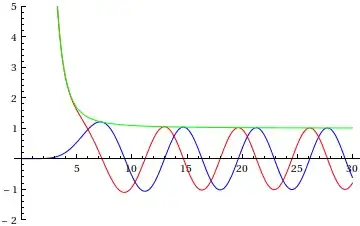
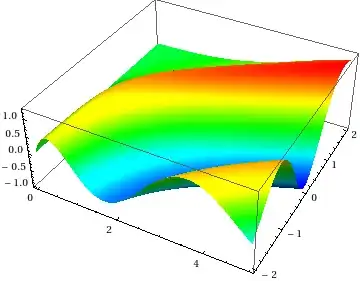
and the plots here:
(* from http://dlmf.nist.gov/help/vrml/aboutcolor;
   cf. https://mathematica.stackexchange.com/a/101933 *)
DLMFHeightColor = Hue[2 (1 - #)/3] &;
Plot3D[CoulombF[0, η, ρ], {ρ, 0, 5}, {η, -2, 2}, BoundaryStyle -> None,
       ColorFunction -> DLMFHeightColor, Mesh -> False, PlotPoints -> 75,
       WorkingPrecision -> 20]
Plot3D[CoulombG[0, η, ρ], {ρ, 0, 5}, {η, -2, 2}, BoundaryStyle -> None,
       ClippingStyle -> None, ColorFunction -> DLMFHeightColor,
       Mesh -> False, PlotPoints -> 55, WorkingPrecision -> 20]
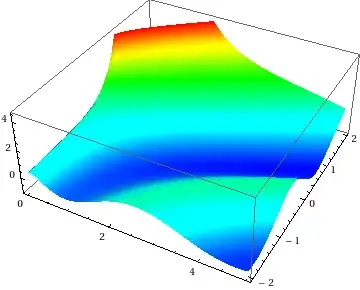
I needed to use arbitrary precision evaluation for these plots since the evaluation of the Coulomb functions with these definitions at machine precision seemed unstable for some combinations of arguments (try them yourself). There should be a way to reformulate these formulae for better stability (there are already a number of papers on the numerical evaluation of Coulomb functions), but I don't have time to look through those at the moment.


HypergeometricU. You can also uncover this by solving the equation directly,DSolve[z f''[z] + (\[Beta] - z) f'[z] - \[Alpha] f[z] == 0, f[z], z]. – whuber Mar 29 '13 at 20:04