We can use Haar wavelets to solve this problem. First we map {y,0,10} on $(0,1)$, then equations turns to
a = 1; A = 2; Pr = 65/10; M = 1; S = 1; B = 5; L = 10;
Ode1 = (-A*T'[y]*f''[y] + (a + A)*f'''[y] - A*T[y]*f'''[y])/L^2 -
   M*(y/2*f''[y] + f'[y]) - (f'[y]*f'[y] - f[y]*f''[y])/L==0;
Ode2 = 1/Pr*(T''[y] + B*T'[y]*T'[y] + B*T[y]*T''[y])/
     L^2 - (M*y/2*T'[y] + M*3/2*T[y]) - (2*f'[y]*T[y] - f[y]*T'[y])/L==0;
Second step, we define colocation points, wavelets, function and derivatives as follows
J = 4; nn = 2^J; dx = 1/(2*nn); h1[x_] := Piecewise[{{1, 0 <= x <= 1}, {0, True}}]; p1[x_, n_] := (1/n!)*x^n;
h[x_, k_, m_] := Piecewise[{{1, Inequality[k/m, LessEqual, x, Less, (1 + 2*k)/(2*m)]},
    {-1, Inequality[(1 + 2*k)/(2*m), LessEqual, x, Less, (1 + k)/m]}}, 0]
p[x_, k_, m_, n_] := Piecewise[{{0, x < k/m}, {(-(k/m) + x)^n/n!, Inequality[k/m, LessEqual, x, Less, (1 + 2*k)/(2*m)]},
    {((-(k/m) + x)^n - 2*(-((1 + 2*k)/(2*m)) + x)^n)/n!, (1 + 2*k)/(2*m) <= x <= (1 + k)/m},
    {((-(k/m) + x)^n + (-((1 + k)/m) + x)^n - 2*(-((1 + 2*k)/(2*m)) + x)^n)/n!, x > (1 + k)/m}}, 0]
xl = Table[l*dx, {l, 0, 2*nn}]; xcol = Table[(xl[[l - 1]] + xl[[l]])/2, {l, 2, 2*nn + 1}];
f3[x_] := Sum[af[i, j]*h[x, i, 2^j], {j, 0, J, 1}, {i, 0, 2^j - 1, 1}] + a0*h1[x];
  f2[x_] := Sum[af[i, j]*p[x, i, 2^j, 1], {j, 0, J, 1}, {i, 0, 2^j - 1, 1}] + a0*p1[x, 1] + f20;
  f1[x_] := Sum[af[i, j]*p[x, i, 2^j, 2], {j, 0, J, 1}, {i, 0, 2^j - 1, 1}] + a0*p1[x, 2] + f20*x + f10;
  f0[x_] := Sum[af[i, j]*p[x, i, 2^j, 3], {j, 0, J, 1}, {i, 0, 2^j - 1, 1}] + a0*p1[x, 3] + f20*(x^2/2) + f10*x + f00;
t2[x_] := Sum[at[i, j]*h[x, i, 2^j], {j, 0, J, 1}, {i, 0, 2^j - 1, 1}] + c0*h1[x];
  t1[x_] := Sum[at[i, j]*p[x, i, 2^j, 1], {j, 0, J, 1}, {i, 0, 2^j - 1, 1}] + c0*p1[x, 1] + t10;
  t0[x_] := Sum[at[i, j]*p[x, i, 2^j, 2], {j, 0, J, 1}, {i, 0, 2^j - 1, 1}] + c0*p1[x, 2] + t10*x + t00;
Third step, we define equations
bc0 = {f1[0] - L, f0[0] - S, t0[0] - 1};
bc1 = {f1[1],
  t0[1]};(*bc={f'[0]\[Equal]L,f[0]\[Equal]S,T[0]\[Equal]1,f'[1]\
\[Equal]0,T[1]\[Equal]0};*)
var = Flatten[
  Table[{af[i, j], at[i, j]}, {j, 0, J, 1}, {i, 0, 2^j - 1, 1}]];
cons = Join[bc0, bc1];
eqf[y_] := (-A*t1[y]*f2[y] + (a + A)*f3[y] - A*t0[y]*f3[y])/L^2 -
   M*(y/2*f2[y] + f1[y]) - (f1[y]*f1[y] - f0[y]*f2[y])/L;
eqt[y_] :=
  1/Pr*(t2[y] + B*t1[y]*t1[y] + B*t0[y]*t2[y])/L^2 - (M*y/2*t1[y] +
     M*3/2*t0[y]) - (2*f1[y]*t0[y] - f0[y]*t1[y])/L;
eq = Join[cons, Flatten[Table[{eqf[x], eqt[x]}, {x, N[xcol]}]]];
varX = Join[{a0, c0, f00, f10, f20, t00, t10}, var];
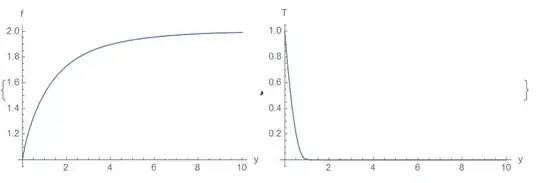
Finally we compute variables and plot solution
solF = FindRoot[Join[Table[eq[[i]] == 0, {i, Length[eq]}]],
  Table[{varX[[i]], 1/10}, {i, Length[varX]}]];
{Plot[f0[x/L] /. solF, {x, 0, 10}, PlotRange -> All,
  AxesLabel -> {"y", "f"}],
 Plot[t0[x/L] /. solF, {x, 0, 10}, PlotRange -> All,
  AxesLabel -> {"y", "T"}]}


NDSolvegives several error messages "boundary values are not satisfied..." – Ulrich Neumann Jan 18 '21 at 11:24