I am not sure exactly what you want but one may proceed as follows. I repeat your start.
v = 50;
x = 2;
tstart = 0;
tend = 0.45;
num = 256;
tstep = (tend - tstart)/(num - 1) // N;
sig = N[Table[{t, (Exp[-(I*2*Pi*v + Pi*x) (t)] +
       Random[NormalDistribution[0, .06]] +
       I Random[NormalDistribution[0, .06]])}, {t, tstart, tend,
     tstep}]];
ListPlot[Re[sig], PlotRange -> All, Joined -> True]

Now I am going to take the Fourier transform. I will assume that you only want the real part of the data you generated.
ft = Fourier[Re[sig[[All, 2]]], FourierParameters -> {-1, -1}];
ListLinePlot[Abs[ft[[1 ;; num/2]]], PlotRange -> All]

In order to look for noise it is probably best to use a log plot
ListLogPlot[Abs[ft[[1 ;; num/2]]], PlotRange -> All, Joined -> True]

This looks to have a background level of noise of about 0.005. I have chosen my FourierParameters so that the total modulus squared in the frequency domain equals the total squaredvalue in the time domain. Thus we have
{Re[sig[[All, 2]]] . Re[sig[[All, 2]]], num ft . Conjugate[ft]}
(* {24.4621, 24.4621 + 0. I} *)
So your background level of 0.005 corresponds to the rms value. The assumption is that your decaying signal in the time domain is narrow band in the frequency domain and thus the background level is revealed.
We can check this by regenerating your data without the noise as follows
v = 50;
x = 2;
tstart = 0;
tend = 0.45;
num = 256;
tstep = (tend - tstart)/(num - 1) // N;
sig = N[Table[{t, (Exp[-(I*2*Pi*v + Pi*x) (t)])}, {t, tstart, tend,
tstep}]];
ft1 = Fourier[Re[sig[[All, 2]]], FourierParameters -> {-1, -1}];
ListLogPlot[{Abs[ft[[1 ;; num/2]]], Abs[ft1[[1 ;; num/2]]]},
PlotRange -> All, Joined -> True]

The assumption that the signal has dropped below the noise in the frequency domain is just about true.
If you wish to use a complex signal in the time domain you can repeat doing that. Why are you complex in the time domain? It would be interesting to know that.
Hope that helps.
Edit
The OP has complex data in the time domain so we have to take this into account in Fourier.
Starting again we have
v = 50;
x = 2;
tstart = 0;
tend = 0.45;
num = 256;
tstep = (tend - tstart)/(num - 1) // N;
sig = N[Table[{t, (Exp[-(I*2*Pi*v + Pi*x) (t)] +
       Random[NormalDistribution[0, .06]] +
       I Random[NormalDistribution[0, .06]])}, {t, tstart, tend,
     tstep}]];
ListPlot[Re[sig], PlotRange -> All, Joined -> True]
ListPlot[{#[[1]], Im[#[[2]]]} & /@ sig, PlotRange -> All,
Joined -> True]
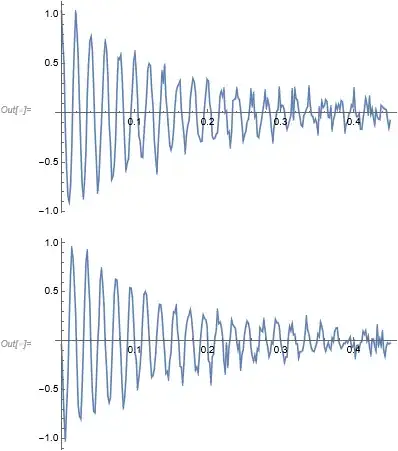
Where both real and imaginary parts are plotted.
Next we take the Fourier transform. It is notable that the OP uses the convention of E^(-I ω t) in the time domain thus indicating that in the FourierParameters the appropriate convention is {-1,1}. If the convention of {-1,-1} is used, common in signal processing, the peak in the spectrum occurs at negative frequencies. Thus
ft = Fourier[sig[[All, 2]], FourierParameters -> {-1, 1}];
{sig[[All, 2]] . Conjugate[sig[[All, 2]]], ft . Conjugate[ft] num}
(* {47.9484 + 0. I, 47.9484 + 0. I} *)
Here I have again checked that the total square in the time domain equals the total square in the frequency domain.
Plotting we have
ListLogPlot[{Abs[ft]}, PlotRange -> All, Joined -> True]

So once again we can see that the noise background is about 0.005.
Finally we check that the signal with no noise is below the noise floor.
sig1 = N[Table[{t, Exp[-(I*2*Pi*v + Pi*x) (t)]}, {t, tstart, tend,
     tstep}]];
ft1 = Fourier[sig1[[All, 2]], FourierParameters -> {-1, 1}];
ListLogPlot[{Abs[ft], Abs[ft1]}, PlotRange -> All, Joined -> True]

The OP wants to consider fitting a Lorentzian. There are plenty of other posts that do that.


v? – Daniel Lichtblau Jun 11 '21 at 19:22