I have looked into the paper and your code, and I think there are two main issues.
- I couldn't have deduced how you obtained the value $V_{dc}=100$, and I also think this is why your results are off. However, neither couldn't I have found the correct value in the paper ($\alpha_2 V^2 = 45, V = V_{ac} + V_{dc}, V_{ac}=0.01$ – this still leaves unknown $\alpha$ and $V_{dc}$).
- Your timerange when solving the DE might be too short for some parameter values (very small $c$).
I have tried by some trial-and-error to deduce that $V_{dc} \approx 5$ gives approximately the same results. Be careful, they used two approximation methods (Chebyshev and Taylor) which have slightly different positions of the peak, $\Omega_{\text{Ch.}} \approx 27.1$ and $\Omega_{\text{Tay.}} \approx 27.4$. However, you are solving the DE without approximations and the peak occurs somewhere in between at $\Omega \approx 27.2$.
data = {Vac -> 0.01 Cos[\[CapitalOmega] t], Vdc -> 5};
eq = q''[t] + c*q'[t] + 864.82*q[t] + 21.78 q[t]^2 + 142.58 q[t]^3 ==
   45.31 ((2 Vac)/Vdc + Vac^2/Vdc^2) + (1 + (2 Vac)/Vdc +
       Vac^2/Vdc^2)*(123.51 q[t] + 74.09 q[t]^2 + 1424.72 q[t]^3 -
       122.45 q[t]^4);
sol = ParametricNDSolve[{eq /. data, q[0] == 0, q'[0] == 0},
   q, {t, .1, 200}, {\[CapitalOmega], c}];
cs = {0.05, 0.1, 0.25};
[CapitalOmega]s = Sort[Union[Range[26.5, 28.5, .1], Range[27, 27.4, .02]]];
lst = Table[{[Omega], First@NMaximize[{q[[Omega], c][t] /. sol, 190 < t < 200}, t]},
   {[Omega], [CapitalOmega]s}, {c, cs}];
lst2 = Partition[Transpose@lst, Dimensions[cs]];
ListPlot[First@lst2, PlotRange -> {0, 0.12}, Joined -> True,
   InterpolationOrder -> 2, PlotLegends -> cs]
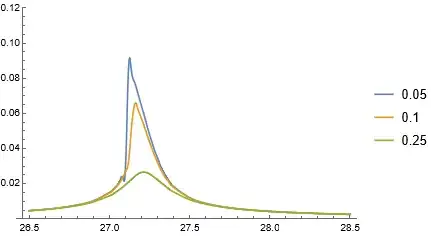
I hope you find any of these comments valuable. Note, however, that there might be some more efficient (faster) ways of calculating the maxima; I haven't looked into that.


