This problem can be solved with the Euler wavelets collocation method even in v.8 as follows
J[w_] := 1/(2 + w^2)
eqn = y'[
   t] == -Integrate[
    y[t1]  J[w]  Exp[I  (0.1 - w)  (t1 - t)], {w,
     0, \[Infinity]}, {t1, 0, t}]
First step. Let define kernel by integration on w
Integrate[
 Exp[I  (-1/10 + w)  dt]/(2 + w^2), {w, 0, \[Infinity]},
 Assumptions -> {dt > 0}]
(Out[]= (E^(-((I dt)/
  10)) (E^(-Sqrt[2] dt) [Pi] +
   I Sqrt[[Pi]]
     MeijerG[{{1/2}, {}}, {{1/2, 1/2}, {0}}, dt^2/2]))/(2 Sqrt[2]))
Therefore
kernel[dt_] := (
 E^(-((I dt)/
   10)) (E^(-Sqrt[2] dt) \[Pi] +
    I Sqrt[\[Pi]] MeijerG[{{1/2}, {}}, {{1/2, 1/2}, {0}}, dt^2/2]))/(
 2 Sqrt[2])
Second step. Using kernel and substitution t1 = t s we transform equation into Fredholm type
eqn = {y'[t] + t  NIntegrate[kernel[t - t  s] y[t  s], {s, 0, 1}] ==
   0, y[0] == 1};
Third step. Let define y[t],D[y[t],t] in the Euler wavelets base as
UE[m_, t_] := EulerE[m, t];
psi[k_, n_, m_, t_] :=
  Piecewise[{{2^(k/2)   UE[m, 2^k  t - 2  n + 1], (n - 1)/2^(k - 1) <=
       t < n/2^(k - 1)}, {0, True}}];
PsiE[k_, M_, t_] :=
 Flatten[Table[psi[k, n, m, t], {n, 1, 2^(k - 1)}, {m, 0, M - 1}]]
k0 = 3; M0 = 4; With[{k = k0, M = M0},
 nn = Length[Flatten[Table[1, {n, 1, 2^(k - 1)}, {m, 0, M - 1}]]]];
dx = 1/(nn); xl = Table[l*dx, {l, 0, nn}]; xcol =
 Table[(xl[[l - 1]] + xl[[l]])/2, {l, 2, nn + 1}]; Psijk =
 With[{k = k0, M = M0}, PsiE[k, M, t1]]; Int1 =
 With[{k = k0, M = M0}, Integrate[PsiE[k, M, t1], t1]];
Psi[y_] := Psijk /. t1 -> y;
int1[y_] := Int1 /. t1 -> y; vary = Array[yy, {nn}];
y[t_] := vary . int1[t] + b0 ; dy[t_] := vary . Psi[t];
Final step. We define system of linear equations and solve it using LinearSolve
int2 = Table[
  t  NIntegrate[kernel[t - t  s] int1[t  s], {s, 0, 1}], {t, xcol}];
int0 = Table[t  NIntegrate[kernel[t - t  s], {s, 0, 1}], {t, xcol}];
eqs = Join[
   Table[vary . Psi[xcol[[i]]] + vary . int2[[i]] + b0  int0[[i]] ==
     0, {i, nn}], {y[0] == 1}];
var = Join[vary, {b0}]; {vec, mat} = CoefficientArrays[eqs, var];
sol = LinearSolve[mat, -vec];
Visualization
rule = Table[var[[i]] -> sol[[i]], {i, Length[var]}]; Plot[
 Evaluate[ReIm[y[t] /. rule]], {t, 0, 1}]
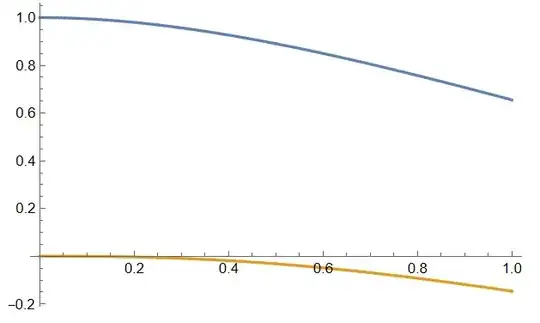


Solve[%, LaplaceTransform[y[t], t, s]]before doingInverseLaplaceTransform[%, s, t]. That's not the real problem, though. Since you have two integrals, the solution would involve two Laplace transforms. Note that thewintegral is itself a Laplace transform integral. – Jens May 31 '13 at 05:35tvariables, but I'm out of time for today. – Jens May 31 '13 at 06:05assumptions may help" – thils May 31 '13 at 06:54
Integrate, it accepts multiple limits. See the third form in the docs. – rcollyer May 31 '13 at 13:02