I would rather define:
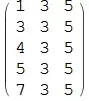
list = {{1, 3, 5}, {3, 3, 5}, {4, 3, 5}, {5, 3, 5}, {7, 3, 5}};
If you prefer for some reasons your own definition you can use list[[1]] instead of list. To extract the first column use First@Transpose@list or list[[All, 1]], for the last column use Last@Transpose@list, for k-th column e.g. list[[All, k]].
Then there are many ways, let's show a few of them:
Position[ KroneckerDelta /@ (Differences[ First @ Transpose @ list] - 1), 0] + 1
{{2}, {5}}
Instead of mapping KroneckerDelta we could use simply Unitize (as pointed out by J.M.), since it is Listable.
Moreover we could substitute Differences with subtruction of Rest and Most to get the proper result:
Position[ Unitize[ Subtract @@ Through@{Rest, Most}@First@Transpose@list - 1], 1] + 1
another method without Apply for extracting non-consecutive numbers of the last column:
Position[ Total[ Through @ { Rest, - Most @ # &} @ Last @ Transpose @ list], 0] + 1
{{2}, {3}, {4}, {5}}
A related discussion useful for the problem at hand you can find reading answers to this question Find zero crossing in a list.


Position[Unitize[Differences[list][[All, 1]] - 1], 1] + 1– J. M.'s missing motivation Jun 01 '13 at 13:32