I am solving a 2D PDE in space and time b(r,t) and would like to find the maximum value of b in space as a function of time t.
Using the solution for maximising a 1D interpolating function from here, I tried the following minimal working example, but it doesn't work:
largerad = 10;
tmax = 80;
b0 = 0.1;
pde = {D[b[r, t], t] == D[b[r, t], r, r] - b[r, t]};
ic = {b[r, 0] == b0};
bc = {Derivative[1, 0][b][largerad, t] == 0,
   Derivative[1, 0][b][0, t] == 0};
zsolv = NDSolve[{pde, ic, bc}, {b}, {r, 0, largerad}, {t, 0, tmax},
   MaxStepSize -> 0.01];
Nbins = 200;
mytableb =
  Table[NMaximize[{ b[r, t] /. zsolv, 0 <= r <= rad}, r,
    Method -> "SimulatedAnnealing"], {t, 0, tmax, tmax/Nbins}];
Does anyone have a suggestion for an alternative implementation that would give b_max(t) as a list of values?
Edit: I'm looking for a general solution, also for PDE's that are not exactly solvable using DSolve. I just gave this as a simple example.

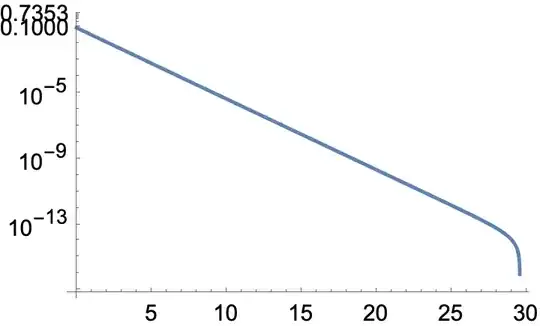

DSolve [{pde, ic, bc}, b , {r, 0, largerad}, {t, 0, tmax} ]evaluates the exact solution{b -> Function[{r, t}, 0.1 2.71828^(-1. t)]}}which doesn't depend on r! – Ulrich Neumann Mar 29 '22 at 16:54