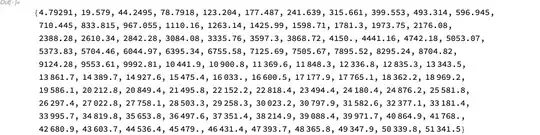
Approximating a function with a Chebyshev interpolation is a powerful way to find roots. See links at the beginning of the code dump. Best to use an analytic function with this method (i.e., drop Abs, which is not differentiable). Takes about 5 sec. to find cc and rts50.
cc = adaptiveChebSeries[
   x |-> Hypergeometric1F1[1/4 (3 - (2*x)/I), 15/10, I], 1, 20000,
   "Points" -> 2^8, WorkingPrecision -> 50];
Length@cc
(*  130  *)
rts50 = chebRoots[cc, {1, 20000}];
Length@rts50
(*  63  *)
ReImPlot[
 Hypergeometric1F1[1/4 (3 - (2*x)/I), 15/10, I], {x, 1, 20000},
 Mesh -> {rts50}, MeshStyle -> Red,
 ScalingFunctions -> {"Log", Automatic}]

Code dump
Code taken from my answer here; see my answer here for a discussion of the code.
(* Chebyshev extreme points *)
chx[n_, prec_: MachinePrecision] := N[Cos[Range[0, n]/n Pi], prec];
(* Chebyshev series approximation to f )
Clear[chebSeries];
chebSeries[f_, a_, b_, n_, prec_: MachinePrecision] := Module[{x, y, cc},
x = Rescale[chx[n, prec], {-1, 1}, {a, b}];
y = f /@ x; ( function values at Chebyshev points )
cc = Sqrt[2/n] FourierDCT[y, 1]; ( get coeffs from values )
cc[[{1, -1}]] /= 2; ( adjust first & last coeffs *)
cc
];
(* recursively double the Chebyshev points
- until the PrecisionGoal is met
- The function values are memoized in f0
- *)
Clear[adaptiveChebSeries];
Options[adaptiveChebSeries] = {PrecisionGoal -> 14, "Points" -> 32,
WorkingPrecision -> MachinePrecision, MaxIterations -> 5};
adaptiveChebSeries[f_, a_, b_, OptionsPattern[]] :=
Module[{cc, f0, max, len = 0, sum},
f0[x_] := f0[x] = f[x]; (* values reused in subsequent series )
NestWhile[
(cc = chebSeries[f0, a, b, #, OptionValue[WorkingPrecision]];
( check error estimate )
max = Max@Abs@cc; ( sum the tail of the series )
sum = 0; ( relative to the max coefficient )
len = LengthWhile[
Reverse@cc, (sum += Abs@#) < 10^-OptionValue[PrecisionGoal]max &];
2 #) &, (* double the number of points )
OptionValue["Points"],
len < 3 && # <= 2^OptionValue[MaxIterations] OptionValue["Points"] &
( at least two coefficients dropped *)
];
If[len < 3,
Message[adaptiveChebSeries::cvmit, OptionValue[MaxIterations]]];
If[TrueQ[len > 1], Drop[cc, 1 - len], cc]
]
(* "Chebyshev companion matrix" (Boyd, 2014) /
"Colleague matrix" (Good, 1961) *)
colleagueMatrix[cc_] := With[{n = Length[cc] - 1},
SparseArray[{{i_, j_} /; i == j + 1 :> 1/2,
{i_, j_} /; i + 1 == j :> 1/(2 - Boole[i == 1])}, {n, n}] -
SparseArray[{{n, i_} :> cc[[i]]/(2 cc[[n + 1]])}, {n, n}]
];
(* Find the real roots of a truncated Chebyshev series
representing a function over an interval [a,b] )
Options[chebRoots] = {( TBD )};
chebRoots::usage =
"chebRoots[c,{a,b}], c = {c0, c1,..., cn} Chebyshev coefficients, over the interval {a,b}
computes the (real) roots in the interval {a,b}";
chebRoots[coeff_, dom_: {-1, 1}, OptionsPattern[]] := Module[{eigs},
eigs = Eigenvalues@colleagueMatrix[coeff];
roots = Sort@Rescale[
Re@Select[
eigs,
Abs[Im[#]] < 1^-15 && (* Im error tolerance )
-1.0001 < Re[#] < 1.0001 &], ( Re error tolerance *)
{-1, 1}, dom]
]




Quiet@FindRoot[Abs[Hypergeometric1F1[1/4 (3 - (2*x)/I), 1.5, I]] == 0, {x, #, 0, a}] & /@ Range[1, a, 20] // Values // Flatten // Union[#, SameTest -> (Abs[#1 - #2]/Abs[#1] < 10^(-3) &)] &. – Michael E2 Apr 08 '22 at 04:04