8

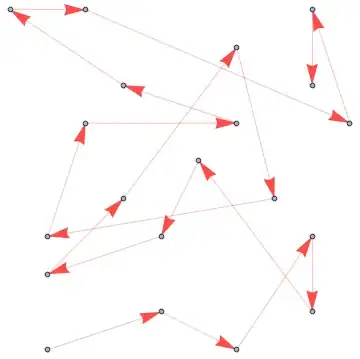
A car has to pick up each person and take them to their destination. I am trying to find the shortest tour that will do this. How can I find the shortest path between any s and t.... visiting all vertices, and without coming back to the start?

competition

In this case I have 10 points. After each For[], I obtain an array with the distances from i to j.

t = {
  {{2, 1}, {5, 2}},
  {{7, 1}, {9, 4}},
  {{9, 2}, {6, 6}},
  {{5, 4}, {2, 3}},
  {{4, 5}, {7, 9}},
  {{8, 5}, {2, 4}},
  {{3, 7}, {7, 7}},
  {{4, 8}, {1, 10}},
  {{3, 10}, {10, 7}},
  {{9, 10}, {9, 8}}
  }
(* t[[i,j,k]    i\[Rule]Trip Nºi    j\[Rule] \
1=Inicio=Pick-Up  2=Fin=Drop-Off     k\[Rule] 1ª o 2ª componente (es \
decir x ó y) *)

Array[t2t, {10, 10}]
For[i = 1, i <= 10, i++,
 For[j = 1, j <= 10, j++,
  If[i != j,
   t2t[i, j] = 
        Sqrt[(t[[j, 1, 1]] - t[[i, 2, 1]])^2 + 
        (t[[j, 1, 2]] - t[[i, 2, 2]])^2], t2t[i, j] = Infinity
   (* In t2t there is the distance from i to j 
      different from distance from j to i, in general *)
   ]
  ]
 ]

I want to find the shortest tour through the 10 vertices, with the weight/distsances t2t[i,j] visiting all vertices, and not coming back to the start.

-- After comments on March´2015 I add the original problem published in ORMS magazine -- Now this kind of puzzles are published in Amalytics ( for example electriying in page 74 http://viewer.zmags.com/publication/79b53367#/79b53367/74 )
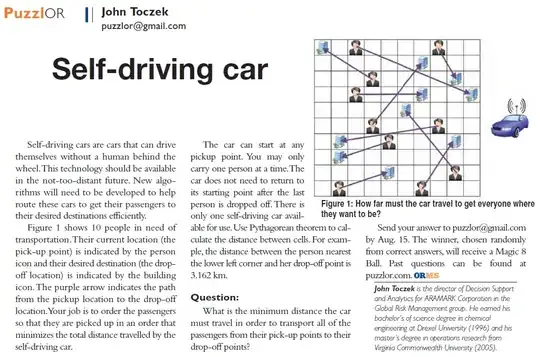
enter image description here

Mika Ike
  • 3,241
  • 1
  • 23
  • 38
  • 1
    Possible duplicate: http://mathematica.stackexchange.com/q/22002/121 – Mr.Wizard Jun 22 '13 at 23:00
  • @Mr.Wizard I think that it isn´t duplicate, because I don´t want to come back to the start, and the solution is not find the shortest Tour and delete the last "movement" – Mika Ike Jun 23 '13 at 09:08
  • I disagree with marking this as duplicate of a TSP question, as well as saying that it already has two answers (which then again are TSP answers). As the o/p said in his comment immediately above mine (this one) and one to my answer, he is NOT looking for a TSP answer, he is looking for an all-pairs shortest path solution. – Andreas Lauschke Jun 23 '13 at 10:09
  • I agree with @andreas-lauschke. I´m looking fot the shortest (in time, in distance, in dollars,...) path. VISITING ALL VERTEX and NOT COMING BACK TO THE START (NOT A TOUR, YES A PATH). – Mika Ike Jun 23 '13 at 12:27
  • Reopened on request. – Mr.Wizard Jun 23 '13 at 21:13
  • 2
    I disagree with @Andreas: This is not an all-pairs shortest path problem, because the path is required to visit all vertices. This really is a minor modification of the travelling salesman problem: all you have to do is create a new vertex, connect it to all the existing vertices via edges of length zero, solve TSP in the augmented graph, and then discard the new vertex and its two edges in the tour you found. This is a standard reduction from Hamiltonian path problems to Hamiltonian cycle problems. I suggest closing as duplicate again. –  Jun 28 '13 at 18:07
  • @Rahul: the text "How can I find the shortest path between any s and t" from the o/p would make it an all-pairs shortest path problem. "Between any s and t" mean all points are a start node s and all others would be end nodes t. Everything else you wrote, I agree, but note the words "... between any s and t". What you say would not be "between any s and t". – Andreas Lauschke Jun 28 '13 at 19:39
  • @RahulNarain Yes, Your answer has convinced me. I like your explanation. But I think that is not duplicated because your explanation can be usefull for other people. – Mika Ike Jun 28 '13 at 19:53
  • @RahulNarain I would like label your answer as THE SOLUTION. – Mika Ike Jun 28 '13 at 19:54
  • and.. How to find "THE SHORTEST" (more economic) Hamiltonian Cycle (with the virtual added vertex) – Mika Ike Jun 28 '13 at 20:00
  • THE UNSOLVED QUESTION is that distance from t1 to t2 is different from the disntace from t2 to t1.... and in general distance from t_i to t_j is diffenrent from the disance from t_j to t_i – Mika Ike Jun 28 '13 at 20:37
  • The picture seems to indicate that one interleaves pickups and dropoffs. The wording of the question is confusing, to say the least. – Daniel Lichtblau Mar 25 '15 at 17:04
  • @DanielLichtblau I post the origial puzzle in the last replay (2015-March-25) – Mika Ike Mar 25 '15 at 17:15
  • If you have posted something today, please provide a link. I've not seen anything that I can identify as being related to this. – Daniel Lichtblau Mar 25 '15 at 17:37
  • For the problem at hand there must be an interleaving of passenger locations and destinations. To effect this, one has to set the distances between any pair of passenger locations to infinity, and likewise any pair of destinations. Also of course since each passenger has a particular destination, the distance between that passenger and all other destinations must be set to infinity (in all cases, "infinity" can simply be a number larger than, say, #passengers times longest distance). After that, the cycle-to-path simplification of @Rahul can be used. – Daniel Lichtblau Mar 25 '15 at 21:44

2 Answers2

8

EDIT 1

Now that the question is getting more specific, here another approach:

I'd like to say that this is not a solution, but it shows you how to set-up your graph accordingly. If you combine this with the comment of @Rahul Narain you should get your result easily.

1) Create a PathGraph from the coordinates, with arrow edge style:

arrow[coord_, e_] := Style[Arrow[coord], Red, Thickness[.001], Arrowheads[0.06]]
pg = PathGraph[Range[Length@t], VertexCoordinates -> t, EdgeShapeFunction -> arrow]

enter image description here

2) Create a 10x10 grid:

gg = GridGraph[{10, 10}]

enter image description here

3) Overlay both graphs:

Overlay[{gg, pg}]

enter image description here

4) Let's find the shortest Tour and pick this tour from the coordinate list:

tour = t[[Last[FindShortestTour@t]]]
PathGraph[Range[Length@tour], VertexCoordinates -> t,EdgeShapeFunction -> arrow]

enter image description here

Looks identical to our PathGraph!

Now let's get some shortest paths. For instance the shortest path from vertex 1 to 9:

Overlay[{gg, HighlightGraph[pg, FindShortestPath[pg, 1, 9]]}]

The path is marked with red dots:

enter image description here


Algorithmic Graph Theory -- All-Pairs Shortest Path

As usual, when it is about graph theory I'm using the Combinatorica package that comes with Mathematica.

Using the Combinatorica package you could use several shortest path algorithms.

Let's turn your t into a graph. Your weighting function seems to be nothing else, but an EuclideanDistance. In Combinatorica the EuclideanDistance for graphs is defined as Euclidean:

<< Combinatorica`

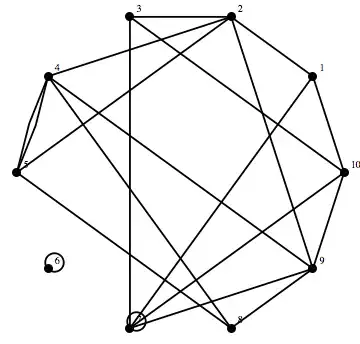
g = SetEdgeWeights[FromUnorderedPairs[Flatten[t, 1]], WeightingFunction -> Euclidean]
ShowGraph[g, VertexNumber -> True, VertexNumberPosition -> UpperRight]

enter image description here

Let's get the All-Pairs shortest path:

(s = AllPairsShortestPath[g]) // Short

==> {{0,0.618034,<<6>>,1.23607,0.618034},<<8>>,{<<1>>}}

Please have a look at here for further Floyd-Warshall algorithm discussion

Let's get the Euclidean shortest paths from vertex 1 to all other vertices, by producing a shortest-path spanning tree:

t = ShortestPathSpanningTree[g, 1];
ShowGraphArray[{g, t}, VertexNumber -> True, VertexStyle -> Disk[0.05]]

enter image description here

Let's turn this into an ordered graph:

op = ToOrderedPairs[g];
ShowGraph[FromOrderedPairs@op, VertexNumber -> True, VertexNumberPosition -> UpperRight]

enter image description here

Ordered this graph will have a different spanning tree, so let's run again a shortest-path spanning tree:

t = ShortestPathSpanningTree[g, 1];
ShowGraphArray[{g, t}, VertexNumber -> True, VertexStyle -> Disk[0.05]]

enter image description here

Stefan
  • 5,347
  • 25
  • 32
  • But I can´t see the "Short" Hamiltonian Path. It´s a cuais-tree – Mika Ike Jun 28 '13 at 19:50
  • Behause there is no? Define please cuais-tree. Why aren't you as specific in your question? – Stefan Jun 28 '13 at 20:06
  • I´m looking for a Hamiltonian path (the most economic), and in yous answer I can´t see hamiltonian paths. It´s only that – Mika Ike Jun 28 '13 at 20:10
  • cuais-tree? The paths are most economic considering Euclidean distance...please refine your question though! – Stefan Jun 28 '13 at 20:13
  • What I want is to Find the Solution to this problem http://img822.imageshack.us/img822/905/qwu9.png I starting using the code provided by other friend of this forum t = {{{2, 1}, {5, 2}}, {{7, 1}, {9, 4}}, {{9, 2}, {6, 6}}, {{5, 4}, {2, 3}}, {{4, 5}, {7, 9}}, {{8, 5}, {2, 4}}, {{3, 7}, {7, 7}}, {{4, 8}, {1, 10}}, {{3, 10}, {10, 7}}, {{9, 10}, {9, 8}}};

    t2t = Table[{If[i != j, Sqrt[(t[[j, 1, 1]] - t[[i, 2, 1]])^2 + (t[[j, 1, 2]] - t[[i, 2, 2]])^2], Infinity], i, j}, {i, 10}, {j, 10}];

    t2tlist = Flatten[t2t, 1]; t2tlistsorted = SortBy[t2tlist, First]

    – Mika Ike Jun 28 '13 at 20:22
  • @MikaIke I added your picture to the question which clarifies it a lot. – cormullion Jun 29 '13 at 09:03
  • @cormullion I like very much your graphs in EDIT 1, but nobody show the solution of the problem. I agree Rahul Narain with add a virtual vertex, but nobody Show how to find the solution, and with that solution show the graph as cormullion done. Here is a code provided for a friend at this forum, but only to sort all the arcs https://dl.dropboxusercontent.com/u/56475675/SelfDrivingCar%2002.nb – Mika Ike Jun 29 '13 at 11:23
  • @MikaIke that's Stefan, not me...perhaps you can delete your comment and try again? – cormullion Jun 29 '13 at 11:29
4

Finding the shortest paths between any s and t is usually called the "all-pairs shortest path" problem, as any is generally interpreted as all. You can do that with the JFloyd function in JVMTools. It can compute the all-pairs shortest distances (guaranteed optimal, this is no heuristic) for thousands of nodes in a few seconds, as that page above shows. Unlike the Dijkstra algorithm, which you could in theory call sequentially to solve this, the function JFloyd also accepts negative arc costs (as long as there are no negative cycles in the network).

I would avoid the term "tour" in this context, as it would point towards the TSP, closed or open. Paths are different from tours, and if I understand you correctly (please correct me if I'm wrong), you want the all-pairs shortest path solutions, no tours. If you want an open TSP solution, just solve the TSP and ignore the edge that closes from end back to start.

Disclosure: I am the owner of Lauschke Consulting, which is the business that sells JVMTools commercially.

Andreas Lauschke
  • 4,009
  • 22
  • 20
  • Yes, I want to visit all vertex (1-10) but without coming back to the start. I think that the solution is not to find the Shortest-Tour and delete the last "edge". – Mika Ike Jun 23 '13 at 09:11