First of all your parameter syntax is not correct; you'll want to use c1_Circle which is a Pattern named c1 for an expression with a head Circle. Your c1_?Circle is a Pattern named c1 that passes the test function Circle (see PatternTest), which of course is not valid for the built-in function Circle.
You removed the issue above from your question. What remains seems underspecified. You can extract the centers and radii either with patterns (useful for inserting these parts into a specific expression), or simply using Apply, e.g.:
f1[cirs__Circle] := {cirs} /.  Circle[center_, radius_] :> {center, radius}

f1[Circle[{0, 0}, 1], Circle[{1, 1}, 3], Circle[{2, 2}, 2]]
{{{0, 0}, 1}, {{1, 1}, 3}, {{2, 2}, 2}}
f2[cirs__Circle] := List @@@ {cirs}

f2[Circle[{0, 0}, 1], Circle[{1, 1}, 3], Circle[{2, 2}, 2]]
{{{0, 0}, 1}, {{1, 1}, 3}, {{2, 2}, 2}}
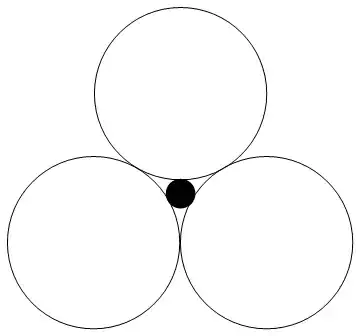
If you are interested in the actual calculation of the inner circle you will need to describe the characteristics of the function input.
Since the element manipulation was indeed your focus let me expand upon what I wrote above with a few additional examples.
The replacement rule Circle[center_, radius_] :> {center, radius} is a very simple example of the kind of destructuring that is possible with pattern-based transformations. These can be done either with RuleDelayed as above, or as part of a SetDelayed definition. You can also be more specific with the patterns, or provide for different cases to accommodate a flexible syntax. The documentation for Circle shows a number of different acceptable syntax forms, and to be robust your function should be able to handle these to some degree. As an example I will give a rule that will give a list {x, y, radius} for a variety of Circle forms.
{
  Circle[{1, 2}],
  Circle[{3, 4}, 7.5],
  Circle[{0, 0}, 1, {Pi/6, 3 Pi/4}]
} /. Circle[{x_, y_}, r_: 1, ___] :> {x, y, r}
{{1, 2, 1}, {3, 4, 7.5}, {0, 0, 1}}
Note that right-hand-side of :> could be any expression into which to substitute values for x, y, r. Here the pattern r_:1 represents a pattern with an Optional value 1 which is used in the case of Circle[{1, 2}].
If you do not require the flexibility and argument testing of pattern matching Apply can be used, of which @@@ is a short form for Apply at levelspec 1. In addition to List as used above this can be any head or function. For example:
{#, #2} & @@ Circle[{0, 0}, 1, {Pi/6, 3 Pi/4}]
{{0, 0}, 1}


findCircle[Circle[c1_,r1_],Circle[c2_,r2_],Circle[c3_,r3_]] :=and use the centersc1..c3and radiir1..r3in the function body – Niki Estner Jun 27 '13 at 09:25