R is also an option. Easy to download just 48 Mb and install. Free ware and add those adds on which you required.
Advantages of R:
R is the most comprehensive statistical analysis package available. It incorporates all of the standard statistical tests, models, and analyses, as well as providing a comprehensive language for managing and manipulating data. New technology and ideas often appear first in R.
R is a programming language and environment developed for statistical analysis by practising statisticians and researchers. It reflects well on a very competent community of computational statisticians. R is now maintained by a core team of some 19 developers, including some very senior statisticians.
The graphical capabilities of R are outstanding, providing a fully programmable graphics language that surpasses most other statistical and graphical packages. The validity of the R software is ensured through openly validated and comprehensive governance as documented for the US Food and Drug Administration (R Foundation for Statistical Computing, 2008). Because R is open source, unlike closed source software, it has been reviewed by many internationally renowned statisticians and computational scientists.
R is free and open source software, allowing anyone to use and, importantly, to modify it. R is licensed under the GNU General Public License, with copyright held by The R Foundation for Statistical Computing.
R has no license restrictions (other than ensuring our freedom to use it at our own discretion), and so we can run it anywhere and at any time, and even sell it under the conditions of the license.
Anyone is welcome to provide bug fixes, code enhancements, and new packages, and the wealth of quality packages available for R is a testament to this approach to software development and sharing.
R has over 4800 packages available from multiple repositories specializing in topics like econometrics, data mining, spatial analysis, and bio-informatics.
R is cross-platform. R runs on many operating systems and different hardware. It is popularly used on GNU/Linux, Macintosh, and Microsoft Windows, running on both 32 and 64 bit processors.
R plays well with many other tools, importing data, for example, from CSV les, SAS, and SPSS, or directly from Microsoft Excel, Microsoft Access, Oracle, MySQL, and SQLite. It can also produce graphics output in PDF, JPG, PNG, and SVG formats, and table output for LATEX and HTML.
R has active user groups where questions can be asked and are often quickly responded to, often by the very people who developed the environment.
New books for R (the Springer Use R! series) are emerging, and there is now a very good library of books for using R.
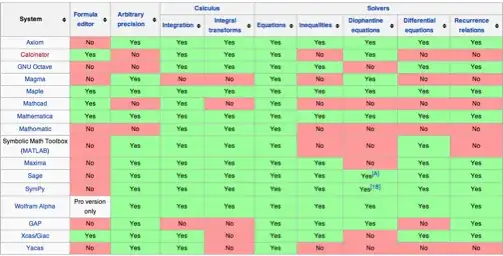
The coding of R is smiler to Mathematica, new user of R which is frequent in Mathematica easily pick and under stand the codes of R.




 .
. 


