It could be that there is a closed form solution. Following considerations demonstrate that it cannot be simple. Important message is that $u_n$, besides quadratic grows demonstrated in the other answer, has sub-leading logarithmic terms.
Let us first reformulate the recurrence using the $t_n^2=u_n+3$ substitution. We get
$$
t_{n+1}^2=t_n^2+t_n+1,\\
t_1=2.
$$
MA cannot solve this recursion.
However, it can be reformulated introducing a difference $y_n=t_{n+1}-t_n$. We get
$$
y_n(y_n+2t_n)=t_n+1.
$$
This can approximately be written as an ordinary differential equation (ODE)
$$
x'(t)\big(x'(t)+t\big)=t+1,\\
x(1)=2.
$$
This can be solved analytically with MA
DSolve[{y'[x] (y'[x] + 2 y[x]) == y[x] + 1, y[1] == 2}, y[x], x]
we select the growing solution and define
f[x_] :=
 InverseFunction[-2 Log[-#1 + Sqrt[1 + #1 + #1^2]] +
     3/2 Log[-1 - 2 #1 + 2 Sqrt[1 + #1 + #1^2]] + #1 + Sqrt[
     1 + #1 + #1^2] &][x + 1/2 (2 + 2 Sqrt[7] - 4 Log[-2 + Sqrt[7]] +
      3 Log[-5 + 2 Sqrt[7]])]
Let us verify the accuracy.
i. Generate log-mesh for plotting purposes. Represent only 20 points in the range $[1, 10000]$
kmx = 20;
nmx = 100000;
p = Exp[Log[nmx]/kmx] // N
ni = Table[t = Round[p^(i - 1)]; t, {i, 1, kmx}] // DeleteDuplicates
ii. Generate the solution of the 2nd recursion.
a = {2};
Do[AppendTo[a, x = Last[a]; N[Sqrt[x^2 + x + 1]]], {n, nmx}]
an = Table[{i, a[[i]]}, {i, ni}]
iii. Generate the solution of the 1st recursion.
u = {1};
Do[AppendTo[u, x = Last[u]; N[x + 1 + Sqrt[x + 3]]], {n, nmx}]
un = Table[{i, u[[i]]}, {i, ni}]
iv. Plot 2nd recursion vs analytic solution
g1 = LogLogPlot[f[n], {n, 1, nmx}];
g2 = ListLogLogPlot[an,
  PlotStyle -> Directive[PointSize[Medium], Orange]];
Show[{g1, g2}]

And here is the same graph with the polynomial asymptotic.

v. Plot 1st recursion vs analytic solution
g3 = LogLogPlot[f[n]^2 - 3, {n, 1, nmx},PlotTheme -> "NeonColor"];
g4 = ListLogLogPlot[un,
  PlotStyle -> Directive[PointSize[Medium], Blue]];
Show[{g3, g4}]
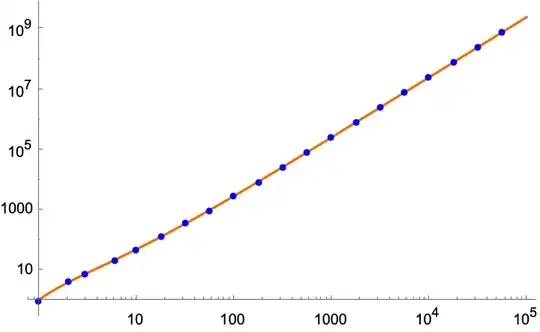
And here is the same graph with the polynomial asymptotic.

Finally, in the case someone needs a practical formula working in the whole range. One can transform the original recursion into a differential equation with the solution
v[n_] := -2 + 2 ProductLog[-1, -3 E^(-(5/2) - n/2)] +
  ProductLog[-1, -3 E^(-(5/2) - n/2)]^2
Using properties of the Lambert W function one can with high accuracy write
g[n_] := Log[3 E^(-(5/2) - n/2)] - Log[5/2 + n/2 - Log[3]] +
  Log[5/2 + n/2 - Log[3]]/Log[3 E^(-(5/2) - n/2)] + (Log[5/2 + n/2 - Log[3]]*(Log[5/2 + n/2 - Log[3]] - 2))/(2* Log[3 E^(-(5/2) - n/2)]^2)
w[n_] := -2 + 2*g[n] + g[n]^2
This function has the following asymptotic form
wa[n_]:=1/4 (-3 + n (6 + n)) - (3 + n) Log[3] + Log[3]^2


RSolve. Another question https://mathematica.stackexchange.com/questions/293296/how-can-i-find-some-first-terms-of-a-sequence – minhthien_2016 Nov 26 '23 at 03:47