Of course, many formulas, that cannot be derived by algorithmical methods - characteristically all forms of Eulers hypergeometric series - are solved by table lookup, corrected by Wolframs work, to verify the tables by numerical approximations, series expansion and algebraical verification methods.
I remember to have read in the first times of CAS invention, that about 15% of all table formulas contain errors.
From the following you see, that general formulas for hypergeometric functions are using different table entries for values of te the summation character from a-k and o-z.
Since this is a local, integer summation variable, the results, depending on its character, show a badly coded table lookup in the sense: ?all symbols from the integer part of the alphabet i,j,k,l,m,n ?.
         ff = Function[{a},
             Sum[(Gamma[n + m + 1] (-x)^a)/
                 (a! (n - a)!  Gamma[a + m + 1]),
                 {a, 0, n}]]
     (# -> ff[#] &) /@
        Symbol /@ (Cases[CharacterRange["a", "z"],
                         Except["l" | "m" | "n" | "x"]]) // TableForm
$$a \dots k \to \frac{\Gamma (m+n+1) \, _1F_1(-n;m+1;x)}{\Gamma (m+1) \Gamma (n+1)}$$
$$o \dots z \to L[n, m, x]$$
If the formula is not textual 1-1 with the definition of the Laguerre polynomial, the general identification as a hypergeometric series from the recurrence formmula of the coefficients in the Taylor series is used.
Mathematica cannot identify the results. There are still large fields open to research for transforms of special function expressions into eachother by an CAS.


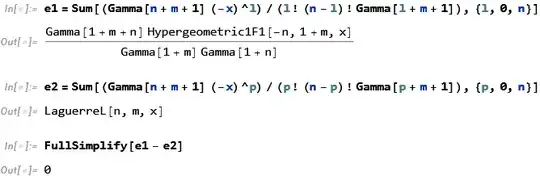 as to why the letter used makes difference, this came up before many times. Internally there is some lexicographical ordering, which causes different code path to be taken somewhere. it is annoying ofcourse. see this as one example. There are more....
– Nasser
Dec 04 '23 at 03:58
as to why the letter used makes difference, this came up before many times. Internally there is some lexicographical ordering, which causes different code path to be taken somewhere. it is annoying ofcourse. see this as one example. There are more....
– Nasser
Dec 04 '23 at 03:58


