I have the following problem which I do not even know if there is a solution.
Say I have following integral:
Integrate[Sum[ToExpression["a" <> ToString@i] ChebyshevT[i, (2 t/tf - 1)], {i,
0, 20}]*Sum[ ToExpression["b" <> ToString@i] ChebyshevT[i, (2 t/tf - 1)], {i, 0,
 20}] E^(a t), t]
$\int (\sum_{i=0}^{20}a_i T_i(t))(\sum_{i=0}^{20}b_i T_i(t))e^{at}dt$
Clearly, this integral is solvable and very easy. However, there are many terms, i.e. it is 400 very easy integrals. Mathematica struggles to execute the code in a reasonable time.
This is puzzling though, since any one of the integral is done quickly and 400 of them should naively be done in 400 the time. This is not the case.
Is it possible to handle such integrals (without doing any substantial amount of work per hand)? Mathematica does not allow for parallelization of sums of integrals, which is a bit weird.
I should mention that in the actual problem, the Chebyshevs are shifted and scaled, which makes it totally impossible to evaluate


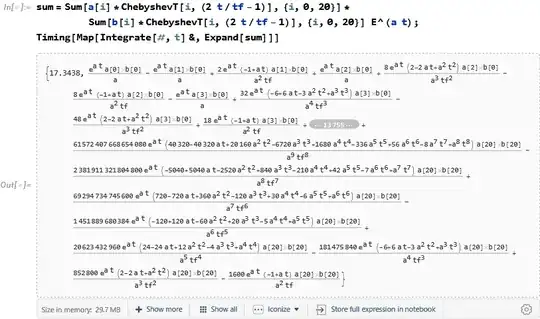
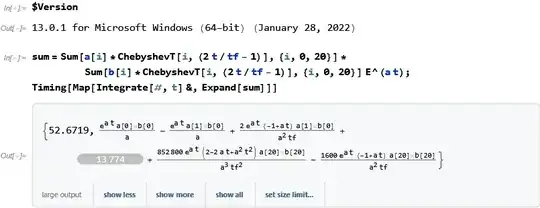


Map[Integrate[#,t]&,t+1]givest+t^2/2. On a single item it has to be a list, like thisMap[Integrate[#,t]&,{t}]gives{t^2/2}. You can't map on atomic item. You said your input is a sum. You can always write a wrapper function to handle the special case. – Nasser Jan 18 '24 at 16:15