This is fractional delayed differential equation (FDDE), therefore we can't use method described in my answer here. Instead of the Haar wavelets method we try to use implicit difference scheme described in this paper. Note that for this type of equations we need to define $y(x)$ at $x\le 0$ and at $2x-1\ge a$ as well. Without this data we can't compute an unique solution. While for $x\le 0$ we have $y(x)=2, y'(x)=0$ (it could not be y'(x)=1 as given above), for $2x-1\ge 2$ we have no data. So, we put for example $f(2 x-1)=0, 2 x-1\ge 2$. To reduce the Caputo derivative order we introduce a new variable $z=y'(x)$, then our code is follows
L = 2; dx = L/100; xgrid = Range[0, L, dx]; nn = Length[xgrid];
M1 = NDSolve`FiniteDifferenceDerivative[Derivative[1], xgrid,
    DifferenceOrder -> 2]@"DifferentiationMatrix";
Z = Array[zz, {nn}]; Y = Array[yy, {nn}]; y0 = 2; dy0 = 0;
eq1 = Drop[Z - M1 . Y, 1]; bc = {Z[[1]] - dy0, Y[[1]] - y0};
a[j_][q_] := (j + 1)^(1 - q) - j^(1 - q);
b[j_][q_] := ((j + 1)^(2 - q) - j^(2 - q))/(2 -
      q) - ((j + 1)^(1 - q) + j^(1 - q))/2;
eq2 = Table[0, {nn - 1}]; q = 1/2; Do[
 c[0] = If[n == 1, 1, a[0][q] + b[0][q]];
 If[n >= 2,
  Do[c[j] = a[j][q] + b[j][q] - b[j - 1][q];, {j, 1, n - 2}];
  c[n - 1] = a[n - 1][q] - b[n - 2][q]];
 eq2[[n - 1]] =
  dx^(-q)/Gamma[2 - q] (c[0] Z[[n]] - c[n - 1] Z[[1]] -
      Sum[(c[n - j - 1] - c[n - j]) Z[[j]], {j, 1, n - 1}]) -
   Sqrt[Y[[n]]] -
   If[2 xgrid[[n]] - 1 <= 0, y0,
    If[Round[(2 xgrid[[n]] - 1)/dx] >= nn + 1, 0,
     Y[[Round[(2 xgrid[[n]] - 1)/dx]]]]];, {n, 2, nn}];
varALL = Join[Y, Z]; eqAll = Join[eq1, eq2, bc];
{res, {evx}} =
  Reap[FindRoot[Table[eqAll[[i]] == 0, {i, Length[eqAll]}],
    Table[{varALL[[i]], .1}, {i, Length[varALL]}],
    Method -> {"Newton", "StepControl" -> "TrustRegion"},
    MaxIterations -> 1000, EvaluationMonitor :> Sow[varALL]]];
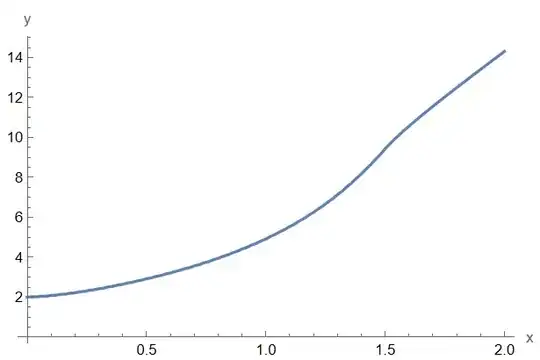
Visualization
ListLinePlot[Transpose[{xgrid, Y /. res}], AxesLabel -> {"x", "y"}]


y[2 x - 1]. In a theory we need initial data forx<0as well to define function forx>0. – Alex Trounev Feb 11 '24 at 12:242>=x>0only since at x<0 we define function with first derivative. Also please pay attention that in a new redaction you puty[x /; x <= 0] == 2, y'[x /; x <= 0] == 1that is apparently wrong. :) – Alex Trounev Feb 11 '24 at 12:53y[x /; x <= 0] == 2, y'[x /; x <= 0] == 1I got a correct numeric solution. Looks like initial conditions are OK. – Mariusz Iwaniuk Feb 11 '24 at 15:48