What is the problem with this expression inside ListPrint? OverTilde generates here a mess:
FrameLabel->{{"f"<>"("<>ToString[OverTilde["x"]]<>")",None},{"x",None}}
What is the problem with this expression inside ListPrint? OverTilde generates here a mess:
FrameLabel->{{"f"<>"("<>ToString[OverTilde["x"]]<>")",None},{"x",None}}


OverTilde["x"] is a short way of writing Overscript["x","~"] so it is not OverTilde per se causing the issue here. The problem is that by default ToString writes OutputForm. So what you need to do is to write the string as StandardForm:
FrameLabel->{{"f"<>"("<>ToString[OverTilde["x"],StandardForm]<>")",None},{"x",None}}
For example this doesn't work:
Plot[Sin[x], {x, 0, 10},
  Frame -> True,
 FrameLabel -> {{"f" <> "(" <> ToString[OverTilde["x"]] <> ")",
    None}, {"x", None}},
  BaseStyle -> {FontSize -> 20, FontFamily -> "TimesNewRoman"}]

But this works fine:
Plot[Sin[x], {x, 0, 10},
  Frame -> True,
 FrameLabel -> {{"f" <> "(" <>
     ToString[OverTilde["x"], StandardForm] <> ")", None}, {"x",
    None}},
  BaseStyle -> {FontSize -> 20, FontFamily -> "TimesNewRoman"}]
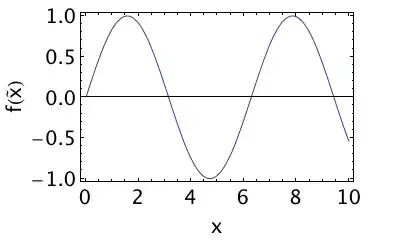

This is get what JohnFultz suggested in a comment on record.
A simple and easy-to-understand approach using Row is demonstrated by
Plot[Sin[x], {x, 0, 2 Pi},
  Frame -> True,
  FrameLabel -> {x, Row[{"f(", OverTilde["x"], ")"}]},
  BaseStyle -> {FontSize -> 16}]


Row is an optimal approach to this problem. I interpret the question as one which requires an explanation of unexpected ToString behaviour ("What is the problem with this expression...").
– Mike Honeychurch
Sep 28 '13 at 12:28
Frame labels are automatically converted to TraditionalForm
Plot[Sin[x], {x, 0, 10},
 Frame -> True, FrameLabel -> {x, f[\!\(\*OverscriptBox[\(x\), \(~\)]\)]},
 BaseStyle -> {FontSize -> 20, FontFamily -> "TimesNewRoman"}]
In the notebook it looks much better:
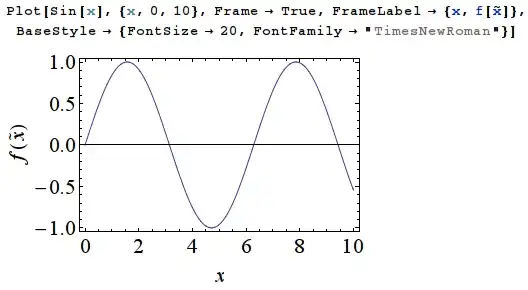
I specify BaseStyle to enlarge the labels. You can enter x̃ as x Ctrl+7~ as Szabolcs write in the comment. More correct to use HoldForm[x] and HoldForm[f[x̃]] to localize f and x.
My solution differs from Szabolcs's comment:
Plot[Sin[x], {x, 0, 10}, Frame -> True,
 FrameLabel -> {"x", "f(\!\(\*OverscriptBox[\(x\), \(~\)]\))"},
 BaseStyle -> {FontSize -> 20, FontFamily -> "TimesNewRoman"}]

It is because TraditionalForm automatically italicizes variables and makes other necessary transformations, e.g. Sin[x] → $\sin(x)$, Hypergeometric2F1[z, b, c, z] → ${}_2F_1(a,b,c;z)$.
Why "f("<>ToString[OverTilde["x"]]<>")" works strange?
Answer:
ToString[OverTilde["x"]]
~
x
It is two-line string with ~ over x. Therefore
"f(" <> ToString[OverTilde["x"]] <> ")"
f(~
x)
"f(" is prepended to first line and ")" is appended to the second line. More correct usage:
ToString[f[OverTilde["x"]]]
  ~
f[x]

FrameLabel -> {"x", "f(\!\(\*OverscriptBox[\(x\), \(~\)]\))"}. I entered this asf(xCtrl-7~). It's readable and easy to format in the notebook, but it becomes a bit ugly when pasting here. – Szabolcs Sep 27 '13 at 14:02ToString. Both answers are correct and sufficient, but surely a solution involvingRowis easier to understand and apply to other similar problems. – John Fultz Sep 27 '13 at 22:53ToStringis not by default writingStandardForm. I agree though thatRowought to be the preferred way of doing this. – Mike Honeychurch Sep 28 '13 at 01:55