1. The first reason is that Sign[0] yields 0, so even assuming x ∈ Reals this expression:
Sign[x]^2 - 1 cannot be evaluated to 0.
2. The next problem is that Assuming[{x ∈ Reals}, x (Sign[x]^2 - 1)] is evaluated first, then the assumption imposed doesn't affect the simplification procedure since FullSimplify being outside Assuming doesn't know anything about x, thus the final result is correct.
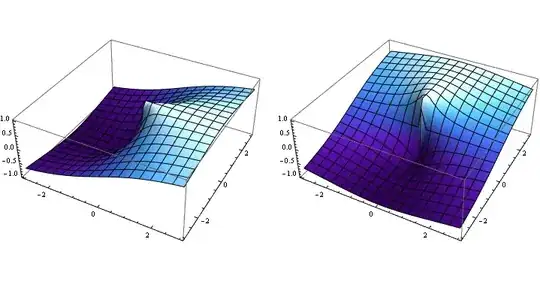
Ad 1. In general Sign is a complex function, for a complex number $ z\neq0\;$ it is equal to z/Abs[z], e.g. see its graphs of the real and imaginary parts:
GraphicsRow[ Table[ Plot3D[ f @ Sign[x + I y], {x, -3, 3}, {y, -3, 3},
                            ColorFunction -> "DeepSeaColors",], {f, {Re, Im}}]]
Ad.2
One can impose global assumptions for a Mathematica session, e.g.
$Assumptions = z ∈ Reals;
then one can do as it was assumed in the question:
z (Sign[z]^2 - 1) // FullSimplify
0
On the other hand you can use assumption restricted to FullSimplify only:
FullSimplify[ x (Sign[x]^2 - 1), x ∈ Reals]
0
For more detailed discussion see e.g. this question How to specify assumptions before evaluation?.


FullSimplify[x (Sign[x]^2 - 1), Assumptions -> {x \[Element] Reals}]gives 0 on version 9.0.1 – cormullion Nov 08 '13 at 12:37