I propose two different solutions with comparable speed.
Some input set
n = 20;
SeedRandom[0];
L = Sort[RandomSample[Subsets[Range[n], {2}],
    RandomInteger[{1, Binomial[n, 2]}]]];
Length[L]
168
The main idea: let's recursively look for all possible non-duplicated subsets and count them. It is relatively fast and it does not require a lot of memory.
Both solutions:
ClearAll[f];
f[set_List, k_] := f[set, k] =
   Sum[f[DeleteCases[
      set[[i + 1 ;;]], {set[[i, 1]], _} | {set[[i, 2]], _} | {_,
        set[[i, 1]]} | {_, set[[i, 2]]}], k - 1], {i,
     Length[set] - 1}];
f[set_List, 1] := Length[set];

f[set_SparseArray, k_, j_: 0] := f[set, k, j] =
   Sum[f[Drop[
      Drop[set[[p[[1]] + 1 ;;]], {p[[2]] - p[[1]] - j}, {p[[1]] + j}],
       None, {p[[2]] - 1}], k - 1, j + p[[1]] - 1], {p,
     set["NonzeroPositions"]}];
f[set_SparseArray, 1, _] := Length@set["NonzeroValues"];
The first takes L as input. The second takes the sparse array
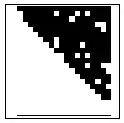
sp = SparseArray[L -> ConstantArray[1, Length[L]], {Max[L] + 1, Max[L] + 1}];
sp // ArrayPlot
k = 3;
Length@Select[Subsets[L, {k}], Length[Gather[Flatten[#]]] === 2 k &] // AbsoluteTiming
{6.013846, 400127}
f[L, 3] // AbsoluteTiming
{0.578520, 400127}
f[sp, 3] // AbsoluteTiming
{0.545830, 400127}
For k = 4 the difference is much more noticeable: 3 sec vs 10 min and 2 GB RAM.
Some notes:
I use memoization.
In the second solution f drops rows and columns of the sparse array so original indexing shifts after each drop. I use additional variable j to deal with it.
Drop failed to drop the row of the sparse array if it has only 1 row. So I pad input array with additional empty row and column by Max[L] + 1.


LandSfor smallnandk? For some reason your code isn't working for me – Dr. belisarius Nov 13 '13 at 11:33