7

I want to draw a set of convex polyhedrons whose vertices are defined by spherical coordinates on the surface of a unit sphere.

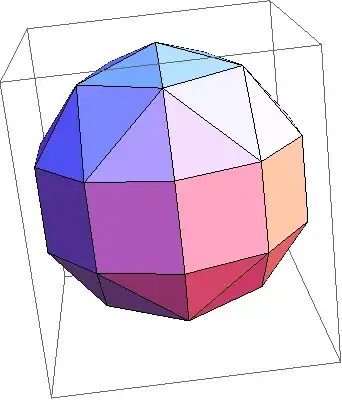
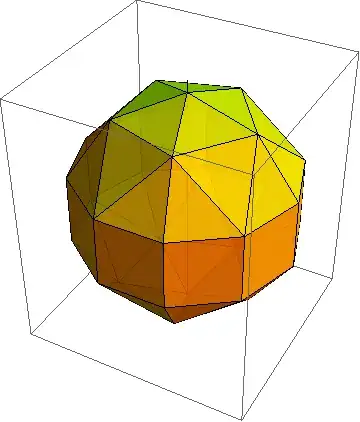
Currently I followed the advice from here: https://mathematica.stackexchange.com/a/21842/651 But it draws diagonals on any tetragonal face. Each face is composed of triangles. Is it possible to accomplish the same but without tetragonal faces diagonaled?

The current code:

Needs["TetGenLink`"]
mapping[{1,0,0}]={0,0,1}
mapping[{1,Pi,0}]={0,0,-1}
mapping:=CoordinateTransformData[{"Spherical"->"Cartesian"},"Mapping"]
verteces[n_]:=Flatten[Table [{1,Pi k/n, i 2Pi/Binomial[n,k]},{k,0,n},{i,0,Binomial[n,k]-1}],1]
Convex[n_]:=TetGenConvexHull[mapping/@ verteces[n]]
pts[n_]:=First[Convex[n]]
surface[n_] :=Last[Convex[n]]
b:=5
Graphics3D[{Yellow,Opacity[.9],GraphicsComplex[pts[b],Polygon[surface[b]]], Black, Line[{{0,0,-1.1},{0,0,1.1}}]}]
Anixx
  • 3,585
  • 1
  • 20
  • 32
  • 1
    Some code to show where you are at would be quite helpful. – Yves Klett Nov 26 '13 at 22:10
  • @Yves Klett I copied the code from the linked answer – Anixx Nov 26 '13 at 22:10
  • @Yves Klett I have added the current code. – Anixx Nov 26 '13 at 22:12
  • You can do this: take the triangle list surface[b]. Find the edges. Each edge has two neighbouring triangles. For each edge, if those two triangles are parallel (the dot product of their normals is 1 to a certain precision), merge them into a tetragon. Can you try to implement this? – Szabolcs Nov 26 '13 at 22:31
  • Quick fix would be to skip edges with: GraphicsComplex[pts[b], {EdgeForm[None], Polygon[surface[b]]}] – Kuba Nov 26 '13 at 22:32
  • Or what Kuba said, that's even better: loop through edges, and do not render those that have parallel adjacent polygons. – Szabolcs Nov 26 '13 at 22:33
  • @Kuba I already tried it. Without edges the picture is uncomprehensible where there are many faces. – Anixx Nov 26 '13 at 22:40

2 Answers2

8
<< ComputationalGeometry`
ComputationalGeometry`Methods`ConvexHull3D[mapping /@ verteces[5], 
                                           Axes -> None, Graphics`Mesh`FlatFaces -> False]

Mathematica graphics


Mapping over n (well, with a trick because it fails with more than three calculations in a row):

Mathematica graphics


Edit

merging with your code:

<< ComputationalGeometry`
mapping[{1, 0, 0}] = {0, 0, 1}
mapping[{1, Pi, 0}] = {0, 0, -1}
mapping := CoordinateTransformData[{"Spherical" -> "Cartesian"}, "Mapping"]
verteces[n_] := Flatten[Table[{1, Pi k/n, i 2 Pi/Binomial[n,k]}, {k,0,n}, {i, 0,Binomial[n,k]-1}], 1]

Graphics3D[{Yellow, Opacity[.9], 
           Sequence @@ ComputationalGeometry`Methods`ConvexHull3D[mapping /@ verteces[5], 
           Axes -> None, Graphics`Mesh`FlatFaces -> False],Black,Line[{{0, 0, -1.1}, {0, 0, 1.1}}]}]

Mathematica graphics

Dr. belisarius
  • 115,881
  • 13
  • 203
  • 453
5

Here is another solution using coplanar triangles idea. Given six vertices of two triangles that share an adjacent edge, we use EigenValues to estimate the mean-square orthogonal distance of the points from the best fitting plane. In case it turns out to be close to zero we can assume the two triangles under consideration are coplanar with in some tolerance. You will find more details here. Once we know this for any two neighboring triangle in the TetGen mesh we can form a Quad by joining them.

trigToedge[list_] := Partition[list, 2, 1, 1]; 
Quad[current_, {pt_, tri_}] := 
 Block[{trigtopt, threeTigs, connectedTrigs, dist, mat, test,coplanar, edges},
  trigtopt[list_] := Extract[pt, Transpose@{list}];
  threeTigs = Select[tri, Length@Intersection[#, current] == 2 &];
  connectedTrigs = (trigtopt[#] & /@ threeTigs);
  dist = (
      mat = (# - Mean@#) & /@ (Transpose@(trigtopt[current]~Join~#));
      Min@Chop@Eigenvalues[(mat . Transpose@mat)/6]
      ) & /@ connectedTrigs;
  test = Position[dist, 0];
  {coplanar} = If[test != {}, Extract[threeTigs, test], {0}];
  If[Length@coplanar == 3, 
   edges = Cases[
     Tally[Join @@ (trigToedge /@ {current, coplanar}),
        (#1 == Reverse[#2] &)], {a_, 1} -> a];
   DeleteDuplicates@Flatten@Sort[edges, First@#2 == Last@#1 &], 
   current]
  ];

Testing:

b = 9;
tri = surface[b];
pt = pts[b];
poly = Quad[#, {pt, tri}] & /@ tri;
Graphics3D[{GraphicsComplex[pt, Polygon[poly]], Black}, Boxed -> False, ImageSize -> 350]

enter image description here

As expected we have now the quads whenever they occur for odd b values. The current implementation is not optimal for very large meshes but the underlying mathematics is interesting!

PlatoManiac
  • 14,723
  • 2
  • 42
  • 74