This is partially in response to a question I posted earlier, although the problem in this case appears to be distinct from the problem there, so I am temporarily filing this as a separate question.
Executing
Length[Reduce[Abs[c1] + Abs[c2] + Abs[c3] + Abs[c4] <= 19, {c1, c2, c3, c4}, Integers]]
yields 97281, which is in full agreement with the result obtained when Reduce is replaced by Solve.
However, executing
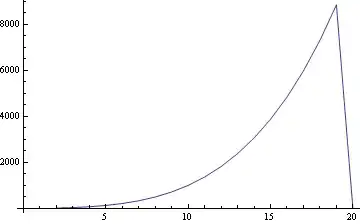
Length[Reduce[Abs[c1] + Abs[c2] + Abs[c3] + Abs[c4] <= 22, {c1, c2, c3, c4}, Integers]]
yields 42736. This is obviously impossible, since the number of $\mathbb{Z}^4$ lattice points within a taxicab ball is a strictly increasing function of radius.
Does anyone know what is going wrong here? I am going to temporarily solve the problem via alternate, more delicate approaches seeing as both Solve[] and Reduce[] have failed to give correct answers for $r\geq20$, but any insight as to this sudden behavioral discontinuity would be appreciated.
EDIT: It may be possible that the lower than expected result from Length may be due to Reduce outputting a solution set whose expression depth was not just that of the simple Or[...] structure that it normally gives for smaller values of $r$. If anyone can confirm this, I'll close this question.



solsand then run this):Cases[sols, Except@HoldPattern@And[__Equal], {1}]. Is this right or wrong? I'm not sure. As this is also the last element, I thinkReduceis just telling us that it gave up exhaustively enumerating solutions at that point. – Oleksandr R. Dec 25 '13 at 02:32