We would like to find all integers x satisfying the following equation Total[ IntegerDigits[x]^3] == x (we don't have to map #^3& since Power is Listable).
Warning: Flexibility and polymorphism of Mathematica notation is restricted by Operator Precedence (see also When is f@g not the same as f[g]?). It appears to be the case here. One could suspect this was the problem defining Func initially.
f[x_] := Total[ IntegerDigits[x]^3] == x
however we might get incorrect results using this definition Total @ IntegerDigits @ x^3 == x while this one works fine Total[ IntegerDigits @ x^3] == x.
Select[ Range[0, 10^5], f @ # &]
{0, 1, 153, 370, 371, 407}
One can easily observe that we don't have to search for such integers anymore since Total[ IntegerDigits[x]^3] increases in a polynomial rate with the exponent in Range while x increases in an exponential rate and
Total[ IntegerDigits[99999]^3] < 10^5
True
Thus the above are all integers satisfying Total[ IntegerDigits[x]^3] == x.
Edit
Out of curiosity I have found how the solutions depend on the exponent.
Defining:
f[x_, k_] := Total[ IntegerDigits[x]^k] == x
immediately we find with Select[ Range[ 0, 10^4], f[#, 2]&] that for k == 2 there are no solutions (besides 0 and 1).
ListPlot[
  Append[
    Table[ Log @ Total[ IntegerDigits[10^k - 1]^m], {m, 3, 9}, {k, 15}],
    Table[ Log[ 10^(k - 1)], {k, 15}]], AxesOrigin -> {1, 0},
  PlotMarkers -> {Automatic, Medium}, PlotRange -> All, Joined -> True,
  PlotStyle -> Thick, PlotLegends -> Range[3, 9]]
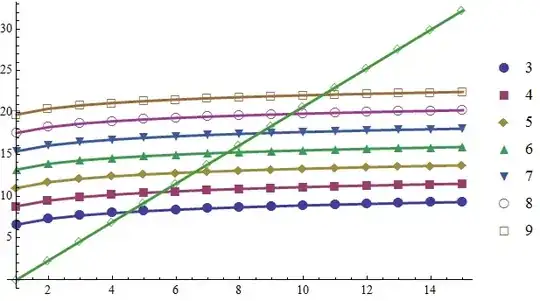
With this plot it appears to be easier to estimate appropriate range of search space.
We've got:
Select[ Range[10^6], f[#, 4]&]
{ 1, 1634, 8208, 9474}
Select[ Range[10^7], f[#, 5]&]
{ 1, 4150, 4151, 54748, 92727, 93084, 194979}
Select[ Range[5 10^7], f[#, 6]&]
{ 1, 548834}


Func[300]returns 0 on my machine... – cormullion Dec 30 '13 at 15:30Func. p.s. you don't have toMapin such cases:Total[IntegerDigits[300]^3]will do too. – Kuba Dec 30 '13 at 15:40